On Page SEO
Strategy
about page SEO, contact page SEO, FAQ page SEO, footer links SEO, hidden SEO pages, important website pages for SEO, internal service hub pages, must have website pages for small business websites, pages every website should have for SEO, pages Google expects on a website, pages that quietly help rankings, privacy policy SEO, SEO supporting pages, SEO trust signals, terms and conditions SEO, trust pages for SEO, website pages that build trust, website pages that improve rankings, website sections that help SEO, website structure for SEO
SEO Checker
0 Comments
The Website Sections That Quietly Help Rankings More Than People Realise
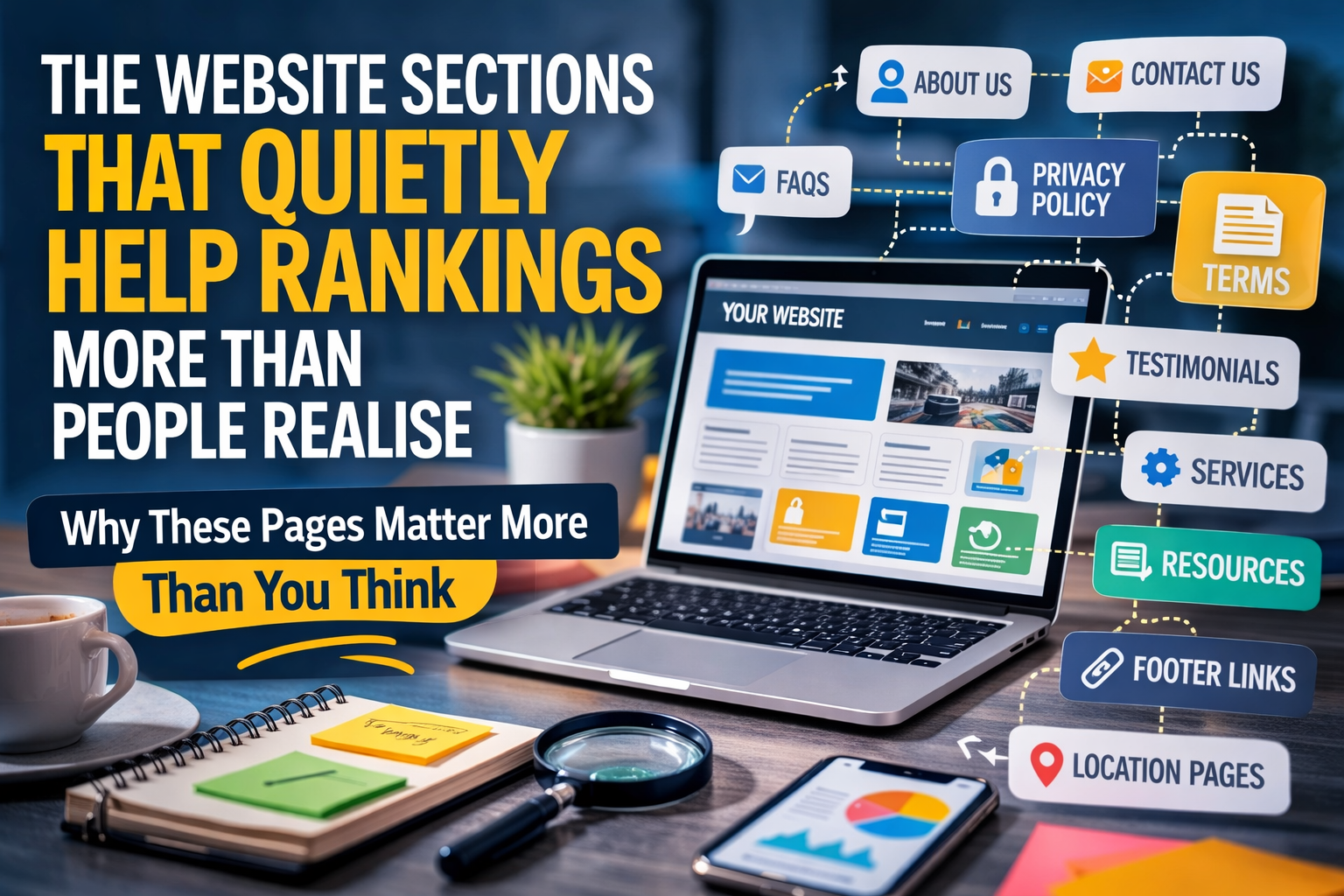
Most people think SEO lives in obvious places.
They think about:
- page titles
- keywords
- headings
- backlinks
- blog posts
- service pages
And yes — those things absolutely matter.
But one of the most overlooked parts of SEO is this:
Some of the sections and pages that quietly support rankings are not the ones most people focus on first.
They’re the parts of a website that often get treated as “secondary”.
The pages that feel like they’re only there for compliance, usability, or trust.
The sections that don’t always get the spotlight.
And yet, when you look at strong websites that rank well over time, they often have these things in common:
- clear business identity
- trust-building support pages
- helpful structural navigation
- contextual internal linking
- supporting informational sections
- obvious legitimacy signals
In other words, they don’t just have “optimised pages”.
They have a well-supported website.
And that matters more than many people realise.
In this post, we’ll break down the website sections that quietly help rankings more than people think, why they matter, and how they contribute to both SEO performance and overall trust.
Because sometimes the difference between a page that struggles… and a site that builds momentum… is not just the page itself.
It’s what surrounds it.
SEO Is Not Just About Pages — It’s About Context
Google does not look at your website the same way a human owner does.
A site owner often sees:
- the homepage
- the main service pages
- the latest blog posts
But search engines are trying to understand something bigger:
- What kind of website is this?
- Is this a real business or a thin affiliate-style setup?
- Is this site trustworthy?
- Does it have clear structure?
- Are the pages well connected?
- Is the content supported by useful surrounding context?
- Are there signs of legitimacy, expertise, and consistency?
That means SEO is not only about whether one page is “optimised”.
It’s also about whether the site as a whole feels complete, coherent, and trustworthy.
That’s where these quieter sections come in.
1) Your About Page Quietly Builds Trust, Relevance and Legitimacy
A lot of site owners treat the About page like an afterthought.
It’s often:
- vague
- generic
- overly brief
- written in a rushed, corporate style
- missing real business detail
But a strong About page can quietly support SEO because it helps reinforce:
- who you are
- what you do
- who you help
- how long you’ve been doing it
- where you’re based
- what makes your business credible
- why your website exists
Why this matters
Google increasingly tries to understand entities and site legitimacy.
A good About page helps support:
- business identity
- brand trust
- expertise signals
- user confidence
- internal linking opportunities
- location relevance (where applicable)
What a stronger About page can include
- your business story
- who the site is for
- your services or purpose
- relevant experience
- team details (if relevant)
- location or service area
- links to key services/resources
- awards, credentials, accreditations, memberships
It’s not that an About page “ranks the site” on its own.
It’s that it helps make the site feel real, established, and worth trusting.
2) Your Contact Us Page Does More Than Just Provide a Form
A Contact Us page is one of the clearest trust signals on a website.
But many sites either:
- hide it
- keep it too minimal
- make it feel generic
- don’t include enough business detail
- use only a contact form and nothing else
Why this matters for SEO
A strong Contact page supports:
- legitimacy
- local relevance
- consistency of business details
- user trust
- conversion confidence
- crawlable business information
For local businesses especially, this page can reinforce:
- business name
- address
- phone number
- service areas
- embedded map
- opening hours
- local trust signals
What a strong Contact page can include
- full business name
- phone number
- email address
- physical address (if relevant)
- service area coverage
- embedded Google Map
- contact form
- response time expectations
- links to key service pages
- FAQs about enquiries
This is one of those pages that helps both:
- users feel reassured
- Google better understand the business
And that combination matters.
3) Privacy Policy Pages Quietly Reinforce Trust and Site Completeness
A Privacy Policy is usually seen as a legal necessity.
And yes, it is.
But it also contributes something important from a broader site quality perspective:
It helps your site look like a real, responsibly managed website.
A missing or weak privacy policy won’t necessarily tank rankings by itself.
But when you zoom out, strong websites often have a fuller set of trust and compliance pages that support the overall impression of legitimacy.
Why it matters
A Privacy Policy can help reinforce:
- that the business/site is real
- that data handling is considered
- that the site is maintained properly
- that forms, cookies, analytics, or marketing tools are disclosed
- that the site feels complete rather than rushed or thin
Especially important if you use:
- contact forms
- lead forms
- email signups
- analytics tools
- cookies
- remarketing pixels
- payment systems
- user accounts
It’s not an “SEO trick”.
It’s part of building a website that doesn’t feel half-finished.
And that absolutely matters over time.
4) Terms & Conditions Pages Help Support Business Credibility
Like privacy pages, Terms & Conditions are often ignored until someone “has to” add them.
But they quietly help reinforce that the site is:
- professionally run
- clearly structured
- transparent
- legitimate
This is especially important for:
- ecommerce sites
- service businesses
- subscription sites
- booking-based businesses
- marketplaces
- membership platforms
- lead generation businesses
Why this matters
Terms pages can help support:
- trust
- transparency
- commercial clarity
- user confidence before buying or enquiring
- overall site completeness
Again, this is less about “Google reads your terms page and boosts rankings”.
It’s more about the bigger trust picture.
If a site has:
- no clear contact details
- no privacy policy
- no terms
- no refund or delivery information
- no business identity
…it often feels weaker overall.
And that can indirectly hurt performance, especially where trust matters.
5) Refund, Returns, Delivery and Service Policy Pages Matter More Than People Think
This is a big one for ecommerce and service-led websites.
A lot of businesses forget that pages like:
- Refund Policy
- Returns Policy
- Delivery Information
- Service Terms
- Cancellation Policy
- Booking Terms
…can have a surprisingly strong impact on buyer confidence.
And buyer confidence affects:
- conversions
- bounce rate
- hesitation
- trust
- repeat visits
- user behaviour signals
Why this matters
If users land on a product or service page and can’t easily find:
- delivery times
- return options
- cancellation rules
- refund terms
- service process details
…they may simply leave.
That doesn’t just affect conversions.
It can also weaken the overall quality perception of the site.
Strong websites often make these answers easy to find.
That’s part of why they feel safer to use.
6) FAQ Sections Quietly Help Rankings by Clarifying Intent
FAQs are one of the most underrated SEO assets on a website.
Done well, they help with:
- user reassurance
- long-tail keyword relevance
- semantic depth
- intent clarification
- conversion objections
- internal linking opportunities
Why they matter
A good FAQ section can help answer:
- the questions people ask before converting
- the smaller intent variations around a topic
- the concerns that stop people taking action
That means FAQs can strengthen:
- service pages
- product pages
- local landing pages
- contact pages
- about pages
- support/resource pages
Examples
A local electrician service page might answer:
- Do you cover emergency callouts?
- Which areas do you serve?
- Do you offer weekend appointments?
- How quickly can you attend?
- What types of properties do you work on?
That helps both:
- the user
- the search engine’s understanding of the page
7) Footer Links Quietly Help Google Understand Site Structure
Footers are often treated as purely navigational.
But they can quietly do a lot of work.
A well-structured footer can help reinforce:
- important pages
- trust pages
- service hubs
- location hubs
- support resources
- contact information
- business legitimacy
What a useful footer often includes
- key service pages
- important categories
- About page
- Contact page
- Privacy Policy
- Terms & Conditions
- Refund / Delivery pages (where relevant)
- location/service area pages
- phone/email/address
- social links (if appropriate)
Why this matters
Footer links can help:
- distribute internal link equity
- surface pages that might otherwise be buried
- reinforce site structure
- make trust pages easy to access
- help crawlers find important supporting pages
This doesn’t mean stuffing a footer with hundreds of links.
It means using it intentionally.
8) Testimonials and Review Sections Do More Than Improve Conversions
Testimonials are usually thought of as conversion tools.
And they are.
But they also help pages feel:
- more credible
- more established
- more trustworthy
- more relevant
- more specific
Why this matters
A service page with:
- no proof
- no trust
- no customer feedback
- no reassurance
…often feels thin, even if the word count is decent.
A service page with:
- real testimonials
- named outcomes
- service-specific proof
- location references
- trust badges
…feels much stronger.
Extra value if testimonials mention:
- the service
- the result
- the location
- the problem solved
- the experience
That creates richer contextual relevance and stronger trust.
9) Internal Service Hubs Quietly Make Important Pages Stronger
This is one of the most powerful structural assets on a website.
A lot of sites have:
- a homepage
- a handful of service pages
- a blog
…but no real hub structure.
That means their pages are disconnected.
What a service hub does
A service hub groups related pages under a stronger parent page.
For example:
- SEO Services
- Technical SEO
- On Page SEO
- Local SEO
- SEO Audits
- SEO for New Websites
Or:
- Plumbing Services
- Emergency Plumbing
- Boiler Repairs
- Leak Detection
- Bathroom Plumbing
- Areas We Cover
Why this matters
Service hubs help:
- reinforce topical relevance
- strengthen internal linking
- clarify hierarchy
- distribute authority
- help Google understand page relationships
- make money pages easier to support
This is one of those structural elements that can quietly make the whole site stronger.
10) Location and Service Coverage Blocks Can Strengthen Relevance
For local or regional businesses, location/service coverage sections are incredibly useful.
These can appear on:
- homepage
- service pages
- contact page
- footer
- dedicated coverage pages
Why they matter
They help reinforce:
- geographic relevance
- local service clarity
- user reassurance
- internal links to location pages
- service-area understanding
What this can look like
- “Areas We Cover” blocks
- links to nearby town/service pages
- service + location combinations
- map-supported service area sections
- short explanatory text about coverage
Done properly, this is useful.
Done badly, it becomes spammy.
The goal is clarity — not keyword stuffing.
11) Author Boxes and Author Pages Can Add Quiet Credibility
This matters especially for:
- blogs
- educational websites
- niche publications
- expert-led businesses
- advice-heavy service sites
If your content is designed to inform or build trust, author signals can help.
Why this matters
Author boxes can reinforce:
- expertise
- accountability
- transparency
- brand trust
- editorial credibility
A good author box might include
- author name
- role or expertise
- short bio
- link to author page
- relevant credentials
- related content
It’s another example of a “small” structural element that helps the site feel more complete and trustworthy.
12) Comparison Sections Can Make Pages More Useful and More Competitive
A lot of service and product pages stay too generic.
They explain what the business offers…
…but they don’t help the user compare.
That’s a missed opportunity.
Comparison sections can answer things like:
- Why choose this service over alternatives?
- What makes this approach different?
- In-house vs agency?
- DIY vs done-for-you?
- Basic vs advanced package?
- This product vs that product?
Why this matters
Comparison sections help:
- address decision-stage intent
- reduce hesitation
- add depth
- improve relevance for “vs” style searches
- strengthen conversion quality
They also make a page more useful than a generic competitor page.
And usefulness is often what wins.
13) Related Content Modules Help Pages Support Each Other
One of the easiest ways to weaken a site is to let pages exist in isolation.
A related content section helps solve that.
Examples
- related blog posts
- related services
- related guides
- next-step resources
- “read this next” sections
- linked case studies
- supporting FAQs
Why this matters
Related content modules help:
- improve internal linking
- keep users engaged
- reduce dead ends
- support topic clusters
- reinforce page relationships
- pass context and authority across relevant pages
This is one of the simplest structural wins many sites ignore.
14) Resource Pages Quietly Build Authority Over Time
A well-built resources page or help centre can be extremely valuable.
This can include:
- guides
- checklists
- templates
- FAQs
- audits
- tools
- calculators
- educational articles
- downloadable resources
Why this matters
Resource pages can help:
- build topical authority
- support internal linking
- attract backlinks
- improve user trust
- create entry points for organic traffic
- support commercial pages indirectly
This is especially powerful for businesses that want to become the trusted voice in their niche.
15) Even “Boring” Pages Help the Site Feel More Complete
This is really the bigger lesson behind all of this.
Pages like:
- About
- Contact
- Privacy Policy
- Terms & Conditions
- Refunds
- Delivery
- FAQs
- Author pages
- Resources
- Service hubs
…may not be the pages you obsess over first.
But together, they help create something bigger:
A site that feels:
- legitimate
- maintained
- structured
- trustworthy
- useful
- easier to understand
- easier to navigate
- easier for Google to interpret
And that matters.
Because Google doesn’t just rank isolated pages.
It evaluates them within the context of the website around them.
These Sections Don’t Replace Core SEO — They Support It
It’s important to be clear:
None of these pages or sections are magic ranking hacks.
A Privacy Policy alone won’t push a page to page one.
A footer link alone won’t suddenly make your service page rank.
A Contact page alone won’t solve weak content.
But together, these sections do something powerful:
They make the site feel more complete, more trustworthy, and more structurally supportive.
That can improve:
- crawlability
- internal linking
- trust perception
- page support
- conversion confidence
- user experience
- content context
- overall site quality
That’s why they matter more than people think.
A Smarter Way to Think About SEO
If you want a stronger mental model for SEO, think of it like this:
Your main pages are not trying to rank alone.
They are being judged alongside:
- the structure around them
- the trust around them
- the supporting content around them
- the clarity around them
- the business legitimacy around them
That means the question isn’t just:
“Is this page optimised?”
It’s also:
“Does the website around this page make it easier to trust, understand and support?”
That’s where a lot of websites quietly fall short.
And it’s also where a lot of hidden opportunity lives.
If You Want Stronger Rankings, Don’t Ignore the “Supporting” Pages
If your site has:
- decent core pages
- some content
- a few backlinks
- reasonable optimisation
…but still feels like it’s underperforming…
it may be worth asking whether the issue is not just the main pages.
It may be the fact that the site is missing the quieter supporting layers that stronger websites tend to have.
That includes:
- a real About page
- a proper Contact page
- clear Privacy and Terms pages
- refund / delivery / policy pages where relevant
- FAQ support
- stronger footer links
- testimonials and proof
- service hubs
- location coverage sections
- related content pathways
- resource areas
- author credibility signals
These don’t always get the attention.
But they often help more than people realise.
And over time, they can make the difference between a website that just “exists”…
…and one that feels like a real, trustworthy, well-built online presence.
Share this content:

Post Comment