The Homepage SEO Myth: Why Your Homepage Can’t Rank for Everything
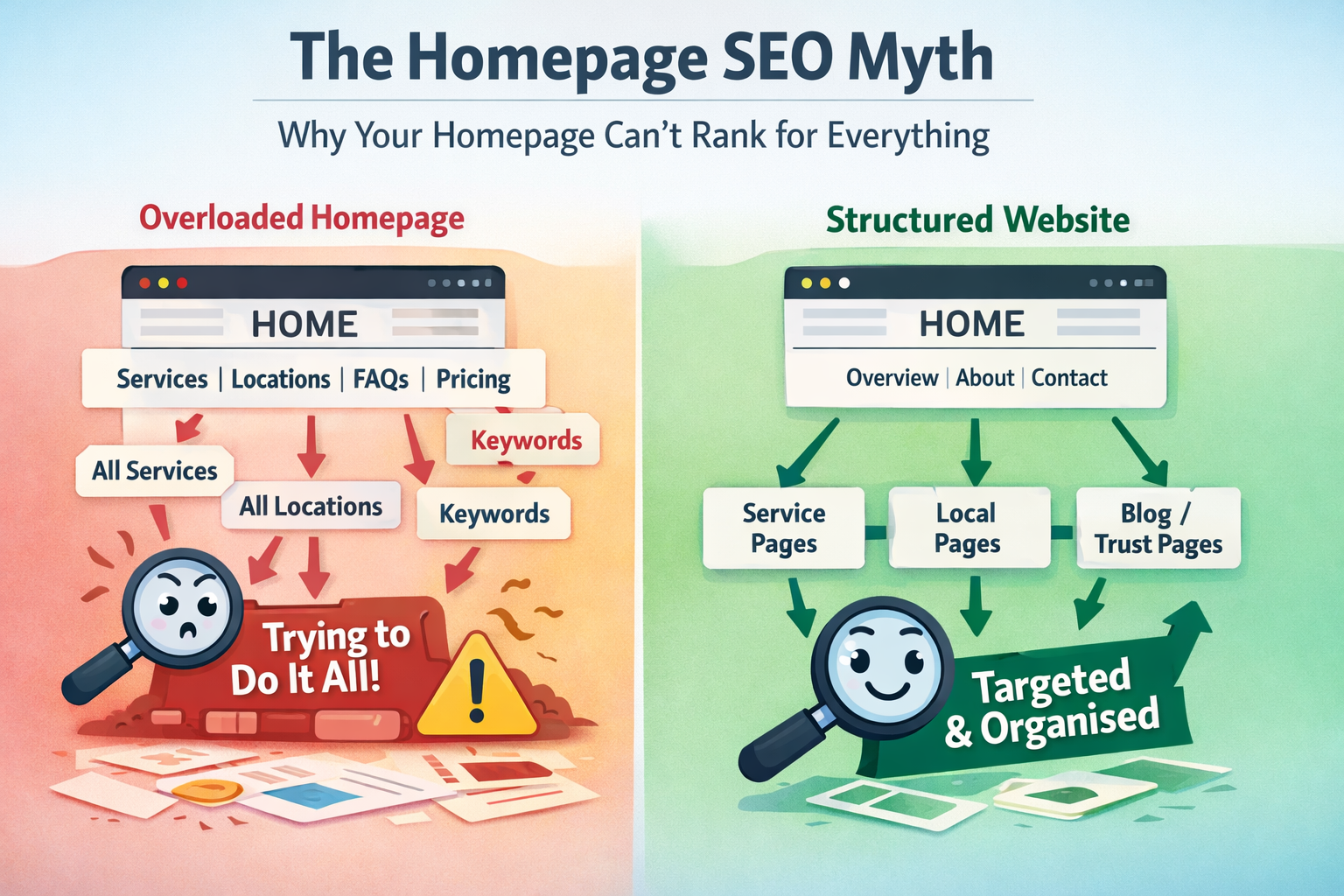
For a lot of small business websites, the homepage ends up trying to do far too much.
It talks about every service.
It mentions multiple locations.
It targets broad industry keywords.
It tries to act like a sales page, a local landing page, a service hub, an about page, and sometimes even a blog index all at once.
On the surface, that feels logical.
If the homepage is the main page of the website, surely it should be the page that ranks for everything… right?
Not quite.
This is one of the most common SEO misunderstandings small businesses have, and it quietly causes a lot of websites to underperform.
A homepage is important. In many cases, it is the most powerful page on the site in terms of authority, internal links, and trust signals. But that does not mean it should be expected to rank for every service, every keyword, every town, and every type of search intent.
In reality, one of the biggest reasons websites struggle to grow in search is because the homepage is being asked to do a job that should be shared across a much better page structure.
If your homepage feels overloaded, your service pages are weak, or you are wondering why Google keeps favouring one page over another, this may be exactly what is holding you back.
Why so many businesses try to make the homepage do everything
This usually happens for understandable reasons.
Many small businesses launch a website with a simple structure:
- Home
- About
- Services
- Contact
Sometimes there are not even individual service pages at all.
Instead, the homepage becomes the “main sales page” and tries to cover:
- what the business does
- who it helps
- every service offered
- every area covered
- trust signals
- calls to action
- pricing hints
- FAQs
- testimonials
- and every keyword the owner wants to rank for
That often happens because:
- the site was built quickly
- the business wanted a simple brochure-style website
- the owner assumed “more keywords on the homepage = better rankings”
- there was no long-term SEO structure in place
- they were told the homepage is the “strongest page”, so everything got pushed into it
And to be fair, the homepage is often strong.
But strength alone is not the same as relevance.
That is where the problem starts.
Why Google does not want one page to do every job
Google is trying to match search intent as closely as possible.
That means when someone searches for something, Google is not just looking for a website that mentions the phrase somewhere. It is trying to find the page that best matches what the user is actually looking for.
That is why:
- someone searching for a specific service often needs a dedicated service page
- someone searching for a service in a location often needs a local landing page
- someone searching for your business name often needs the homepage
- someone researching trust, background, or credibility may need the homepage or about page
A homepage is typically best used as:
- a brand anchor
- a trust-building overview
- a central navigation point
- a broad summary of what the business offers
A service page is typically better for:
- detailed service relevance
- matching specific search intent
- explaining outcomes, process, FAQs, proof, and benefits
- converting users looking for that exact service
A location page is typically better for:
- local intent
- service + area combinations
- location-specific proof, coverage, and context
- ranking for searches tied to towns, cities, or regions
If your homepage is trying to rank for:
- “plumber in Surrey”
- “emergency plumbing services”
- “boiler repair”
- “bathroom installation”
- “drain unblocking”
- “plumber in Guildford”
- “plumber in Woking”
- “plumber in Epsom”
…all on one page, Google has to guess what that page is really for.
That usually creates weaker relevance signals than a site with:
- a clear homepage
- dedicated plumbing service pages
- dedicated emergency plumbing page
- dedicated boiler repair page
- strong local service pages where needed
The real role of the homepage in SEO
A homepage matters a lot in SEO — but not in the way many people assume.
A well-optimised homepage should usually focus on:
- your brand
- what you do at a high level
- your main value proposition
- trust and credibility
- guiding users to the right next step
- supporting your core site structure
Think of the homepage as the hub, not the entire map.
It should help Google and users understand:
- who you are
- what type of business you are
- what your core services are
- where you generally operate
- which deeper pages matter most
It should then push authority and clarity into:
- service pages
- category pages
- location pages
- key trust pages
- supporting content
That is very different from trying to make the homepage the only page that matters.
The difference between homepage, service pages, and location pages
One of the easiest ways to fix homepage SEO confusion is to understand what each page type is actually supposed to do.
1. Homepage = brand, trust, and overview
Your homepage should normally:
- introduce the business clearly
- explain what you do in simple terms
- highlight your core services
- build trust fast
- show proof (reviews, results, credentials, years in business, etc.)
- make it easy to navigate deeper
It can absolutely mention your main services and main locations.
But mention is not the same as fully targeting.
The homepage is often where you:
- establish brand authority
- create confidence
- show legitimacy
- direct users to the most relevant internal pages
2. Service pages = intent capture
Service pages are where you target specific search intent.
Examples:
- boiler repair
- web design
- loft conversions
- tree surgery
- family law mediation
- commercial cleaning
A strong service page gives Google a much clearer signal than a homepage because it can focus on:
- one service
- one search intent
- one topic cluster
- one conversion goal
That page can then include:
- detailed service explanation
- who it is for
- common problems solved
- process or approach
- trust signals
- FAQs
- internal links to related services
- strong calls to action
This is usually where rankings become more stable and more targeted.
3. Location pages = local intent
If you serve multiple areas, location pages can be extremely valuable — when done properly.
These are pages designed for searches like:
- electrician in Kingston
- accountant in Croydon
- web designer in Richmond
A location page should not just be:
- the same page copied 20 times
- a list of town names
- a few swapped place words with no real depth
Instead, it should provide:
- real local relevance
- service + area context
- location-specific proof where possible
- useful supporting details
- internal links to relevant service pages
This is where many businesses go wrong.
They either:
- cram all locations into the homepage
or - create thin duplicate pages that do not really deserve to rank
Signs your homepage is trying to do too much
If your homepage is overloaded, there are usually clear warning signs.
1. It is targeting too many keywords at once
If you are trying to rank one page for:
- multiple services
- multiple service variations
- multiple towns or cities
- multiple audience types
…you are probably diluting relevance.
2. It has huge blocks of broad, generic copy
A homepage should not read like a desperate keyword catch-all.
If the copy feels like:
- a little bit of everything
- no clear priority
- repeated keyword variations
- broad generic wording
…it may be trying to carry too much SEO weight.
3. Your service pages are thin or barely exist
A common pattern:
- homepage is massive
- service pages are short, vague, or missing
- all the real detail is on the homepage
That often results in:
- homepage ranking when it should not
- service pages failing to rank
- unstable keyword performance
- weaker conversions
4. Users have to scroll too far to find the right thing
If someone lands on the homepage and has to:
- dig through multiple sections
- work out which service applies
- guess which location is relevant
- interpret broad sales messaging
…that is usually a structural issue, not just a content issue.
5. Google keeps ranking the wrong page
This is a big clue.
If you want a service page to rank, but Google keeps showing the homepage instead, it often means:
- the service page is too weak
- the internal linking is poor
- the homepage is over-signalling the topic
- the structure is confusing
- the intent match is unclear
Why dedicated pages usually outperform an overloaded homepage
Dedicated pages win because they are more precise.
They make it easier for Google to understand:
- what the page is about
- what search intent it matches
- which keywords it should be associated with
- what role it plays within the site
They also make it easier for users to:
- find exactly what they need
- feel like they landed in the right place
- understand the offer faster
- convert with less friction
This matters because good SEO is not just about rankings.
It is about:
- relevance
- clarity
- trust
- usability
- conversion efficiency
A homepage can support all of that.
But it should not be forced to replace the entire site structure.
How to restructure without a full website redesign
The good news is this problem usually does not require a complete rebuild.
In many cases, you can improve homepage SEO and overall rankings by changing structure, content focus, and internal linking — without touching the visual design much at all.
Step 1: Decide what the homepage should actually target
Ask yourself:
- What is the primary purpose of the homepage?
- Is it mainly brand + trust?
- Is it targeting one broad core service?
- Is it trying to introduce the business and route users deeper?
For most small business sites, the homepage should focus on:
- branded relevance
- broad service category relevance
- trust
- conversion guidance
Not every keyword variation.
Step 2: Create or strengthen dedicated service pages
If you offer multiple services, each core service should usually have its own page.
For example, instead of one homepage trying to rank for everything:
- Homepage
- Boiler Repair
- Boiler Installation
- Emergency Plumber
- Bathroom Plumbing
- Drain Unblocking
Each page should:
- focus on one clear service
- have stronger depth than the homepage section
- include FAQs, proof, and internal links
- feel like the best answer for that service
Step 3: Pull heavy service copy off the homepage
A lot of homepages are bloated because they contain full service-page style copy.
You do not need to remove services from the homepage completely.
Instead:
- keep short service summaries
- link to dedicated pages
- use concise supporting sections
- let the homepage guide, not carry
This often improves:
- clarity
- crawl focus
- user flow
- perceived quality
Step 4: Improve internal linking
Your homepage is usually one of the strongest internal link sources on the site.
Use that strategically.
Link clearly from the homepage to:
- your main service pages
- your key location pages
- trust pages (about, testimonials, case studies)
- important conversion pages
That helps distribute authority and reinforce structure.
Step 5: Build a better hierarchy
A better SEO hierarchy might look like this:
- Homepage
- Main Service 1
- Main Service 2
- Main Service 3
- Location / Area Pages
- About
- Reviews / Case Studies
- Contact
For larger service businesses:
- Homepage
- Service Category
- Individual Service Page
- Individual Service Page
- Location Page
- Location Page
- Blog / Resources
- About / Trust Pages
- Service Category
This creates a much cleaner relationship between:
- broad relevance
- specific relevance
- local relevance
- supporting content
What a better homepage actually looks like
A stronger homepage is usually:
- clearer
- shorter in the right places
- more focused
- easier to navigate
- better at routing users
- less obsessed with cramming in every keyword
A good homepage often includes:
- a clear headline
- a strong subheading explaining what you do
- key trust signals near the top
- short sections for main services
- links to dedicated service pages
- a brief location overview (not a keyword dump)
- testimonials or proof
- FAQs if useful
- strong calls to action
- clean navigation to deeper pages
It feels intentional.
It does not feel like the website is trying to win every search in one page.
The biggest mindset shift: your homepage is a gateway, not the whole strategy
This is the part many businesses miss.
Your homepage is important, but it should not be the only page doing serious SEO work.
A website grows when:
- the homepage builds trust and routes authority
- service pages capture commercial intent
- location pages capture local intent
- supporting pages strengthen topical and trust signals
- internal links make the structure obvious
That is how a website becomes stronger overall.
If the homepage is doing everything, the rest of the site often becomes weak.
If the structure is doing the work together, the whole site becomes more understandable to both Google and users.
Final thought
If your homepage feels like it is carrying the entire SEO strategy on its back, that is usually a sign the structure needs work.
The goal is not to make the homepage weaker.
The goal is to stop forcing it to do jobs it was never meant to do alone.
A strong homepage should:
- build trust
- establish brand clarity
- highlight your core offer
- support internal navigation
- pass strength into the pages that deserve to rank for specific intent
That is when SEO usually starts to feel less random.
Because instead of asking one page to rank for everything, you are building a site where every important page has a clear purpose.
And that is what Google tends to reward.
Share this content:



Post Comment