Why Your “About” Page Might Be More Important for SEO Than You Think
A lot of business owners treat the About page like an afterthought.
It gets added because it feels like a standard page a website is supposed to have.
So they throw in:
- a short paragraph about the company
- a generic line about “quality service”
- maybe a stock photo
- maybe a quick mention of being experienced
- and then move on
It exists.
It ticks the box.
It is technically there.
But that is often where the opportunity gets missed.
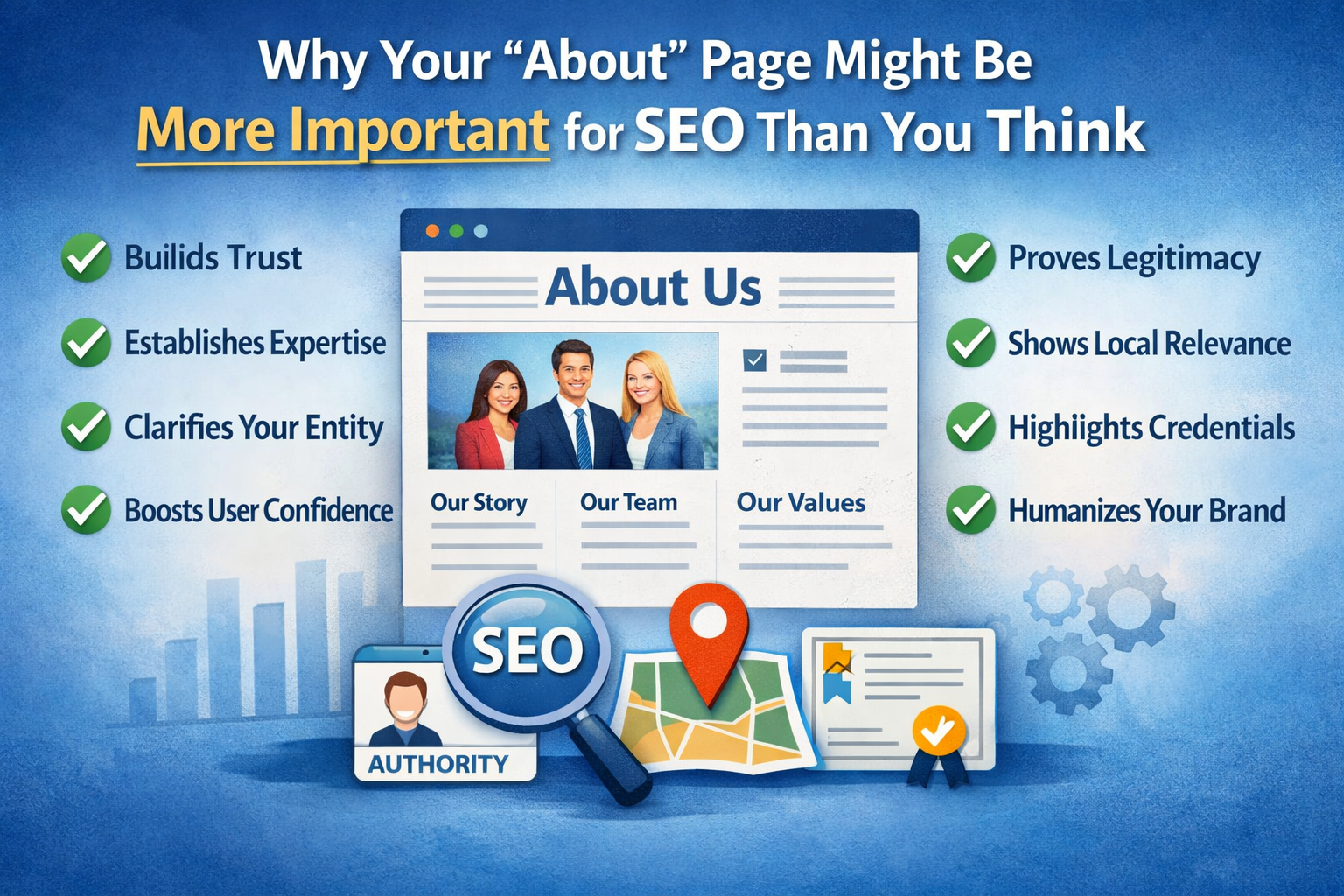
Because while the About page is not usually the page you expect to rank for your main commercial keywords, it can still be doing far more SEO work than people realise.
In fact, for a lot of small business websites, the About page is one of the most underrated trust and legitimacy pages on the entire site.
It can help reinforce:
- who you are
- what kind of business you are
- why you should be trusted
- what experience you have
- who is behind the business
- where you operate
- what makes you credible
- why a user should feel confident taking the next step
And while those things may not look like “classic SEO” on the surface, they are often part of what makes a website feel stronger, more established, and more deserving of visibility.
That matters more than many people think.
Why the About page is often misunderstood
When people think about SEO, they usually focus on pages like:
- the homepage
- service pages
- location pages
- blog posts
- landing pages
That makes sense.
Those are the pages people often expect to rank directly for keywords.
So the About page gets mentally filed under:
- nice to have
- low priority
- not really an SEO page
- more for users than search engines
That is only partly true.
An About page may not be the main page you target for “emergency plumber near me” or “web design for dentists”.
But that does not mean it has no SEO value.
A strong About page can support the website in quieter, more indirect ways by helping strengthen:
- trust
- expertise
- clarity
- legitimacy
- entity understanding
- conversion confidence
- overall site quality perception
And for small business websites especially, those things matter a lot.
Not every valuable SEO page is a keyword page
This is one of the most important mindset shifts.
A lot of business owners think SEO pages are only the pages that directly target search terms.
But that is too narrow.
Some pages do direct ranking work.
Other pages do supporting ranking work.
An About page usually falls into that second category.
It can help the website feel:
- more real
- more credible
- more complete
- more trustworthy
- more connected to a genuine business
- more aligned with what users expect to see before they enquire
That matters because SEO is not just about keywords.
It is also about:
- trust
- relevance
- user confidence
- page quality
- site completeness
- clear signals about who is behind the website
A strong About page helps with that.
Why About pages matter more than most businesses realise
A lot of small business websites quietly feel weaker than they should because they are missing pages that build confidence.
And the About page is often one of the biggest missed opportunities.
A stronger About page can help support:
- trust
- expertise
- brand clarity
- business legitimacy
- local relevance
- user reassurance
- better conversions
- a more complete website structure
It is not usually the “money page”.
But it is often one of the pages that helps the money pages feel more believable.
That is a very different role — and a very valuable one.
How an About page supports trust
Trust is one of the biggest things an About page can strengthen.
When someone lands on a small business website, they often want to know:
- Who is actually behind this business?
- Is this a real company?
- Is there real experience here?
- Does this feel established?
- Is this someone I can trust?
If the About page is weak, vague, or barely exists, that confidence can drop.
A poor About page often feels like:
- a placeholder
- a generic company paragraph
- corporate fluff
- nothing personal
- nothing specific
- nothing memorable
A strong About page helps a visitor feel:
- this is a real business
- there are real people behind it
- they know what they are doing
- they have experience
- they have a story
- they feel credible
That can absolutely affect how people interact with the rest of the site.
And when enough pages across a site feel stronger and more trustworthy, the whole website often feels stronger overall.
How an About page supports expertise and credibility
A good About page helps explain why this business should be taken seriously.
That might include:
- years of experience
- industry background
- specialist knowledge
- qualifications
- accreditations
- certifications
- relevant training
- team expertise
- founder story
- specific niche experience
This is especially useful in industries where trust matters heavily, such as:
- legal services
- healthcare-related services
- trades
- finance
- consulting
- agencies
- home services
- professional services
A generic “we provide high-quality service” paragraph does not do much.
But a page that clearly shows:
- who you are
- what experience you have
- why you do this
- what makes your approach credible
…can make the whole website feel more authoritative.
That does not automatically equal rankings by itself.
But it often strengthens the environment in which rankings happen.
How an About page helps with entity clarity
This is one of the most overlooked parts.
Search engines are trying to understand:
- what this website is
- what business it represents
- who is behind it
- what it does
- what type of entity it is
- how it relates to its services and brand
A clear About page can help reinforce that.
It can clarify:
- business name
- business type
- founder or team
- specialism
- history
- location
- values
- areas served
- experience
- how the business positions itself
That helps create a more coherent picture of the business behind the site.
In other words, it can help your website feel less like:
- a random collection of pages
…and more like:
- a real, established business presence
That is especially useful for smaller businesses trying to build authority online.
How an About page can improve user confidence and conversions
A lot of users do check the About page.
Not everyone, of course.
But enough people do that it matters.
Especially when they are:
- comparing providers
- unsure who to trust
- dealing with a higher-value service
- looking for reassurance before making contact
- checking whether the business feels genuine
If the About page is strong, it can quietly increase confidence.
That can lead to:
- longer time on site
- more trust in the brand
- more clicks into service pages
- more contact form submissions
- higher enquiry confidence
- better overall conversion quality
This is why the About page is not “just a filler page”.
It often helps users decide whether the rest of the site feels credible enough to take seriously.
What a weak About page usually looks like
A weak About page is very common.
And once you know what to look for, you start seeing the same patterns everywhere.
A weak About page often has:
- one short generic paragraph
- vague claims like “we pride ourselves on quality”
- no real names or people
- no story
- no experience detail
- no credentials
- no location relevance
- no explanation of who the business helps
- no sense of what makes the business different
- no proof
- no personality
- no trust-building depth
It might technically exist.
But it does not really do anything.
That is the problem.
It fills a navigation slot, but it does not strengthen the website.
What a stronger About page should include
A strong About page does not need to be long for the sake of it.
It just needs to feel real, specific, and useful.
At a minimum, a stronger About page should usually include:
1) Who you are
This sounds obvious, but many sites barely explain it.
Make it clear:
- who the business is
- who founded it (if relevant)
- who the team are (if relevant)
- what kind of business it is
- how it positions itself
This creates immediate clarity.
2) Who you help
A lot of businesses talk only about themselves.
A stronger About page also explains:
- who the business works with
- what type of clients it helps
- what problems it typically solves
- what type of work it is known for
That makes the page more useful and more relevant.
3) Experience and background
This is one of the biggest trust-builders.
Include:
- years in business
- years of industry experience
- specialist experience
- relevant career background
- notable expertise areas
- the reason the business was created
This helps the site feel more established.
4) Values and approach
This is not about fluffy slogans.
It is about helping users understand:
- how you work
- what you care about
- how you treat clients
- what makes your approach different
- what standards you hold yourself to
This is especially useful for small businesses, where personal trust matters.
5) Location relevance
If you are a local business, the About page can help reinforce:
- where you are based
- where you work
- the communities or areas you serve
- how long you have operated locally
- any relevant local ties
This is not about keyword stuffing locations.
It is about helping the site feel grounded in a real service area.
6) Credentials, certifications, or accreditations
If relevant, include:
- qualifications
- industry memberships
- certifications
- awards
- accreditations
- licences
- insurance references where appropriate
These can be extremely useful trust signals.
7) Team, founder, or process insight
People trust people.
If appropriate, show:
- founder background
- team introductions
- photos of real people
- how the business works
- what clients can expect
This often makes the site feel far more human and far more credible.
Why a stronger About page can support rankings indirectly
This is where people often ask:
“Okay, but will my About page directly rank me higher?”
Usually, not in a simple one-to-one way.
That is not how it works.
The value of the About page is often indirect but meaningful.
A stronger About page can help because it supports the overall site by making it feel:
- more trustworthy
- more complete
- more legitimate
- more coherent
- more established
- more credible
- more conversion-friendly
That can improve the overall strength of the website environment around your core pages.
In practice, that can support:
- better user confidence
- stronger brand trust
- better engagement
- stronger perceived legitimacy
- more complete site structure
- improved support for service and conversion pages
In other words:
The About page may not be the page that ranks for your main service keyword.
But it can absolutely be part of what helps the rest of the site feel stronger.
How to improve your About page without overcomplicating it
You do not need to turn it into a massive essay.
A better About page is usually just:
- more specific
- more human
- more credible
- more grounded
- more useful
A simple upgrade path might be:
- rewrite the generic opening with a clear, real explanation of who you are
- add who you help and what you specialise in
- include experience or background
- add local relevance if appropriate
- include any accreditations or credentials
- add team or founder detail
- include a short section on your approach or values
- link to key service pages
- link to contact or next steps
That alone can make a big difference.
The best About pages make the business feel real
That is the simplest way to put it.
A weak About page says:
- “We added this because websites have one.”
A strong About page says:
- “This is a real business, with real people, real experience, and a clear reason to trust us.”
That difference matters more than most businesses realise.
Especially when the rest of the site is trying to convince users — and search engines — that the business deserves visibility.
Final thought
A lot of businesses think the About page is just a filler page.
Something nice to have.
Something that sits in the navigation.
Something users might glance at if they are curious.
But in reality, it can be doing much more than that.
A strong About page can help reinforce:
- trust
- legitimacy
- expertise
- entity clarity
- local relevance
- user confidence
- conversion confidence
- overall site completeness
And while it may not be the page that directly targets your biggest commercial keywords, it can still be one of the pages that helps the rest of your website feel stronger.
That is why the About page is often more important for SEO than people think.
Not because it is a secret ranking trick.
But because it helps your website feel more like a real, established business — and less like a collection of pages trying to look like one.
Share this content:

Post Comment