Marketing
Strategy
advertising vs organic search, best marketing investment 2026, compounding traffic growth, cost per acquisition Google Ads, cost per acquisition SEO, digital marketing ROI, Google Ads vs SEO strategy, is SEO better than ads, long term marketing strategy, marketing budget allocation, organic vs paid traffic, paid ads or SEO, paid ads vs SEO, paid advertising strategy, SEO for business growth, SEO vs Google Ads, SEO vs PPC comparison, startup marketing strategy, sustainable marketing strategy
SEO Checker
0 Comments
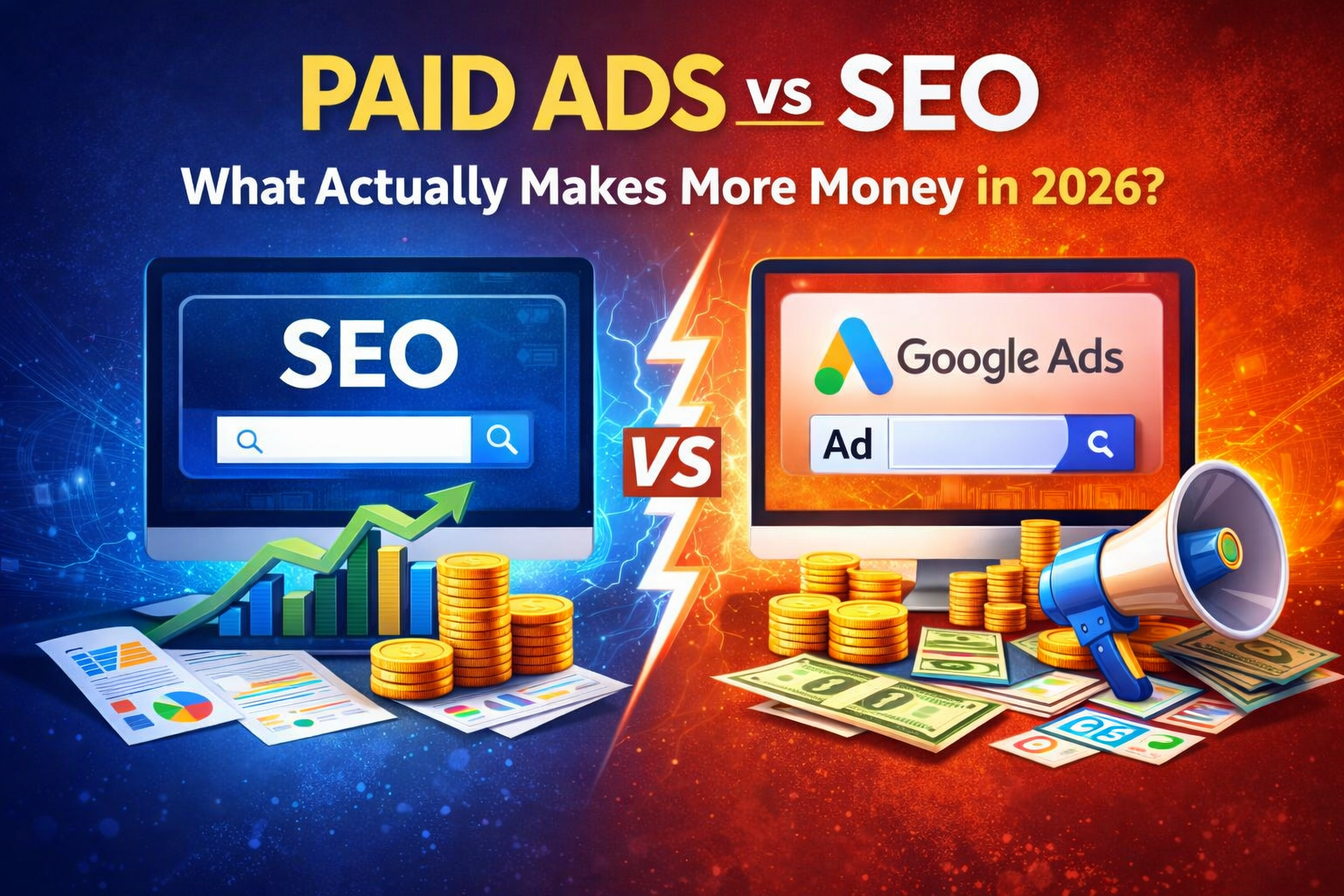
Paid Ads vs SEO: What Actually Makes More Money in 2026?
Every founder eventually faces this question:
Should we invest in paid ads or SEO?
It sounds simple — but the answer determines how your marketing performs not just this month, but over the next five years.
In 2026, the debate isn’t about which one “works.”
Both work.
The real question is:
Which one makes more money — and under what conditions?
Let’s break this down properly.
Speed vs Sustainability
Paid Ads: Instant Visibility
With paid ads, you can:
- Launch a campaign today
- Appear at the top of search results tomorrow
- Generate traffic immediately
For startups validating an idea, ads are incredibly powerful.
You don’t need authority.
You don’t need backlinks.
You don’t need months of content.
You need budget.
The trade-off?
The moment you stop paying, traffic stops.
SEO: Slow Start, Long Tail
SEO is slower.
You build:
- Content
- Technical foundations
- Authority signals
- Search trust
For the first few months, it often feels quiet.
But once rankings stabilise, something important happens:
Traffic continues without paying for every click.
SEO builds a traffic asset.
Ads generate traffic flow.
Control vs Compounding
Ads: Total Control
With paid advertising, you control:
- Budget
- Audience targeting
- Timing
- Creative testing
- Scaling speed
If you need leads this week, ads win.
If you want to test messaging fast, ads win.
If you’re launching something new, ads win.
But there’s no compounding effect.
Each click has a cost attached to it.
SEO: Compounding Growth
SEO behaves differently.
A strong page can:
- Rank for multiple keywords
- Improve over time
- Strengthen related pages
- Benefit from authority growth
One high-performing article today can still drive traffic in 3–5 years.
That’s compounding.
SEO builds long-term asset value.
Ads rent attention.
Cost Per Acquisition Over Time
This is where the financial comparison becomes clearer.
Paid Ads CPA
At the start, ads can feel predictable:
Spend £1,000 → get X leads → convert Y sales.
But over time:
- Competition increases
- Cost per click rises
- Conversion fatigue appears
- Creative performance declines
CPA tends to increase unless constantly optimised.
SEO CPA
SEO requires upfront investment:
- Content creation
- Technical optimisation
- Authority building
Early CPA may be high because traffic is low.
But once rankings stabilise:
Cost per acquisition often decreases dramatically.
Why?
Because traffic keeps coming without paying per click.
Over a 24–36 month horizon, SEO frequently becomes the lower CPA channel.
When Ads Are Smarter
Paid ads are usually the better choice when:
- You need immediate traction
- You’re validating product-market fit
- You have strong conversion funnels already
- You want fast testing of offers
- You operate in highly competitive SERPs dominated by brands
Ads are also effective when:
- Margins are strong
- Lifetime value is high
- Speed matters more than asset building
If survival depends on quick revenue, ads are powerful.
When SEO Is Smarter
SEO becomes the stronger strategy when:
- You’re building a long-term brand
- You want predictable inbound traffic
- You’re competing on expertise, not budget
- You want to reduce dependency on paid acquisition
- You value compounding growth
For SaaS founders and small businesses, SEO often becomes the stabilising channel that reduces marketing volatility.
Especially when budgets aren’t unlimited.
The Hybrid Model: Where It Gets Powerful
The real leverage appears when you combine both.
Use Ads To:
- Test messaging
- Identify high-converting keywords
- Validate landing pages
- Generate early revenue
Use SEO To:
- Build long-term content around validated topics
- Strengthen authority
- Reduce future CPA
- Create durable traffic streams
Ads give you speed.
SEO gives you durability.
Together, they create momentum.
The Mistake Most Businesses Make
They choose one exclusively.
Either:
“We’ll just run ads.”
Or:
“We’ll just focus on SEO.”
The smarter question is:
What stage is our business at right now?
Early-stage startups may lean toward ads for validation.
Scaling businesses often shift toward SEO to reduce acquisition costs.
Mature businesses integrate both strategically.
Risk Profile Comparison
Ads Risk:
- Budget burn
- Rising CPC
- Platform dependency
- Policy changes
SEO Risk:
- Slow results
- Algorithm updates
- Competition authority gaps
Ads feel predictable but are volatile in cost.
SEO feels uncertain early but stabilises long-term.
So What Actually Makes More Money in 2026?
Short-term?
Paid ads often win.
Long-term?
SEO usually wins.
The businesses that generate the most stable profit in 2026 are those that:
- Use ads to accelerate growth
- Use SEO to protect margins
- Gradually reduce reliance on paid channels
Because traffic you own is more valuable than traffic you rent.
A Practical Decision Framework
If you’re deciding where to invest budget, ask:
- Do we need revenue immediately?
- Can we afford rising ad costs?
- Are we building a long-term brand?
- Is our website technically strong enough for organic growth?
- Do we want compounding traffic or controlled traffic?
If your technical foundation is weak, scaling ads simply amplifies inefficiencies.
Before scaling either channel, it’s worth ensuring your site is structurally ready — crawlable, optimised, and aligned with search intent.
Final Thought
This isn’t a battle between SEO and paid ads.
It’s a timeline question.
Ads generate speed.
SEO generates equity.
In 2026, the most profitable businesses understand that:
- Ads fund growth.
- SEO protects margins.
- Together, they create leverage.
The smartest investment isn’t choosing one.
It’s knowing when to lean into each.
Share this content:

Post Comment