SEO Fundamentals
client side rendering seo, fallback content seo, free website seo checker, google rendering seo, googlebot javascript, improve website seo, javascript rendering issues, javascript seo, js heavy website seo, seo audit, seo checker, seo indexability issues, server side rendering seo, website seo checker, why javascript sites don’t rank
SEO Checker
0 Comments
What Google sees when JavaScript fails
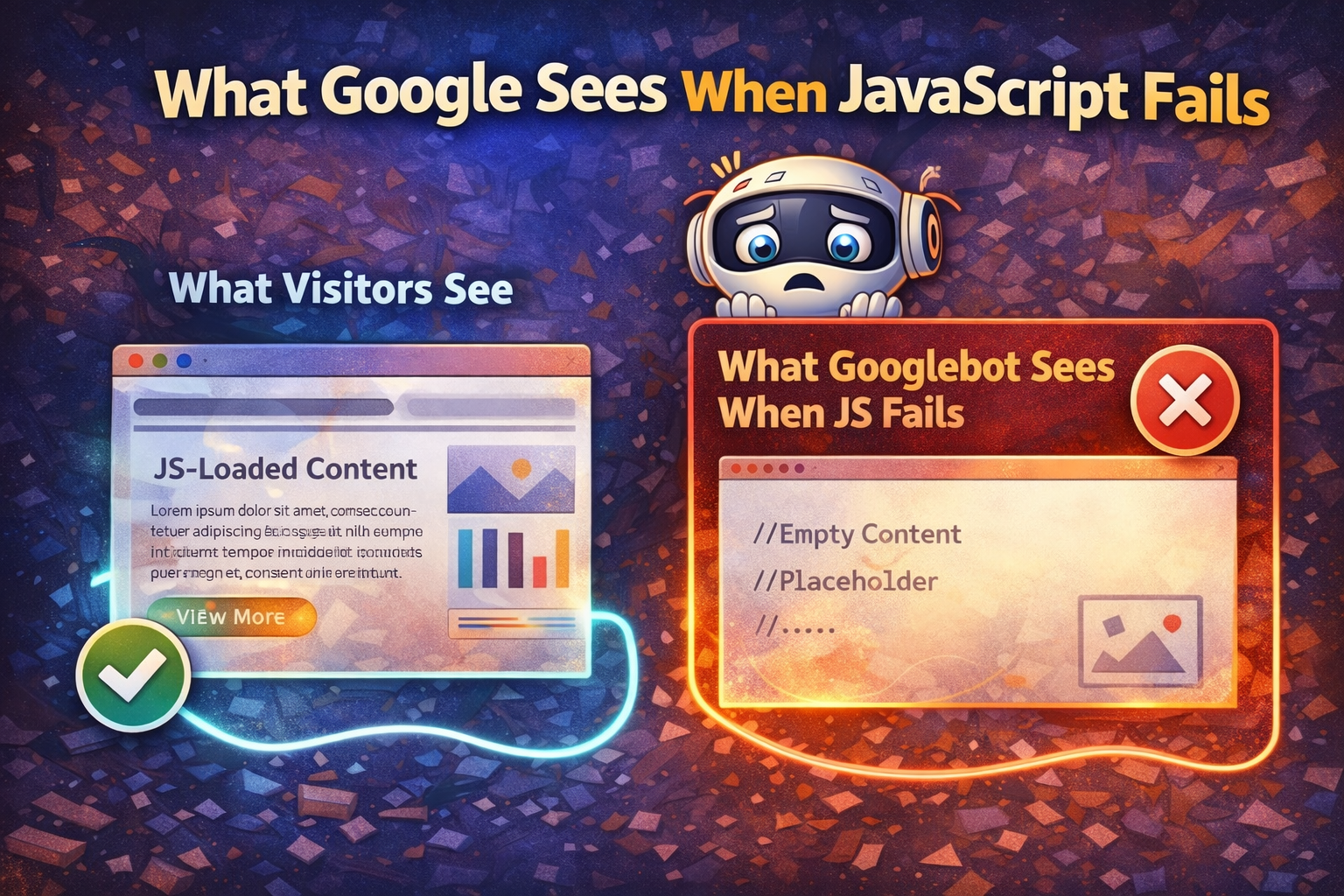
JavaScript powers modern websites — layouts, interactions, dynamic content, and entire frameworks.
When it works, everything feels seamless.
When it doesn’t, most site owners never notice.
Google does.
Crawling isn’t the same as seeing
One of the biggest misunderstandings in SEO is assuming that if a page is crawlable, it’s fully understood.
Crawling simply means:
- Google can access the URL
- The server responds
- The HTML is fetched
Rendering is different.
Rendering is when Google:
- Executes JavaScript
- Builds the page visually
- Decides what content actually exists
A seo audit will often show a page as indexable — while still flagging rendering concerns underneath.
What happens when JavaScript fails (or partially loads)
JavaScript can fail in more ways than people realise:
- Scripts blocked by robots.txt
- Third-party scripts timing out
- Errors during execution
- Heavy bundles that exceed rendering budgets
- Content injected after long delays
When this happens, Google may see:
- Empty content containers
- Placeholder text
- Navigation without context
- Missing headings or body copy
To a user, the page looks fine.
To Google, the page is thin, incomplete, or unclear.
This is one of the quiet reasons JS-heavy sites underperform.
Google doesn’t wait forever
Google renders pages under time and resource constraints.
If critical content:
- Appears too late
- Depends on multiple chained scripts
- Requires user interaction
- Loads only after animations
…there’s a real chance it won’t be fully processed.
A free website seo checker may flag this as:
- “Content not visible in rendered HTML”
- “Text loaded via JavaScript”
- “Potential rendering delay”
Nothing is technically “broken” — but visibility is compromised.
Fallback content matters more than people think
Well-built sites plan for failure.
This includes:
- Server-rendered core content
- Meaningful HTML before JavaScript runs
<noscript>fallbacks where appropriate- Graceful degradation rather than blank states
Fallback content ensures that:
- Search engines always see the primary message
- Users on slow devices aren’t blocked
- Rendering delays don’t erase intent
Sites without fallback content often rely entirely on JavaScript to exist.
That’s a risk.
Frameworks amplify the problem
Modern frameworks make it easy to build powerful interfaces — and easy to hide content from search engines accidentally.
Common issues include:
- Client-side routing without pre-rendering
- Content assembled only after API calls
- Headings injected dynamically
- Metadata updated post-load
Without server-side rendering or static generation, Google may see a shell instead of a page.
This is why JS-heavy sites often “pass” a seo checker but still struggle to rank consistently.
Why this shows up in SEO audits
When an audit flags JavaScript or rendering issues, it’s not criticising modern development.
It’s highlighting uncertainty.
Search engines want confidence:
- Clear content
- Clear structure
- Clear intent
If the page only becomes clear after JavaScript runs perfectly, that confidence drops.
A seo audit is often the first place these silent issues surface.
How to reduce reliance on JavaScript for meaning
You don’t need to abandon JavaScript — but you do need to decide what it’s responsible for.
Strong sites ensure:
- Core headings exist in raw HTML
- Primary content loads immediately
- Navigation works without JS
- Enhancements layer on top, not instead
JavaScript should enhance meaning, not create it.
Quiet failures are the hardest to diagnose
JavaScript SEO issues rarely cause dramatic crashes.
They cause:
- Slower growth
- Inconsistent indexing
- Pages ranking below expectation
- Strong UX with weak visibility
Which is why they’re often missed until a free website seo checker or deep audit forces a closer look.
JavaScript isn’t the enemy.
Invisible content is.
If Google can’t reliably see what your page is about, it can’t confidently rank it — no matter how good it looks to users.
A solid seo checker doesn’t just test if your site works.
It tests whether your meaning survives when JavaScript doesn’t.
Share this content:


Post Comment