SEO Fundamentals
build website authority, clean website architecture, free website seo checker, google trust signals, internal linking strategy, seo audit, seo authority building, seo ranking trust, seo signal consistency, seo trust factors, structured site hierarchy, technical seo fundamentals, topical authority seo, url stability seo, website seo checker, why my website isn’t ranking
SEO Checker
0 Comments
Why Google Trusts Some Websites Instantly (And Hesitates With Others)
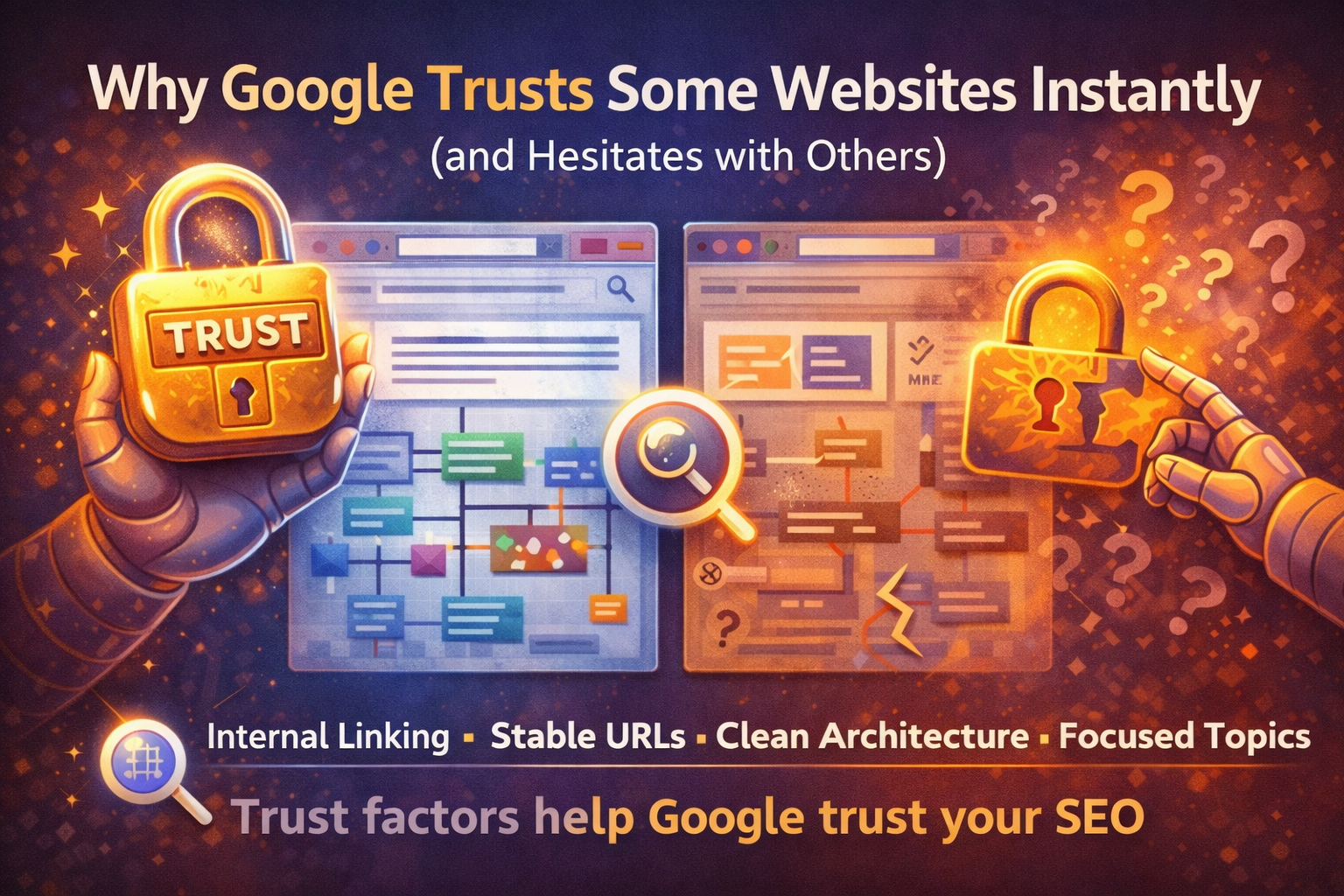
Two websites can publish content on the same topic.
One ranks quickly.
The other struggles for months.
Both might:
- Pass a seo audit
- Load quickly
- Have clean meta tags
- Use structured data properly
So why does Google appear to “trust” one instantly — and hesitate with the other?
The answer isn’t luck.
It’s trust mechanics.
Trust Isn’t a Score — It’s a Pattern
Google doesn’t wake up and decide it “likes” a website.
Trust is built from patterns over time:
- Signal consistency
- Structural clarity
- Historical stability
- Topical depth
- Predictable behaviour
When these align, Google gains confidence.
When they fluctuate, hesitation follows.
Let’s break this down properly.
1️⃣ Consistent Internal Linking Patterns
Internal links are more than navigation — they’re declarations of importance.
Trusted sites tend to:
- Link contextually, not randomly
- Reinforce topic relationships
- Use natural, consistent anchor text
- Avoid excessive repetition or automation
Over time, this creates a clear map.
Google understands:
- Which pages are core
- Which pages support others
- How topics relate
Less trusted sites often show:
- Scattered linking
- Inconsistent anchor phrasing
- Important pages buried deep
- Overuse of keyword-stuffed anchors
It doesn’t look malicious.
It just looks unclear.
Clarity builds trust.
2️⃣ Stable URLs Over Time
URL stability is an underrated trust factor.
Trusted sites:
- Avoid frequent URL restructuring
- Don’t constantly change slugs
- Don’t redirect content repeatedly
- Maintain consistent hierarchy
When URLs change often, Google has to re-evaluate:
- Is this the same content?
- Has intent shifted?
- Are signals resetting?
Even when redirects are technically correct, repeated structural changes can slow trust accumulation.
A free website seo checker won’t tell you “you’ve changed too much” — but long-term volatility absolutely affects confidence.
3️⃣ Clean, Predictable Architecture
Google trusts what it can understand quickly.
Strong architecture usually means:
- Logical category structures
- Shallow crawl depth
- Clear URL hierarchy
- No orphaned pages
- Minimal parameter clutter
When architecture is clean, search engines see:
“This site is organised. Topics are deliberate.”
Weak architecture creates hesitation:
- Mixed content types in one directory
- Blog posts and product pages blended without clarity
- Important pages four or five clicks deep
- Navigation shifting frequently
The site isn’t broken — it’s just harder to interpret.
And interpretation speed matters.
4️⃣ Focused Topical Clusters
Trusted websites rarely chase everything.
They build depth.
Instead of:
- One article on SEO
- One on fitness
- One on crypto
- One on gardening
They create:
- Multiple related pieces
- Clear internal references
- Progressive topic expansion
- Supporting explainers
This builds topical authority through repetition and reinforcement.
Google begins to associate the domain with a subject area.
This is where many technically perfect sites fail.
They pass every seo checker, but publish isolated content with no thematic reinforcement.
Trust grows when patterns repeat consistently.
5️⃣ Avoiding Erratic Changes
Search engines watch behaviour over time.
Frequent instability can slow trust:
- Constant theme swaps
- Large design overhauls every few months
- Changing primary topics
- Switching from blog to ecommerce to SaaS positioning
- Rewriting key pages repeatedly
To a human, this looks like evolution.
To a search engine, it can look like uncertainty.
Trusted sites tend to evolve steadily, not dramatically.
Consistency compounds.
Trust Is Built Through Predictability
If you zoom out, a pattern appears:
Google trusts websites that behave predictably.
Predictable means:
- Topics reinforce each other
- Internal links make sense
- URLs stay stable
- Architecture remains clear
- Content depth grows logically
When everything aligns, confidence increases.
When signals fluctuate, hesitation creeps in.
Why This Matters for Rankings
When two pages compete and both are technically sound, trust becomes the differentiator.
A technically perfect page on a low-trust domain often loses to:
- A slightly less optimised page on a stable, consistent site
- A domain with deeper topical coverage
- A structure that has reinforced meaning over time
This is why some sites seem to rank effortlessly.
It isn’t magic.
It’s accumulated clarity.
SEO Tools Can’t Measure All of This
A seo audit can identify:
- Broken links
- Canonical conflicts
- Missing tags
- Indexing problems
A website seo checker can confirm technical eligibility.
But trust mechanics go beyond checklists.
They’re built through:
- Stability
- Focus
- Repetition
- Structural integrity
You don’t “optimise” for trust in a day.
You earn it through consistency.
Google doesn’t reward clever tricks.
It rewards signals that make sense over time.
If your site passes every audit but still feels slow to gain traction, ask yourself:
- Are my topics focused?
- Is my structure predictable?
- Do my internal links reinforce meaning?
- Have I changed direction too often?
Trust isn’t a setting.
It’s a pattern.
And patterns, once established, are incredibly powerful.
Share this content:

Post Comment