Strategy
branded vs non branded seo, free website seo checker, improve website seo, measure seo authority, non branded traffic growth, query distribution seo, ranking stability seo, seo analytics strategy, seo audit, seo authority building, seo traffic vs rankings, site wide ranking strength, sustainable seo growth, traffic growth vs ranking strength, website seo checker
admin
0 Comments
The Difference Between Traffic Growth and Ranking Strength
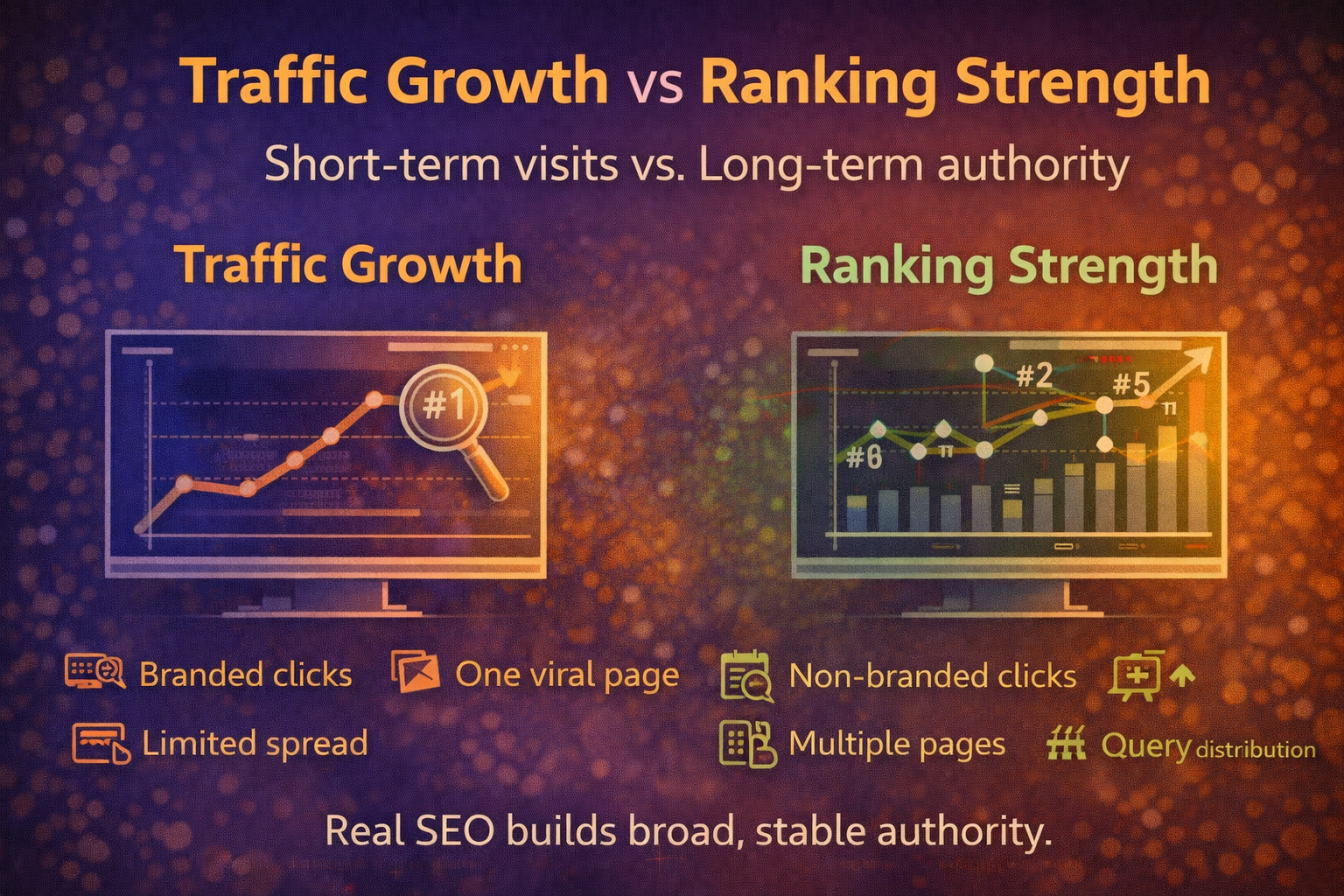
The Difference Between Traffic Growth and Ranking Strength
Traffic is exciting.
Graphs go up.
Clicks increase.
Sessions rise.
It feels like success.
But traffic growth and ranking strength are not the same thing.
In fact, you can see rising traffic while your authority weakens — or experience flat traffic while your long-term ranking position improves.
If you only watch visits, you’ll misread what’s actually happening.
Understanding the difference between traffic growth and ranking strength is what separates short-term spikes from sustainable authority.
Traffic Is an Outcome. Ranking Strength Is a Foundation.
Traffic measures:
- How many users arrive
- How often they click
- How visible you are right now
Ranking strength measures:
- How consistently you rank across topics
- How deep your authority runs
- How stable your visibility is
- How resilient you are to competition
Traffic is immediate.
Ranking strength is structural.
You can temporarily inflate one without strengthening the other.
1️⃣ Branded vs Non-Branded Growth
One of the clearest distinctions is branded versus non-branded traffic.
Branded Traffic
Users searching for:
- Your business name
- Your product name
- Your brand + service
This traffic grows when:
- Brand awareness increases
- Marketing campaigns succeed
- Social presence expands
It does not necessarily reflect improved search authority.
You could double branded traffic while your non-branded visibility remains stagnant.
Non-Branded Traffic
Users searching for:
- General industry terms
- Informational queries
- Problem-based keywords
- Comparison terms
Non-branded growth reflects broader trust from search engines.
If non-branded impressions rise steadily, your ranking strength is expanding.
If traffic increases but non-branded impressions decline, that’s a warning sign.
Branded growth is reputation.
Non-branded growth is authority.
2️⃣ One Viral Page vs Site-Wide Improvement
A single page can distort your perception of growth.
Example:
- One blog post goes viral
- It earns backlinks
- It dominates impressions
- Traffic spikes
But the rest of the site remains unchanged.
This creates fragile growth.
If that page drops or loses relevance, traffic collapses.
True ranking strength looks different.
It shows:
- Multiple pages ranking
- Growth across topic clusters
- Distributed impressions
- Balanced query coverage
Sustainable authority spreads across your site.
Not just one URL.
3️⃣ Query Distribution Spread
Search Console reveals how diversified your visibility is.
Look at:
- Total queries driving impressions
- Number of queries ranking top 10
- Query spread across categories
If most of your traffic comes from:
- A small handful of queries
- One dominant topic
- Narrow intent coverage
You are exposed.
If visibility is spread across:
- Dozens or hundreds of related queries
- Multiple intent types
- Several content clusters
You are building ranking strength.
Breadth reduces vulnerability.
4️⃣ Depth of Topical Coverage
Ranking strength is not about individual keywords.
It’s about topical coverage.
Strong sites:
- Publish interconnected content
- Link internally with purpose
- Cover foundational and advanced topics
- Reinforce concepts across pages
Weak sites:
- Target isolated keywords
- Publish scattered articles
- Lack internal reinforcement
- Avoid depth
Search engines interpret depth as expertise.
When you consistently cover subtopics, related questions, and supporting ideas, your authority compounds.
Traffic might rise slowly — but stability strengthens.
5️⃣ How to Measure Sustainable Authority
Instead of only tracking sessions, measure:
1️⃣ Non-Branded Impression Growth
Are impressions rising for generic, competitive queries?
2️⃣ Average Position Across Topic Clusters
Are multiple pages improving together?
3️⃣ Query Count Expansion
Are you ranking for more queries over time?
4️⃣ Top 10 Distribution
Are more URLs appearing in strong positions?
5️⃣ Ranking Stability
Are fluctuations narrowing rather than widening?
These indicators reveal structural improvement.
Traffic alone cannot show this.
When Traffic Rises but Authority Weakens
This can happen when:
- Branded campaigns drive clicks
- One page dominates traffic
- Paid campaigns increase brand searches
- Trending topics temporarily spike interest
If non-branded impressions fall while traffic rises, you may be masking structural decline.
Always compare traffic sources and query types.
When Authority Strengthens but Traffic Stalls
This happens more often than people realise.
Signs include:
- Rising impressions
- Expanding query coverage
- Improved average positions
- More URLs appearing in Search Console
But traffic doesn’t spike immediately.
Why?
Because:
- Rankings may be moving from page 3 to page 2
- CTR may be limited by strong competitors
- SERP features may suppress clicks
This is groundwork being laid.
Authority improvements often precede traffic gains.
Patience matters.
Why This Distinction Matters
If you chase traffic alone, you might:
- Overreact to small dips
- Ignore structural weaknesses
- Invest in short-term spikes
- Neglect internal reinforcement
If you focus on ranking strength, you:
- Build resilient authority
- Reduce volatility
- Strengthen clusters
- Compound long-term growth
Short-term traffic is exciting.
Long-term authority is strategic.
The Strategic Shift
Instead of asking:
“Did traffic go up?”
Ask:
- Is non-branded visibility expanding?
- Is topic depth increasing?
- Are more pages ranking consistently?
- Is my query footprint widening?
This mindset positions you as an operator — not a reactor.
Final Perspective
Traffic is a surface metric.
Ranking strength is structural.
One can rise while the other weakens.
The sites that win long-term are not the ones with occasional spikes.
They are the ones with:
- Distributed authority
- Reinforced topical coverage
- Stable ranking patterns
- Expanding non-branded reach
Build strength first.
Traffic will follow.

Post Comment