Strategy
ad performance issues, conversion rate problems, digital marketing strategy 2026, growth strategy mistakes, improve ad ROI, landing page optimisation mistakes, marketing budget waste, marketing mistakes small business, paid ads not converting, scaling ads too early, small business advertising mistakes, technical issues hurting conversions, traffic but no sales, wasting money on ads, website conversion optimisation, website not ready for traffic, website readiness checklist, why ads don’t convert, why my ads aren’t working
SEO Checker
0 Comments
The Marketing Trap: Why Most Businesses Promote Before They’re Ready
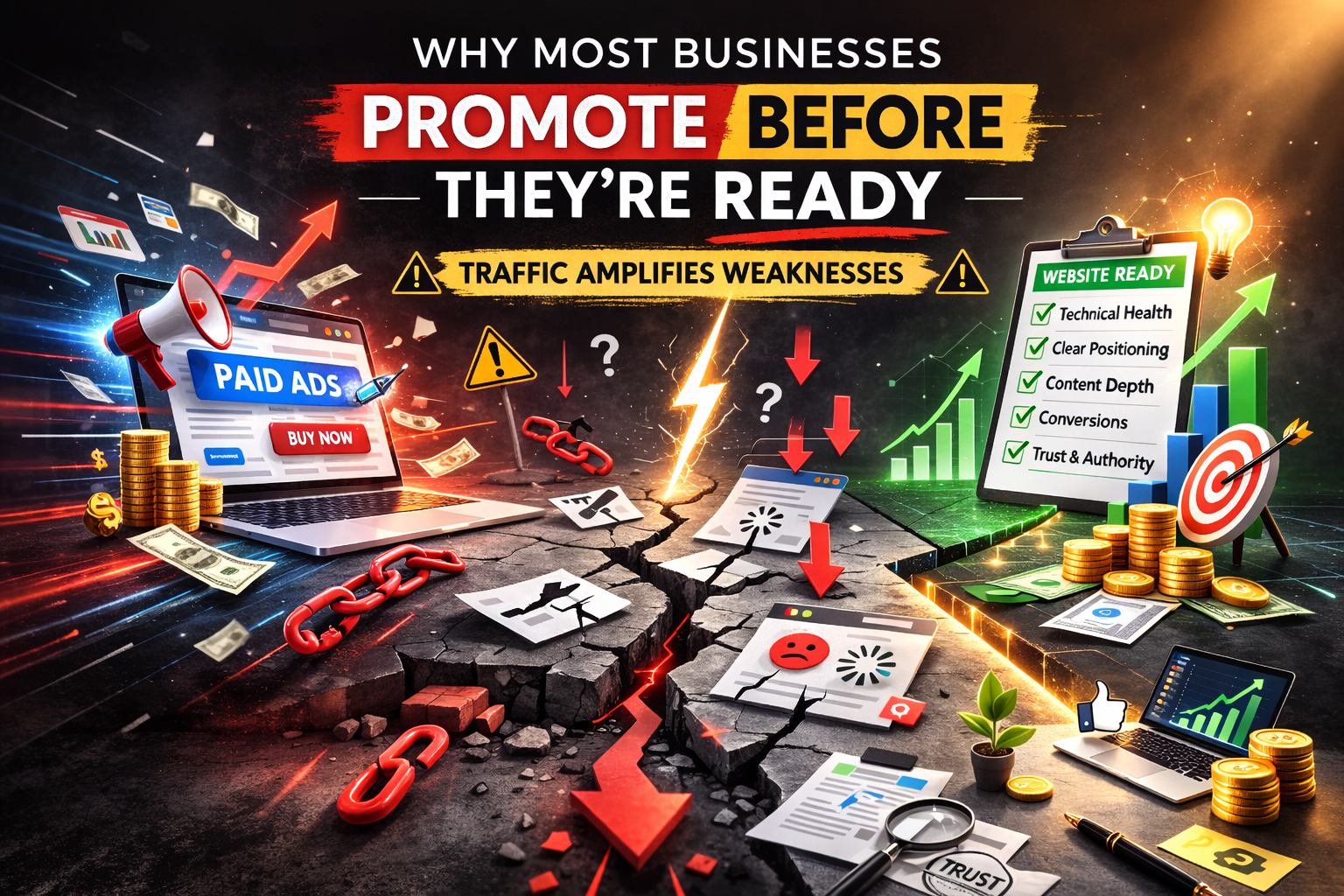
Here’s something slightly controversial:
Most businesses don’t have a traffic problem.
They have a readiness problem.
They launch ads.
They boost posts.
They scale campaigns.
They increase budget.
And then they ask:
Why aren’t our ads converting?
The uncomfortable answer is usually this:
Traffic amplifies weaknesses.
If your foundation is weak, more traffic doesn’t fix it — it exposes it.
The Most Common Growth Mistake
Modern marketing makes promotion incredibly easy.
You can:
- Launch Google Ads in minutes
- Boost a Facebook post instantly
- Run TikTok campaigns the same day
- Start scaling spend immediately
So businesses do.
But here’s what often happens next:
- High bounce rates
- Low conversions
- Expensive cost per acquisition
- Declining ROI
- Frustration
They assume the problem is targeting.
Or creative.
Or the platform.
Often, the real issue is that the website wasn’t ready.
The Four Big “Not Ready” Patterns
Let’s break down what typically goes wrong.
1. Running Ads Before Validating Messaging
Many businesses assume they know what their audience wants.
They create ads based on internal assumptions instead of market clarity.
Without validating:
- The core pain point
- The strongest hook
- The real buyer objection
- The language customers actually use
The ad brings traffic — but the message doesn’t resonate.
Result?
Low click-through rates.
Weak engagement.
Poor conversion.
Promotion without validation is expensive guessing.
2. Pushing Traffic to Weak Pages
This is one of the biggest marketing mistakes small businesses make.
They send paid traffic to:
- Thin landing pages
- Generic homepages
- Confusing layouts
- Pages with no clear CTA
- Slow-loading sites
Paid traffic is impatient.
If your page doesn’t immediately:
- Communicate value
- Build trust
- Guide the user
- Load quickly
Visitors leave.
And every click costs money.
3. Scaling Before Fixing Technical Issues
Technical issues are invisible killers.
Examples include:
- Slow page speed
- Broken mobile layouts
- Missing meta information
- Poor internal linking
- Crawlability problems
- Redirect errors
If your site has hidden technical friction, paid ads magnify it.
You’re effectively pouring fuel onto an unstable engine.
Before scaling promotion, your website needs to be structurally sound.
4. Spending Budget Before Building Trust
Trust is the silent conversion driver.
Ask yourself:
Does your site clearly show:
- Testimonials?
- Social proof?
- Clear expertise?
- Authority signals?
- Depth of knowledge?
If not, traffic will hesitate.
Cold traffic especially requires reassurance.
Promotion before trust-building is like inviting guests into an unfinished house.
The Core Principle: Traffic Amplifies Weaknesses
This is the trap.
Businesses think:
“We need more traffic.”
But more traffic simply amplifies:
- Weak messaging
- Poor positioning
- Technical flaws
- Conversion friction
If 1,000 visitors convert poorly, 10,000 visitors won’t magically convert better.
The Website Readiness Checklist (Before You Scale)
Before increasing ad spend or promotion, audit these five areas.
1. Technical Health
Your site must:
- Load quickly
- Be fully crawlable
- Work flawlessly on mobile
- Avoid broken links and redirects
- Present clean structure
Technical friction reduces both SEO and paid performance.
Running a full SEO scan before scaling traffic is often the smartest move.
It highlights structural weaknesses before they cost you money.
2. Clear Positioning
Visitors should immediately understand:
- Who it’s for
- What problem it solves
- Why it’s different
- Why they should trust you
If your homepage or landing page requires explanation, conversions will suffer.
Clarity beats cleverness.
3. Core Content Depth
If users explore your site, what do they find?
- Thin pages?
- Surface-level content?
- No supporting information?
Depth builds authority.
Authority builds trust.
Trust increases conversion rates.
Businesses that invest in content depth often see both SEO and paid performance improve.
4. Conversion Structure
Ask yourself:
- Is there one clear next step?
- Is the call-to-action obvious?
- Are distractions removed?
- Is friction minimised?
Many websites look “nice” but lack structured conversion flow.
Ads don’t fix that.
5. Authority Signals
Even small signals matter:
- Consistent branding
- Blog content
- Structured internal linking
- Social mentions
- Backlinks
- Clear expertise
Authority reassures visitors they’re in the right place.
Without it, paid traffic behaves cautiously.
Why Ads Sometimes “Don’t Convert”
When businesses search:
- why ads don’t convert
- wasting money on ads
- website not ready for traffic
The root issue is often not the ad platform.
It’s premature promotion.
Ads are accelerators.
If your foundation is strong, they scale growth.
If your foundation is weak, they scale losses.
The Smarter Sequence
Instead of:
- Launch ads
- Optimise later
Try:
- Validate messaging
- Fix technical weaknesses
- Strengthen core pages
- Build content depth
- Confirm structural health
- Then scale traffic
This approach reduces wasted budget dramatically.
Where SEO and Paid Media Intersect
SEO forces you to:
- Improve structure
- Strengthen content
- Clarify positioning
- Fix technical issues
- Build authority
That preparation often improves paid ad performance naturally.
Before scaling campaigns, running a full site audit can reveal issues that directly affect conversion and quality score.
Using a comprehensive SEO scan helps ensure your site is technically and structurally ready for traffic.
Because once traffic starts flowing, small problems become expensive.
The Bottom Line
The marketing trap isn’t promotion.
It’s premature promotion.
Most businesses don’t fail because they lack traffic.
They fail because they amplify weaknesses before fixing them.
Traffic doesn’t create growth on its own.
It magnifies whatever foundation you’ve built.
Build the foundation first.
Then scale.
And when you do scale, you’ll see very different results.
Share this content:

Post Comment