Strategy
add value seo content, content optimisation mistakes, content usefulness seo, free website seo checker, improve website seo, keyword stuffing seo, optimised content seo, over optimisation seo, search intent seo, seo audit, seo content strategy, seo ranking problems, strategic seo writing, technical seo vs content, website seo checker, why my content isn’t ranking
SEO Checker
0 Comments
The SEO Illusion of “Optimised” Content
There’s a moment many website owners experience.
You’ve:
- Added the keyword to the title
- Included it in the H1
- Used it naturally throughout the page
- Optimised images
- Improved internal links
- Passed every major seo audit
Everything looks correct.
Yet rankings barely move.
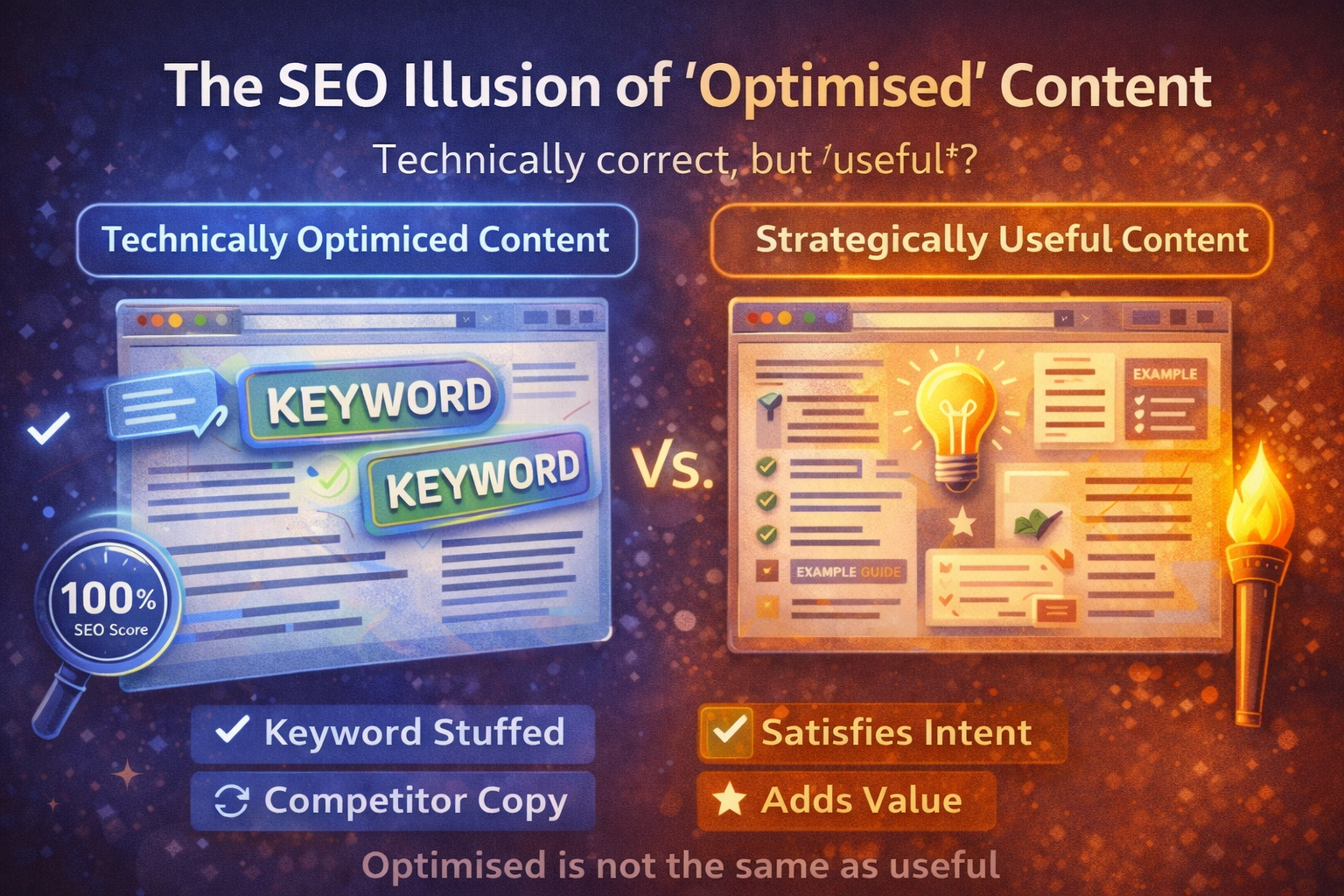
This is the illusion of “optimised” content.
Because technically optimised does not mean strategically strong.
And Google is far more interested in usefulness than perfect formatting.
Optimisation Is Eligibility — Not Superiority
Technical optimisation gets your page into the race.
It ensures:
- Search engines can crawl it
- It’s indexable
- Signals aren’t conflicting
- The keyword theme is clear
A website seo checker can confirm all of that.
But optimisation only proves your page is valid.
It does not prove it’s the best result.
Keyword Placement ≠ Intent Satisfaction
Many content creators treat keywords like a checklist:
- Primary keyword in title ✔
- Primary keyword in H1 ✔
- Keyword density acceptable ✔
- Semantic variations included ✔
But none of that guarantees intent alignment.
Search intent asks:
- What is the user actually trying to achieve?
- What format do they expect?
- What depth do they require?
- What problem are they trying to solve?
For example:
If someone searches:
“how to fix canonical issues”
And your page:
- Defines canonicalisation
- Mentions fixes briefly
- Ends quickly
You’ve technically used the keyword.
But you haven’t satisfied the intent.
Search engines don’t reward repetition.
They reward resolution.
Over-Optimisation Sends Subtle Warning Signals
Ironically, content can look too optimised.
Signs of over-optimisation include:
- Repeated keyword phrasing in headings
- Identical anchor text used excessively
- Forced keyword insertions that disrupt readability
- Multiple near-identical variations targeting slight keyword changes
To a human reader, this feels unnatural.
To Google, it can feel manipulative.
The goal isn’t density.
It’s clarity.
Over-optimised pages often lose tone, depth, and flow — all in pursuit of mechanical signals.
And mechanical signals alone don’t win rankings.
Rewriting Competitors Isn’t Adding Value
One of the most common SEO traps is this:
- Search the keyword.
- Read the top three results.
- Repackage what they say.
- Add slightly more words.
On paper, this looks strategic.
In practice, it creates redundancy.
If your content:
- Says the same things
- Uses the same structure
- Covers the same surface points
Google has no incentive to replace the existing results.
Optimised duplication is still duplication.
To outperform competitors, you must:
- Add new insight
- Improve clarity dramatically
- Provide better structure
- Deliver deeper explanation
- Offer examples they don’t
Usefulness must increase — not just word count.
Surface-Level Updates Don’t Change Performance
Another illusion appears when pages are “updated”.
Common update patterns include:
- Changing the year in the title
- Tweaking the introduction
- Adding a paragraph near the bottom
- Slightly adjusting keywords
These are maintenance changes — not strategic improvements.
If the core usefulness hasn’t improved, rankings rarely respond.
Real updates often involve:
- Reworking the structure entirely
- Expanding thin sections
- Improving clarity
- Addressing missing intent layers
- Adding stronger internal context
Optimisation tweaks polish the surface.
Strategic revisions strengthen the core.
Why SEO Tools Can’t Detect This
A free website seo checker can measure:
- Technical health
- Page speed
- Missing tags
- Canonical conflicts
- Indexability
It cannot measure:
- Whether your page genuinely solves the query
- Whether users leave satisfied
- Whether competitors provide deeper answers
- Whether your structure reduces cognitive friction
When your page passes every check but still underperforms, the tool hasn’t failed.
It has confirmed the technical layer is not the issue.
That’s your cue to look deeper.
The Difference Between Optimised and Valuable
Here’s the real shift:
Optimised content says:
“I’ve included the right signals.”
Valuable content says:
“I’ve solved the right problem.”
Optimised content aligns with algorithms.
Valuable content aligns with users.
When both align together, rankings strengthen.
When only optimisation is present, growth stalls.
What To Do Instead
If your content is technically clean but stagnant, ask:
- Does this fully resolve the searcher’s intent?
- What would make this 2x clearer?
- What questions are competitors not answering?
- Is the structure genuinely easy to scan?
- Would I bookmark this if I were the reader?
Then improve usefulness first.
Let optimisation support that — not replace it.
Optimisation creates eligibility.
Usefulness creates preference.
If your site passes every seo audit but still struggles to rank, the problem may not be technical at all.
It may simply be that your content is optimised…
…but not indispensable.
Share this content:



Post Comment