Strategy
advanced SEO growth tactics, break SEO plateau, competitive catch up SEO, content saturation SEO, how to grow SEO further, improve search rankings further, increase organic traffic after plateau, intermediate SEO strategy, internal linking strategy, link velocity slowdown, rankings stopped improving, scaling SEO strategy, SEO authority ceiling, SEO growth stagnation, SEO performance decline, SEO plateau, traffic growth stalled, why organic traffic flatlined, why SEO traffic stopped growing
SEO Checker
0 Comments
The SEO Plateau: What To Do When Growth Suddenly Stops
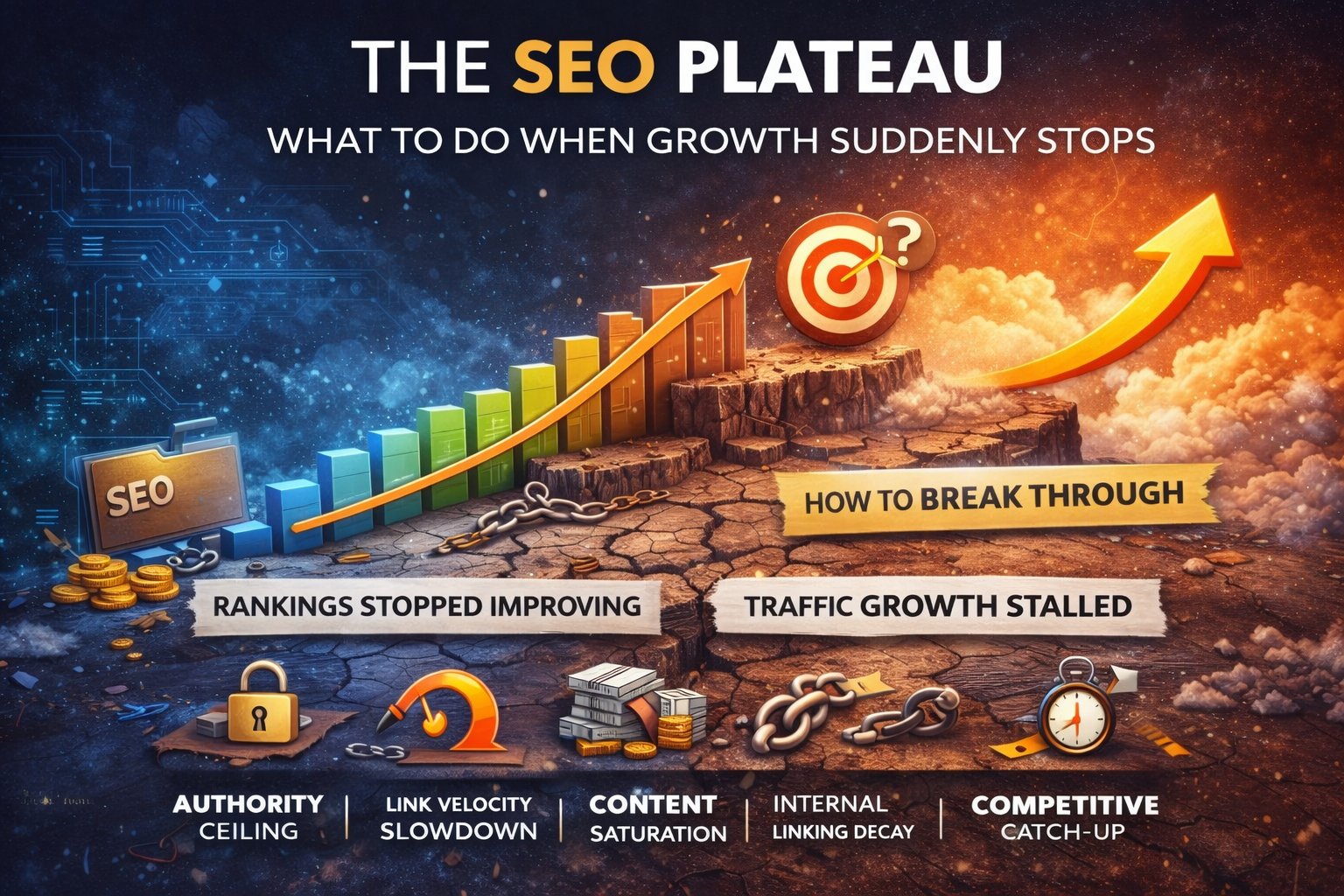
The early stages of SEO are exciting.
You fix technical issues.
You publish content.
You earn links.
Traffic starts rising.
Then one day it slows.
Rankings stabilise.
Traffic flattens.
Growth stalls.
Welcome to the SEO plateau.
Most SEO guides focus on how to start.
Very few talk about what happens when progress stops.
If you’re experiencing:
- rankings stopped improving
- traffic growth stalled
- struggling to grow SEO further
This article is for you.
What Is an SEO Plateau?
An SEO plateau is when:
- Traffic stops increasing
- Rankings hover within a narrow range
- New content doesn’t move the needle
- Link building has diminishing returns
It’s not a penalty.
It’s not necessarily an algorithm hit.
It’s usually a structural growth ceiling.
And understanding the cause determines the solution.
Why SEO Growth Stalls
There are predictable reasons growth slows after initial success.
Let’s break down the most common ones.
1️⃣ The Authority Ceiling
In early SEO, low to medium competition keywords are easy wins.
You publish decent content.
You optimise properly.
You gain traction.
But eventually, you hit keywords dominated by:
- Established brands
- High domain authority sites
- Deep backlink profiles
Your site reaches its authority ceiling.
At this stage, technical optimisation alone won’t move you higher.
Breaking through requires:
- Stronger backlinks
- Higher quality mentions
- Better topical coverage
- Brand signal growth
This is often the first true wall in SEO.
2️⃣ Link Velocity Slowdown
Link velocity refers to how consistently your site earns new backlinks.
Early on, it’s common to:
- Do outreach
- Build guest posts
- Earn some mentions
But then link building slows.
Competitors continue earning links while your profile stagnates.
Google compares growth signals over time.
If competitors are building authority faster, they gradually overtake you.
A plateau here means you’re no longer increasing relative trust.
3️⃣ Content Saturation
Another common cause is content saturation.
You’ve covered:
- All obvious keywords
- Core service topics
- Basic educational posts
Now what?
Without deeper content layering, your site may lack:
- Supporting cluster articles
- Advanced topic coverage
- Updated perspectives
- Fresh intent angles
Google increasingly rewards topical depth.
If your content is broad but shallow, growth stalls.
4️⃣ Internal Linking Decay
This is rarely discussed.
Over time:
- New content is added
- Old content remains unchanged
- Internal links aren’t updated
Authority becomes fragmented.
Your strongest pages may no longer receive sufficient internal support.
Without intentional linking updates, crawl flow weakens.
Even strong content can plateau if authority distribution becomes uneven.
5️⃣ Competitive Catch-Up
SEO is not static.
Your competitors:
- Publish new content
- Earn new links
- Improve technical performance
- Strengthen intent alignment
What worked 12 months ago may no longer be enough.
If your site improves slowly while competitors evolve rapidly, rankings flatten.
Plateaus often reflect relative stagnation — not absolute decline.
How to Break Through an SEO Plateau
Now the important part.
Plateaus are not permanent — but they require strategic shifts.
Step 1: Audit for Hidden Technical Friction
Even small technical issues can suppress further growth.
Check for:
- Crawl inefficiencies
- Broken internal links
- Slow page speed
- Orphaned content
- Indexing inconsistencies
Before escalating content or link strategies, ensure your technical foundation remains strong.
A full SEO scan often reveals small barriers that quietly limit scaling.
Step 2: Upgrade Content Depth (Not Volume)
Don’t publish more generic articles.
Instead:
- Expand existing high-performing pages
- Add deeper supporting sections
- Create advanced cluster content
- Improve search intent precision
Focus on strengthening your best-performing topics rather than chasing new shallow ones.
Step 3: Improve Internal Authority Flow
Revisit your top-ranking pages.
Ask:
- Are weaker pages linking to them?
- Are anchor texts strategic?
- Are topic clusters clearly structured?
Strong internal linking refreshes relevance signals.
Many sites break through plateaus simply by redistributing internal authority properly.
Step 4: Strengthen Authority Signals
If you’ve hit an authority ceiling, the solution isn’t more on-page tweaks.
It’s external validation.
This means:
- Higher-quality backlinks
- Brand mentions
- PR-style exposure
- Industry authority content
You don’t need hundreds of links.
You need better links.
Step 5: Re-Evaluate Search Intent Alignment
Sometimes rankings plateau because intent evolves.
A keyword that once matched your content may now favour:
- More commercial pages
- More in-depth guides
- More up-to-date resources
Analyse the current top results.
If they’ve changed format, your page may need realignment.
Search intent is not static.
The Psychological Trap of the Plateau
Many site owners panic at this stage.
They:
- Redesign the site
- Delete content
- Change strategy entirely
- Abandon SEO for paid ads
But plateaus are normal.
They represent the transition from beginner SEO to intermediate growth.
Breaking through requires:
- Structural refinement
- Strategic depth
- Patience
- Authority strengthening
Not drastic resets.
The Growth Phases of SEO
Understanding the lifecycle helps.
Phase 1: Quick Wins
Low competition. Fast traction.
Phase 2: Stabilisation
Rankings consolidate.
Phase 3: Plateau
Growth slows. Ceiling reached.
Phase 4: Breakthrough
Authority deepens. Rankings expand.
The plateau is not failure.
It’s the middle stage of serious growth.
Final Thought
If your:
- SEO plateau is frustrating
- rankings stopped improving
- traffic growth stalled
It’s not necessarily because SEO stopped working.
It’s because your strategy needs to evolve.
Early growth is tactical.
Breaking plateaus is strategic.
Audit your structure.
Strengthen your authority.
Deepen your content.
Realign intent.
And instead of restarting, refine.
Because once you break through an SEO plateau, growth often resumes faster than it did the first time.
Share this content:


Post Comment