The SEO Problem With “One Page Websites” for Small Businesses
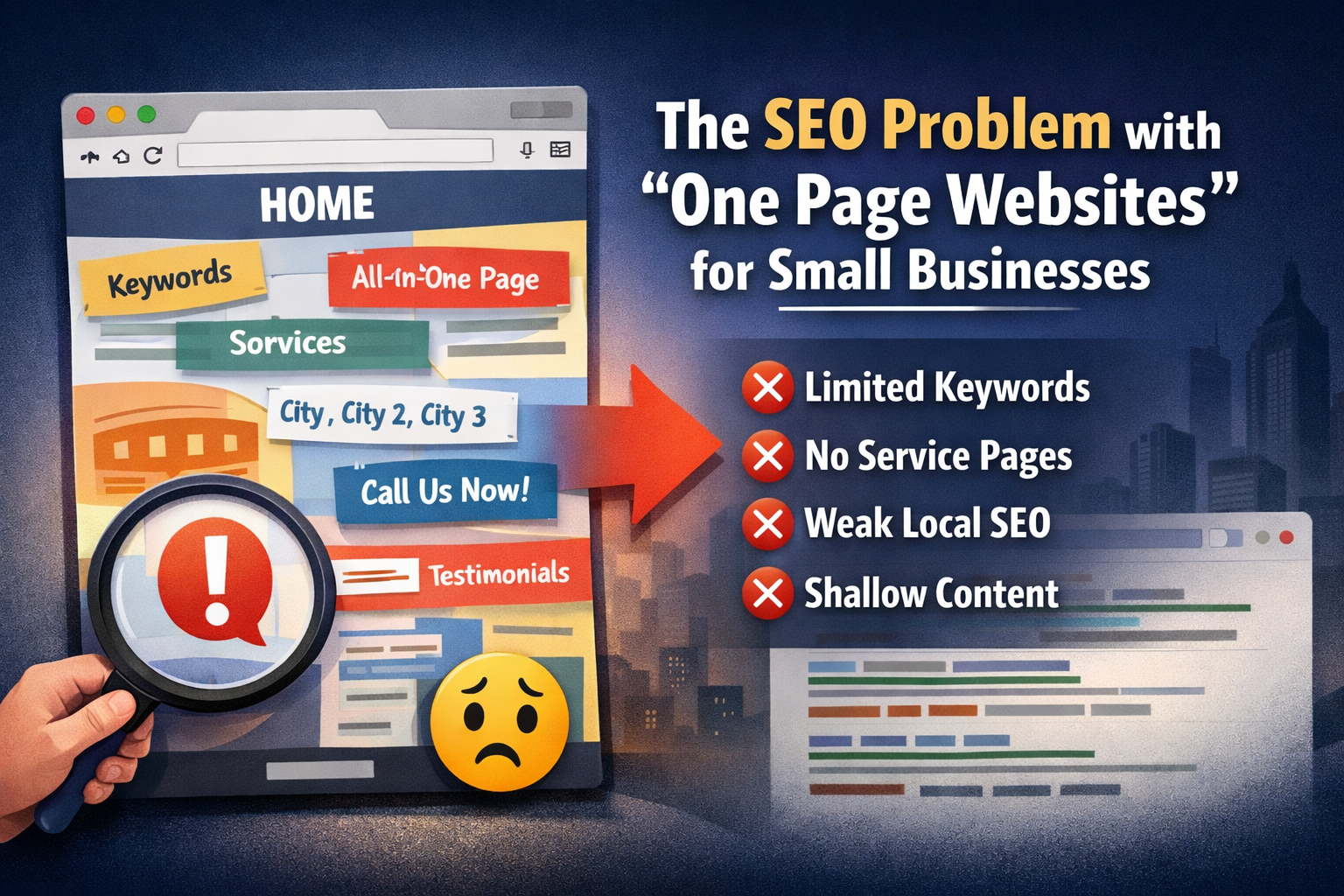
One-page websites can look clean, modern, and simple.
For a lot of small businesses, that is exactly why they choose them.
They are quick to build, easy to understand, and often feel like a tidy way to get a business online without overcomplicating things. Everything is in one place. A visitor scrolls down, sees the services, reads a bit about the business, checks a few reviews, and gets to the contact form.
On the surface, that can work well.
But when it comes to SEO, one-page websites often hit a ceiling much faster than people realise.
That does not mean every one-page website is “bad”. It does not mean they can never rank. And it does not mean they are automatically the wrong choice for every business.
What it does mean is this:
If your website is built as one long homepage, with no real service pages, no local landing pages, and no deeper structure, you are often making SEO much harder than it needs to be.
For many small businesses, this is one of the most overlooked structural reasons why rankings feel limited, inconsistent, or frustratingly stuck.
If your site is basically one long scrolling page and you have ever wondered why SEO feels like an uphill battle, this may be exactly why.
Why one-page websites are so attractive to small businesses
There is a reason one-page sites are still popular.
For many small businesses, they seem like the perfect solution.
They are often:
- cheaper to build
- quicker to launch
- easier to manage
- visually cleaner
- less intimidating than a larger site
- pitched as “simple and modern”
- good enough for social traffic or paid traffic
A lot of business owners also like the idea that:
- customers do not have to click around
- all the important information is in one place
- the site feels straightforward
- there is less content to maintain
For some businesses, especially very early-stage businesses, that can feel like a sensible starting point.
And in fairness, a one-page website can work well for:
- brand credibility
- direct referrals
- paid ads to a single offer
- social traffic
- a temporary launch site
- businesses with one highly focused service
The problem starts when people expect that same structure to support broader SEO growth.
That is where one-page websites often begin to struggle.
Why one-page websites often struggle in SEO
Search engines do not just rank websites.
They rank pages.
That is one of the most important things to understand.
A lot of small business owners think in terms of:
- “I want my website to rank”
But Google is usually thinking in terms of:
- “Which page on this website best matches this search?”
That difference matters.
If your entire website is basically one long page, you only have one real page trying to rank for:
- your brand
- your main service
- secondary services
- related services
- multiple keyword variations
- different customer intents
- possibly multiple locations
- trust queries
- and conversion intent
That creates a structural limitation from day one.
A one-page site may look simple to a user.
But from an SEO point of view, it often means:
- limited keyword targeting
- poor intent separation
- no dedicated pages for deeper relevance
- weak internal linking opportunities
- less crawlable structure
- shallower content depth for important topics
That does not always kill rankings entirely.
But it often limits how far the site can go.
The first big issue: limited keyword targeting
One of the biggest SEO weaknesses of a one-page site is that it gives you very little room to target keywords properly.
If you are a small business offering multiple services, one page may end up trying to rank for things like:
- emergency electrician
- rewiring
- fuse board upgrades
- landlord certificates
- EV charger installation
- electrician in Kingston
- electrician in Richmond
- electrician in Twickenham
That is a lot of intent to force into one page.
Even if you mention all of those things, the page still has one overall identity.
Google has to work out:
- what is this page mainly about?
- which search intent does it best match?
- what should it rank for first?
- what is the strongest relevance signal here?
That usually leads to weaker targeting than a better-structured site with:
- a homepage
- dedicated service pages
- dedicated location pages where needed
- supporting trust pages
In short, one page can mention many things.
But it rarely targets many things well.
The second issue: no dedicated service pages
This is where one-page websites really start to hit SEO limitations.
If you offer more than one service, each major service usually deserves its own page.
Why?
Because a dedicated service page can focus on:
- one core topic
- one search intent
- one user need
- one conversion path
For example, if you are a plumber, these should not all be squeezed into one scrolling homepage section:
- Boiler repairs
- Boiler installation
- Emergency plumbing
- Bathroom plumbing
- Leak detection
- Drain unblocking
Each of those services can attract different searches.
Each of them can justify:
- different headings
- different FAQs
- different trust signals
- different supporting content
- different internal links
- different calls to action
If all of that is collapsed into a short homepage section, the site often feels:
- broad
- shallow
- vague
- underdeveloped
That can make it harder for Google to see the site as the best result for specific service searches.
The third issue: no real local landing pages
This is a huge problem for local businesses.
Many one-page websites try to solve local SEO by doing something like this:
“We serve Kingston, Richmond, Twickenham, Wimbledon, Putney, Surbiton, and surrounding areas…”
That might help with general context.
But it is usually not enough if you genuinely want to rank well in multiple areas.
Why?
Because local intent is often stronger when there is a dedicated page that clearly matches:
- service + location
For example:
- boiler repair in Kingston
- emergency plumber in Richmond
- electrician in Twickenham
If your site is one page, you usually do not have room to build:
- useful location-specific relevance
- local proof
- area-based service context
- location FAQs
- supporting internal links
Instead, everything gets squeezed into a broad area mention.
That may be enough for very low competition or branded searches.
But for stronger local SEO, it is often a structural disadvantage.
The fourth issue: weak internal linking architecture
Internal linking is one of the quiet strengths of a well-structured website.
A stronger site can link between:
- homepage
- service pages
- sub-service pages
- location pages
- FAQs
- case studies
- blog posts
- trust pages
That helps search engines understand:
- which pages matter most
- how topics relate to each other
- which pages support which intent
- how authority flows through the site
A one-page site does not really have that.
Yes, you can use anchor links that jump users down the page.
But anchor links are not the same thing as a real internal page structure.
You are still mostly dealing with:
- one URL
- one page entity
- one main ranking target
- one limited framework for relevance
That means you lose one of the most useful structural tools in SEO:
a clear hierarchy of pages supporting each other.
The fifth issue: shallow content depth
One-page sites often feel polished on the surface.
But in SEO terms, they can be thin where it matters most.
That is because there is only so much room before the page becomes:
- too long
- too cluttered
- too repetitive
- too unfocused
So what usually happens?
The business ends up with:
- a short service section
- a short about section
- a short trust section
- a short FAQ section
- a contact form
- maybe a testimonial block
Everything exists.
But nothing has real depth.
This often creates pages that are:
- visually nice
- easy to skim
- not strong enough for competitive search intent
A dedicated service page can go deeper.
A dedicated location page can go deeper.
A case study page can go deeper.
A blog can go deeper.
A one-page site often cannot.
Can one-page websites ever work for SEO?
Yes — in some cases, they absolutely can.
A one-page website can still work when:
1. The business has one very focused service
If a business only really offers one main thing, and the service is tightly defined, a one-page site may be enough to support that single intent.
For example:
- a niche consultant with one offer
- a personal brand
- a local specialist with one clear service
- a short-term launch site
2. The business mainly gets traffic from referrals or paid ads
If most visitors come from:
- word of mouth
- direct traffic
- social media
- PPC ads
- email campaigns
…then the SEO limitations may matter less.
3. The goal is simple credibility, not search expansion
Some businesses just need:
- a professional online presence
- a place for people to check legitimacy
- a basic contact route
- a simple digital brochure
That is different from trying to grow through search.
And that distinction matters.
When a one-page website has outgrown itself
This is the key question.
A one-page site may have been fine when the business started.
But many businesses reach a point where the structure is no longer helping them grow.
Signs a one-page site has outgrown itself include:
- you offer multiple services but they all live in short homepage sections
- you want to rank in multiple locations
- you keep adding more text to the homepage but rankings do not improve
- your site ranks mostly for branded terms only
- you struggle to rank for service-specific searches
- competitors with deeper site structures keep outperforming you
- your site feels visually nice but SEO progress feels limited
- you want to add blogs, FAQs, case studies, or guides but there is nowhere logical for them to sit
That is often the turning point.
The issue is no longer the design.
The issue is the structure.
The good news: you do not always need a full rebuild
A lot of businesses assume that fixing this means:
- scrapping the site
- redesigning everything
- starting again from scratch
- paying for a full redevelopment
Usually, that is not necessary.
In many cases, the design can stay largely the same.
What needs to change is the page architecture.
That means moving from:
- one page doing everything
To:
- one homepage
- several dedicated service pages
- location pages where appropriate
- trust pages
- optional supporting content
That shift alone can make a huge difference.
How to expand a one-page website into a stronger SEO structure
Here is a practical way to do it without overcomplicating the site.
Step 1: Keep the homepage — but simplify its role
Your homepage can still stay as the main front door.
But instead of making it carry every SEO target, make it focus on:
- who you are
- what you do at a high level
- your core value proposition
- trust signals
- navigation into the right pages
Shorter service summaries are fine.
Keyword stuffing every variation into the homepage is not.
Step 2: Create dedicated service pages
Start with the most commercially important services.
For example:
- Homepage
- Boiler Repairs
- Boiler Installation
- Emergency Plumbing
- Bathroom Plumbing
Each page should feel like the best answer for that service.
That means including:
- clear headings
- useful detail
- trust signals
- FAQs
- strong calls to action
- internal links to related pages
Step 3: Add local landing pages only where they make sense
If you genuinely serve multiple areas, create pages where there is:
- real search demand
- real relevance
- a strong business reason to rank there
Do not create dozens of thin, near-duplicate pages just to chase keywords.
Focus on:
- quality
- local context
- service + location intent
- helpful content
Step 4: Add supporting trust pages
These often make a site feel stronger overall.
Examples:
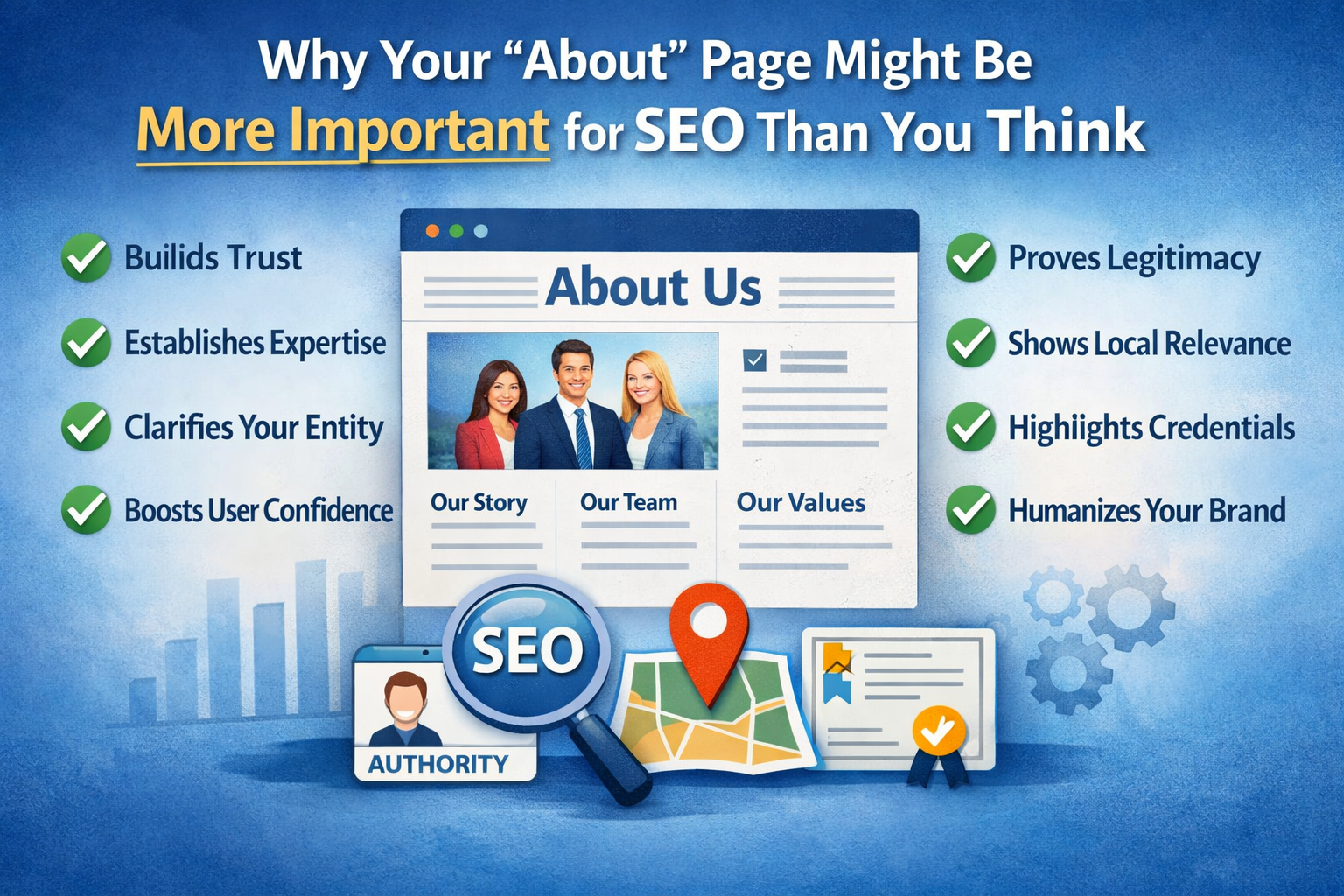
- About
- Testimonials / Reviews
- Case Studies
- FAQs
- Contact
- Service Area Overview
- Process / How It Works
These pages do not always target big keywords directly.
But they strengthen the site’s trust and completeness.
Step 5: Use internal links properly
Once you have multiple pages, use them strategically.
Your homepage should link to:
- main services
- key locations
- trust pages
Your service pages should link to:
- related services
- relevant locations
- FAQs
- contact pages
That is how the site starts behaving like a proper SEO structure rather than one long brochure.
The real issue is not that one-page websites are “bad”
This is important.
The goal is not to say:
“One-page websites are bad.”
The real issue is that many small businesses expect a one-page website to support a level of SEO growth that it was never really built for.
A one-page website can be:
- clean
- modern
- attractive
- easy to use
- good for simple conversions
- fine for a narrow offer
But if you want stronger SEO across:
- multiple services
- multiple keywords
- multiple locations
- broader search visibility
…you usually need more than one page doing the work.
That is not a design problem.
It is a structural SEO problem.
Final thought
If your website is one long page and SEO always feels harder than it should, there is a good chance the structure is part of the reason.
The problem is not that the site looks simple.
The problem is that one page is often being asked to do too many jobs at once.
A stronger small business website usually gives each important part of the business its own place to breathe.
That means:
- the homepage builds trust and gives direction
- service pages target real intent
- location pages support local visibility
- trust pages strengthen credibility
- internal links create a clearer structure
That is when SEO usually becomes easier to scale.
Because instead of trying to make one page rank for everything, you are building a website where every important page has a clear purpose.
And that is usually what performs better in the long run.
Share this content:

Post Comment