Strategy
diagnose ranking drop, free website seo checker, google algorithm recalibration, google ranking fluctuations, ranking testing period, ranking volatility seo, search ranking movement, seasonal traffic decline seo, seo audit, sudden ranking drop, technical seo issues, website seo checker, why did my rankings drop, why rankings fluctuate
SEO Checker
0 Comments
Why Rankings Fluctuate (And When You Should Actually Worry)
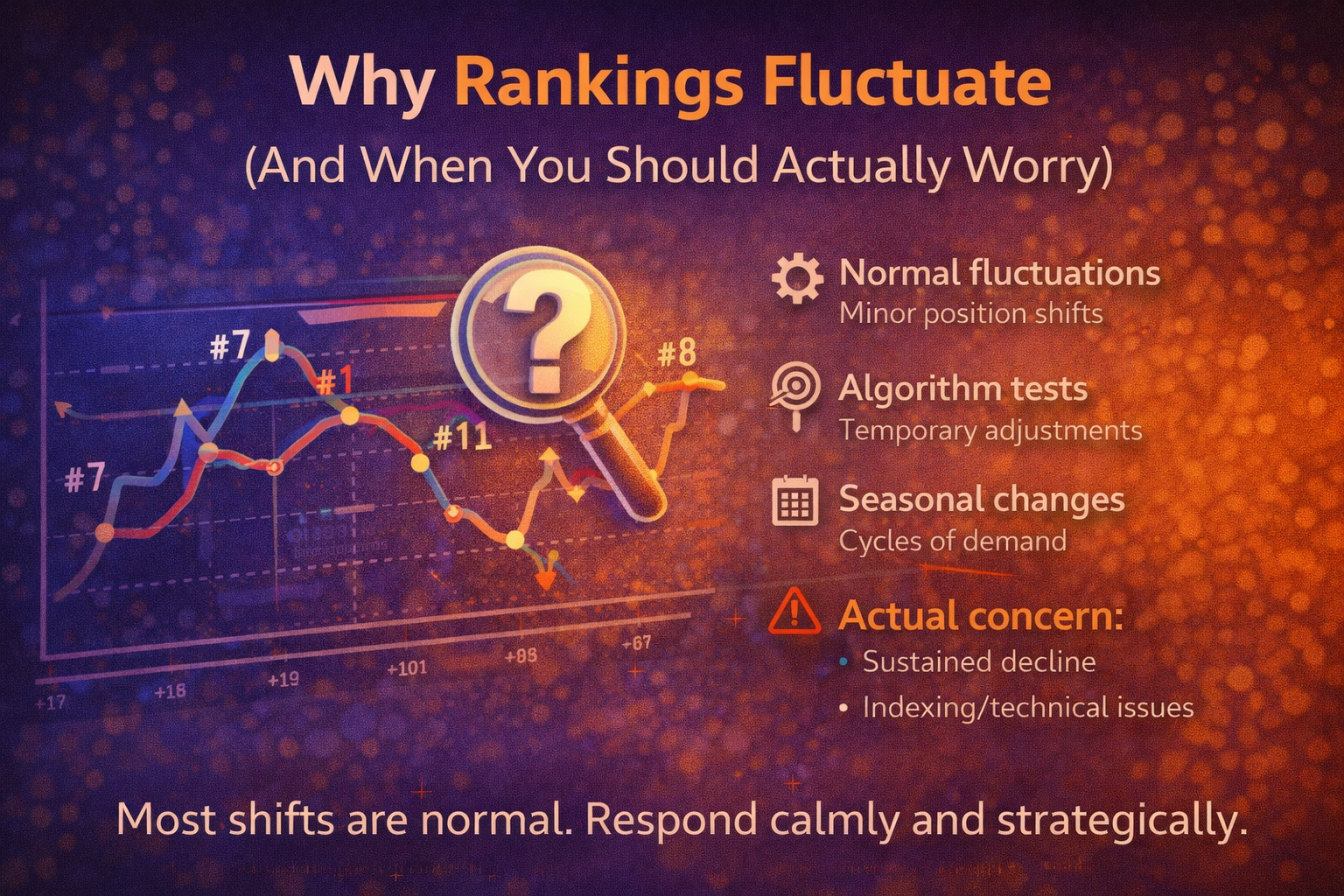
Few things create more anxiety than opening your analytics and seeing rankings drop.
Yesterday you were position 7.
Today you’re 11.
Next week you’re back to 8.
It feels unstable. It feels unpredictable. It feels like something is wrong.
Most of the time, it isn’t.
Ranking fluctuation is normal.
Understanding the difference between healthy movement and real danger is what separates reactive SEO from strategic SEO.
Ranking Movement Is Built Into The System
Search engines don’t operate like static leaderboards.
They:
- Re-evaluate content constantly
- Test user engagement
- Rebalance competitive queries
- Adjust intent interpretations
- Update algorithm weighting
This means movement is not a sign of failure.
It’s a sign of a dynamic system.
1️⃣ Natural Ranking Oscillation
Small shifts — especially within positions 3–15 — are completely normal.
Common causes include:
- Minor competitor changes
- User behaviour signals fluctuating
- Query mix variation
- Localisation differences
- Personalisation
A page ranking position 6 today and 9 tomorrow has not “lost authority”.
It’s within normal oscillation.
What Normal Looks Like
- Movement within a 2–4 position range
- Fluctuation without sustained downward trend
- Stable impressions despite small ranking shifts
- No major technical changes on your site
If performance stabilises over 2–3 weeks, it’s normal variance.
Not every dip requires intervention.
2️⃣ Algorithm Recalibration Phases
Google frequently updates and fine-tunes ranking systems.
Sometimes updates are confirmed.
Often they are not.
During recalibration phases, you may see:
- Temporary volatility across many keywords
- Industry-wide movement
- Forums discussing “ranking chaos”
- Movement that reverses within days
These are often evaluation periods.
Search engines test new weightings, measure engagement responses, and adjust accordingly.
If your site returns to its normal range within a few weeks, it wasn’t a penalty.
It was recalibration.
3️⃣ Testing Periods for New Content
New pages rarely rank steadily immediately.
Search engines often:
- Place new content higher temporarily
- Monitor user interaction
- Measure click behaviour
- Compare against established pages
- Adjust accordingly
This is sometimes called a “ranking honeymoon”.
You may see:
- Early visibility
- A drop
- Gradual re-climb
That pattern is normal testing behaviour.
Panic-editing during this phase often does more harm than good.
New content needs stability before strategic revision.
4️⃣ Seasonal Shifts vs Structural Decline
Not all traffic changes are technical.
Seasonality plays a larger role than many realise.
Examples:
- E-commerce spikes before holidays
- Travel queries peaking in spring
- Fitness queries rising in January
- Academic topics fluctuating by term
If impressions decline seasonally but rankings remain stable, the issue is demand — not structure.
Structural decline looks different.
It shows:
- Falling rankings across many pages
- Reduced impressions site-wide
- Decline across both seasonal and evergreen content
- Increasing crawl or indexing errors
Context matters more than the raw number.
When You Should Actually Worry
Not every fluctuation is harmless.
Here are the signals that require investigation.
1️⃣ Sustained Decline Over 4–6 Weeks
If rankings:
- Drop steadily
- Do not recover
- Affect multiple important pages
That suggests structural change, not variance.
Investigate:
- Recent site updates
- Internal linking changes
- Canonical adjustments
- Robots directives
- Rendering issues
This is where a structured seo audit becomes valuable.
2️⃣ Sudden Large Drops Across Multiple Keywords
If you experience:
- 10+ position drops overnight
- Traffic falling sharply
- Pages disappearing from index
Check for:
- Accidental noindex tags
- Robots.txt misconfigurations
- Canonical errors
- Server downtime
- Security issues
These are technical problems, not algorithm tests.
They require immediate attention.
3️⃣ Indexing Status Changes
If pages move from:
- Indexed → Discovered, not indexed
- Indexed → Crawled, not indexed
This suggests quality or duplication concerns.
Not necessarily a penalty — but a confidence issue.
Review:
- Content uniqueness
- Canonical clarity
- Internal linking strength
- Page usefulness
4️⃣ Decline Is Query-Specific
If only one topic cluster drops while others remain stable, the issue may be:
- Intent shift
- Competitive improvement
- Content aging
- SERP feature expansion
This requires strategic revision, not technical panic.
How To Respond Calmly and Strategically
Instead of reacting emotionally, follow this process:
Step 1: Look At Trend Duration
Is this 48 hours or 6 weeks?
Step 2: Check Impressions
Are impressions stable while position shifts slightly? That’s normal oscillation.
Step 3: Compare Site-Wide vs Page-Specific
Broad drop = structural.
Isolated drop = competitive or intent shift.
Step 4: Review Technical Health
Run a structured website seo checker to confirm:
- No indexation errors
- No canonical conflicts
- No crawl blocks
- No rendering failures
Clarity replaces fear.
Why Panic Edits Often Make Things Worse
One of the biggest ranking mistakes is reactive editing.
When site owners:
- Rewrite content aggressively
- Change URLs unnecessarily
- Modify internal linking randomly
- Over-optimise titles
…during temporary fluctuation, they introduce new instability.
Stability builds trust.
Erratic changes weaken it.
The Real Long-Term Signal
Search engines reward:
- Consistency
- Stability
- Clear structure
- Incremental improvement
Not constant reinvention.
Most volatility is part of the evaluation process.
Your job is to:
- Monitor patterns
- Improve strategically
- Avoid emotional overreaction
Final Perspective
Rankings are not static achievements.
They are ongoing evaluations.
Movement within a healthy range is normal.
Short-term drops during recalibration are expected.
Testing phases for new content are built into the system.
You should only worry when:
- Decline is sustained
- Technical signals change
- Indexing status shifts
- Structural errors appear
Everything else is part of the process.
Confidence comes from understanding the system.
And when you understand the system, you stop reacting to noise — and start responding to real signals.
Share this content:




Post Comment