Off Page SEO
Strategy
backlink relevance vs authority, backlinks and keyword cannibalisation, backlinks not helping page rank, homepage links vs deep links SEO, internal linking and backlinks SEO, link equity not passing to target page, why backlinks are not boosting my rankings, why backlinks are not helping my page rank, why backlinks are not helping my target page, why backlinks are not helping my website, why backlinks are not helping service page rank, why backlinks are not improving rankings, why backlinks are not improving SEO, why backlinks are not increasing organic traffic, why backlinks don’t help the page you expect, why backlinks help the wrong page, why my backlinks are not moving my rankings, why my backlinks are not working, why my target page is not ranking after backlinks, why the wrong page ranks after backlinks
SEO Checker
0 Comments
Why Your Backlinks Aren’t Helping the Page You Thought They Would
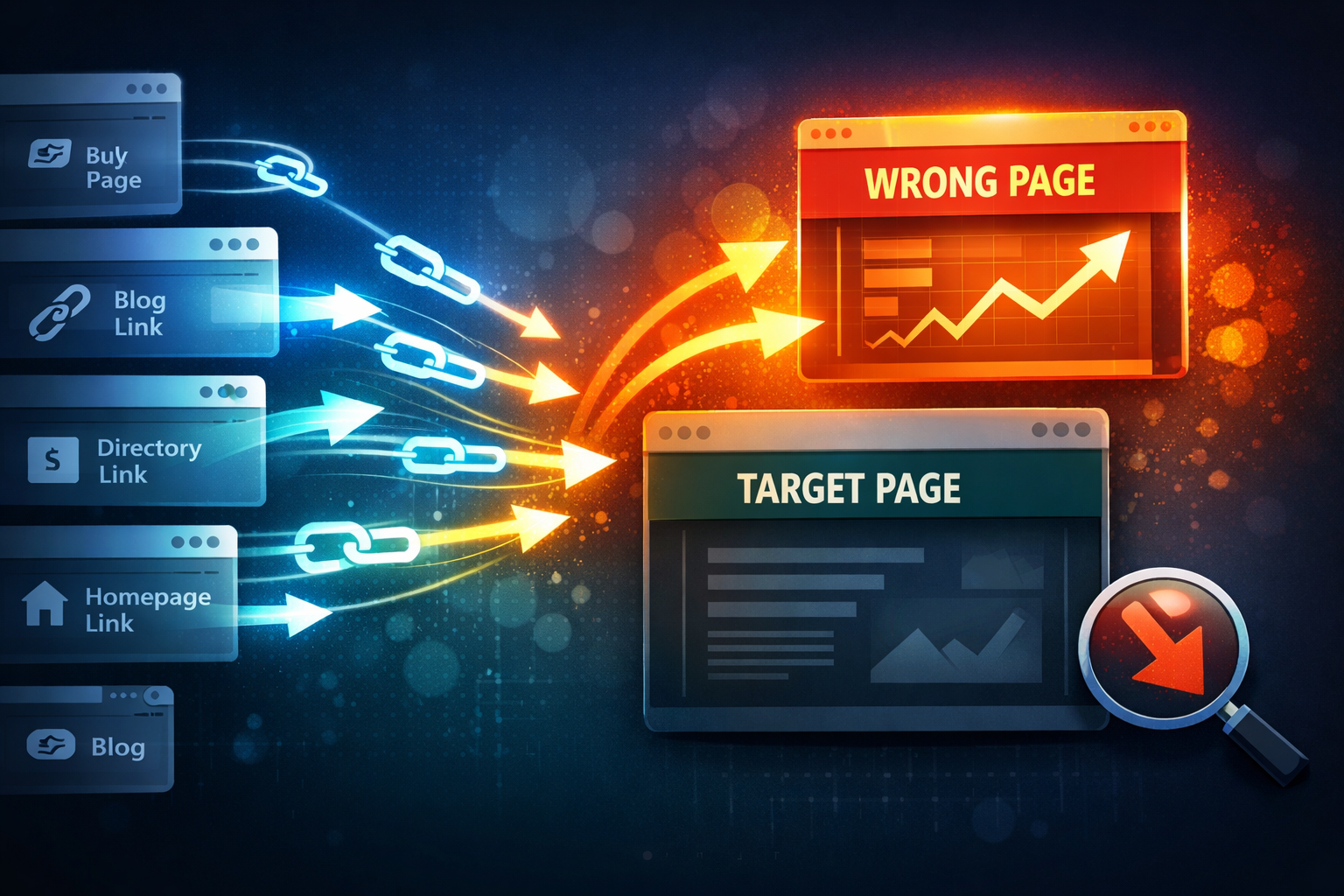
Backlinks are one of the most talked-about parts of SEO.
And for good reason.
They still matter.
A lot.
If other websites link to yours, Google can take that as a sign that:
- your site is being referenced
- your content is worth citing
- your business is being mentioned
- your pages may deserve more trust, authority, and visibility
So naturally, a lot of website owners and marketers do what they believe is the right thing.
They:
- build links
- buy links
- get directory links
- land guest post links
- get homepage links
- earn mentions from blogs
- pay for niche edits
- secure citations
- add links to resources and listings
Then they sit back and wait for a specific page to move.
Usually a page like:
- a service page
- a product page
- a category page
- a location page
- a landing page
- a money page they really care about
And then… nothing.
Or at least, not what they expected.
The page they wanted to rank doesn’t move much.
Or it moves only slightly.
Or another page moves instead.
Or the homepage seems to benefit more.
Or rankings go up for random keywords, but not the ones they were targeting.
That’s when people start asking the question:
“Why didn’t my backlinks help the page I actually wanted to rank?”
This is one of the most misunderstood parts of SEO.
Because while backlinks absolutely matter…
they do not always strengthen the exact page you expected, in the exact way you expected, at the exact speed you expected.
And if you don’t understand why, it’s very easy to waste money, waste time, and misread what your SEO is actually doing.
In this post, we’ll break down why this happens, what usually causes it, and how to make your backlinks work more intentionally for the pages that matter most.
The Biggest Misconception About Backlinks
A lot of people think link building works like this:
- get a backlink
- point it at the target page
- page goes up
Or:
- get a few homepage links
- Google trusts the site more
- target service page jumps
Sometimes it does work that cleanly.
But very often, it doesn’t.
That’s because backlinks don’t work in a vacuum.
Google doesn’t just see:
“This page got a link, so boost it.”
Instead, it tries to understand:
- what page got the link
- how relevant that link is
- how strong the linking page is
- what context the link sits in
- whether the target page is actually strong enough
- how the rest of the site supports that page
- whether another page is more relevant for the query
- whether the link helps discovery, trust, or actual ranking power
- how authority flows through the site internally
That means the relationship between backlinks and rankings is often less direct than people assume.
Homepage Links vs Deep Page Links: They Don’t Behave the Same
This is one of the most common reasons expectations don’t match results.
Homepage links
If you build links to your homepage, those links can absolutely help the site overall.
They can improve:
- domain-level trust signals
- crawl discovery
- homepage authority
- overall site strength (to a degree)
- how much authority can be passed internally
But here’s the key:
Homepage links do not automatically send maximum value to the exact service or landing page you care about.
That only happens well if your internal linking and site structure are strong enough to route that value intentionally.
If your homepage links to:
- 20 service pages
- 40 blog posts
- 15 categories
- lots of footer links
- random navigation layers
…the authority gets distributed.
Sometimes thinly.
So yes, homepage links can help.
But if your site structure is messy, the page you wanted to benefit may only get a diluted share of that value.
Deep page links
Links pointing directly to:
- service pages
- landing pages
- category pages
- product pages
- key resources
…are often more targeted.
They can send clearer signals because the link lands closer to the page you actually want to strengthen.
But even then, it still depends on:
- the quality of that page
- its relevance
- internal support
- whether Google sees it as the right page to rank
That’s why deep links can be powerful — but they’re not magic either.
Internal Linking Decides Where a Lot of Link Value Actually Ends Up
This is a huge one.
A backlink might point at one page…
…but where the benefit goes next is heavily influenced by internal linking.
If the linked page is well integrated into the site, some of that authority can flow through to:
- related service pages
- category pages
- parent pages
- supporting content
- commercial pages
But if the linked page is:
- isolated
- poorly linked
- buried
- orphaned
- not connected to the target page
- part of a weak structure
…then a lot of that value gets trapped or wasted.
Example
Let’s say you build 5 good links to a blog post.
You expect your service page to improve.
But the blog post:
- doesn’t link clearly to the service page
- only mentions it vaguely
- sits in a weak category
- isn’t part of a proper topic cluster
- has no related content structure
In that case, the blog post might gain some value…
…but the service page may barely feel it.
This is one of the biggest reasons people say:
“I built links, but the wrong page moved.”
Link Relevance Often Matters More Than Raw Authority
Another common mistake is overvaluing “strong” links that aren’t especially relevant.
People often chase:
- high DA/DR sites
- generic guest posts
- broad directories
- powerful-looking domains
- homepage links on sites with metrics
And then assume those links must help.
But Google cares about more than raw strength.
It also cares about:
- topical relevance
- contextual relevance
- editorial fit
- how naturally the link makes sense
- whether the linking page actually relates to the target page’s topic
Example
A generic high-authority blog linking to your page from a vague paragraph may be less useful than:
- a niche-relevant article
- a local industry resource
- a relevant supplier/partner mention
- a contextual citation inside a highly relevant article
So if your backlinks look “strong on paper” but weak in topic alignment, the page impact may be far smaller than expected.
Link Placement and Context Matter More Than People Think
Not all links on a page are equal.
A link buried in:
- a random author bio
- a generic directory listing
- a cluttered sidebar
- a sitewide footer
- a weak “resources” dump
- a sponsored section with little context
…doesn’t always carry the same weight as a link that appears:
- inside the main content
- in a relevant paragraph
- naturally surrounded by related context
- as part of a useful recommendation
- in a page that itself has value and relevance
This is why some people build “lots of links” but see weak results.
Because the links exist…
…but they’re not especially persuasive signals.
Sometimes the Wrong Page Benefits Instead
This is one of the most frustrating outcomes.
You build links expecting one page to improve…
…but another page starts moving instead.
Why?
Because Google may decide another page is the better fit.
That can happen when:
- the homepage has stronger authority
- another blog post is better aligned to the query
- a category page has more internal support
- a related page has stronger content depth
- the target page is too thin
- internal links point more strongly to another URL
- Google is confused about page intent
This is why backlink outcomes can feel messy.
You may be trying to push Page A…
…but Google may keep rewarding Page B because it sees it as the better destination.
Weak Target Pages Can’t Always Absorb Link Value Properly
This is a brutally important point.
A lot of people assume:
“If I build enough links, the page will rank.”
But if the page itself is weak, backlinks often won’t save it.
A weak target page might be:
- too thin
- poorly structured
- vague in intent
- badly optimised
- not satisfying the searcher
- lacking trust signals
- too generic
- missing supporting content
- not clearly better than competitors
If the page doesn’t deserve to rank well on its own merits, links may help a little…
…but not nearly as much as expected.
This is why link building often feels disappointing when the real issue is:
the target page isn’t strong enough to convert authority into rankings.
If the Target Page Isn’t Internally Supported, It Often Underperforms
This connects to structure again.
A target page should not be left to stand alone.
If you want a page to benefit from backlinks, it often needs support from:
- related blog posts
- service hubs
- category pages
- FAQs
- comparison content
- internal anchor text
- nearby supporting pages
- contextual mentions across the site
If the page is isolated, Google may not see it as the clear centre of authority for that topic.
That makes it harder for backlinks to have the impact you wanted.
Keyword Cannibalisation Can Quietly Absorb the Benefit
This is a sneaky one.
You might build links to a page expecting it to rank for a keyword…
…but the site has multiple pages that overlap.
Examples:
- two similar service pages
- a service page and a blog post targeting the same intent
- several local pages with similar content
- FAQs or guides that partially compete
- old pages still indexed that muddy the signals
In those cases, backlinks can still help the site…
…but the benefit gets spread, confused, or redirected toward another URL.
That’s why sometimes:
- rankings jump around
- different pages appear for the same keyword
- the “wrong” page ranks
- the target page never becomes stable
If multiple pages compete, your backlinks may be helping the topic…
…but not the exact page you wanted.
Some Backlinks Help Discovery or Crawling More Than Rankings
Not every backlink is a ranking weapon.
Some backlinks are more useful for:
- discovery
- crawling
- indexing
- initial trust
- getting Google to notice pages
- reinforcing that the site exists and is being referenced
That still has value.
But it’s not the same as:
- directly moving a page up for a competitive keyword
Examples of links that may help more with discovery than rankings
- directory listings
- low-context citations
- profile links
- local business listings
- certain basic mentions
- weaker nofollow-ish ecosystem links
- generic low-impact references
These can still be useful in a broader profile.
But if you expect them to move a competitive service page by themselves, you may be disappointed.
Links to Pages Google Doesn’t Value Much Can Underperform
Sometimes the problem is not the link.
It’s the destination.
If you point links at pages Google already sees as low-value, the impact may be weak.
Examples:
- thin location pages
- weak tag/category pages
- near-duplicate service pages
- low-effort landing pages
- outdated posts
- pages with poor UX or weak mobile experience
- pages that don’t satisfy intent
In simple terms:
A backlink can’t fully rescue a page Google doesn’t really want to rank.
That doesn’t mean links are useless.
It means the page itself has to be worth backing.
How to Route Link Authority More Intentionally
This is the part that matters most.
If you want backlinks to help the right pages, you need to be more intentional about where authority flows.
1) Decide Which Page Is Meant to Rank for What
Before building links, get clear on:
- which URL is the main target
- what search intent it is designed for
- whether any other pages overlap
- whether Google is already favouring a different page
If you don’t know which page should be the clear winner, backlinks can amplify confusion.
2) Strengthen the Target Page Before Building Links
Make sure the page is actually good enough.
Improve:
- depth
- clarity
- headings
- search intent match
- trust signals
- FAQs
- supporting content
- proof/testimonials
- internal links
- conversion structure
If the page is weak, fix that first.
3) Support the Target Page with Internal Links
This is huge.
Use:
- contextual links from relevant blog posts
- service hub links
- category support
- related content modules
- FAQ references
- comparison content links
Make it obvious that this page is:
- important
- central
- relevant
- supported
That way, when links arrive, Google sees a clearer destination for the benefit.
4) Use Deep Links Strategically, Not Just Homepage Links
Homepage links can help overall site strength.
But if you want a specific page to move, you often need a smarter mix of:
- homepage links
- deep page links
- contextual internal routing
- supporting links to adjacent content
Don’t assume all roads naturally lead to your money page.
Sometimes you need to build that path.
5) Prioritise Relevant Links Over Vanity Metrics
A smaller, highly relevant link can outperform a “big” generic one.
Ask:
- Is this page topically aligned?
- Does the link make sense in context?
- Would a human see it as a natural recommendation?
- Is the linking page itself useful?
- Does the content around the link reinforce the topic?
That mindset often produces better outcomes than chasing DR alone.
6) Watch for Cannibalisation Before and After Link Building
If the wrong page is ranking, don’t just keep building more links blindly.
Check whether:
- multiple pages overlap
- internal anchors are inconsistent
- titles/headings muddy intent
- old pages are competing
- category pages are intercepting relevance
- blog posts are outranking service pages
Sometimes the fix is not “more links”.
Sometimes the fix is:
- consolidate
- reposition
- improve hierarchy
- change internal linking
- clarify intent
7) Think in Terms of Page Systems, Not Just Single Pages
This is one of the smartest SEO mindsets.
Your target page should usually sit inside a system.
That system might include:
- the main target page
- supporting blog content
- FAQs
- related guides
- comparison pages
- local support pages
- service hubs
- trust elements
When links point into a strong system, the results are often much better than when they point at a lonely page with no real support.
A Better Way to Think About Backlinks
Instead of thinking:
“This link should make this page rank.”
Think:
“This link adds authority, trust, discovery, and signals into a wider page system — and I need to make sure that system routes value clearly to the right place.”
That’s a much smarter way to think about link building.
Because backlinks are not just about raw power.
They’re about:
- where the power lands
- how the site distributes it
- whether the target page deserves it
- whether Google agrees with your page choice
- whether the site structure supports the outcome
Why This Matters If You’re Paying for Links
This is especially important if you’re:
- buying backlinks
- paying an SEO agency
- ordering guest posts
- using link insertion services
- investing in digital PR
- building citations at scale
Because if you don’t understand this, it’s easy to:
- waste budget
- blame the wrong thing
- keep buying more links when the page is the issue
- strengthen the wrong page
- ignore internal linking
- overlook cannibalisation
- misread what’s actually happening
Sometimes the problem is not that link building “doesn’t work”.
It’s that the link equity is not being captured, supported, or routed properly.
That’s a very different issue.
If Your Backlinks Aren’t Moving the Right Page, Don’t Assume the Links Failed
That’s really the big takeaway.
If your backlinks aren’t helping the page you thought they would, it doesn’t automatically mean:
- the links were useless
- link building is pointless
- Google ignored them
- SEO is broken
It often means one of these things instead:
- the link landed on the wrong page
- the value got diluted through poor structure
- the target page is too weak
- another page is absorbing the benefit
- the links aren’t relevant enough
- the context is weak
- the page isn’t properly supported internally
- cannibalisation is muddying the signals
- the links helped discovery more than rankings
- Google doesn’t think that URL is the best result yet
That’s a much more useful diagnosis.
Build Links Smarter, Not Just Harder
Backlinks still matter.
A lot.
But if you want them to help the pages that actually matter to your business, you need to think beyond:
- raw volume
- DR metrics
- homepage links
- “just get more links”
The smarter approach is:
- choose the right target page
- make that page strong enough
- support it internally
- reduce overlap
- use relevant links
- understand where authority flows
- build around page systems, not isolated URLs
That’s how you stop asking:
“Why didn’t my target page move?”
…and start building links in a way that gives the right page a much better chance to win.
Share this content:

Post Comment