SEO Fundamentals
Strategy
professional website but no traffic, small business website content depth, small business website ranking issues, small business website seo, trust signals for seo, website feels too small for seo, website structure for small business seo, why small business websites do not rank
SEO Checker
0 Comments
Why Your Website Feels “Too Small” to Rank (Even If It Looks Professional)
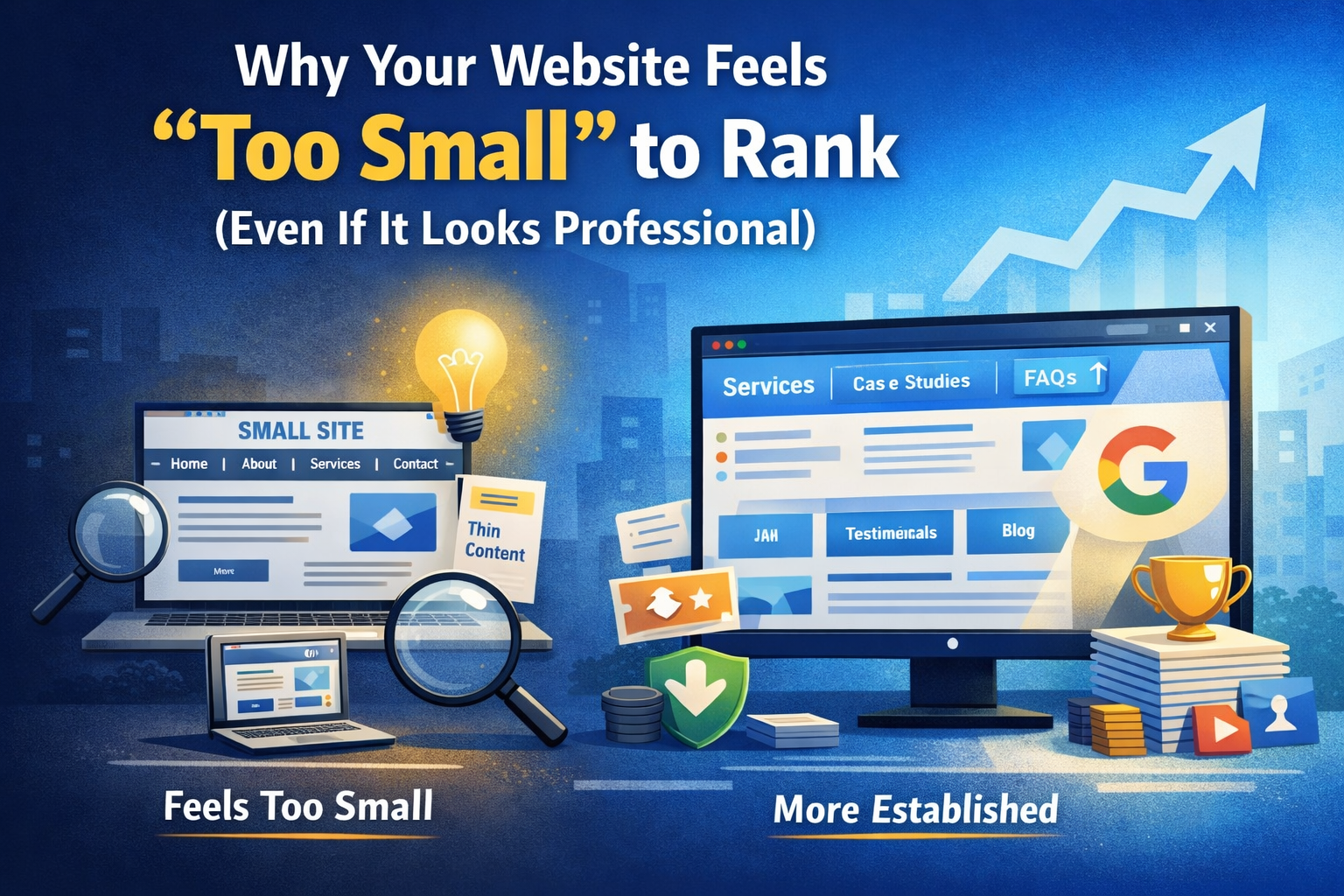
A lot of small business websites look perfectly fine on the surface.
They load properly.
They have a modern design.
They show the services.
They include a contact form.
They might even have a few testimonials and a polished homepage.
And yet… SEO still feels harder than it should.
The rankings do not move much.
The traffic feels limited.
The site might rank for the business name, but broader visibility never really seems to build.
It looks professional, but somehow it still feels like Google does not fully take it seriously.
If that sounds familiar, you are not imagining it.
This is a very real issue — and it is one that a lot of business owners struggle to explain.
The website does not necessarily look “bad”.
It just feels… too small.
Not visually small.
Not cheap-looking.
Not obviously broken.
But structurally, strategically, and in SEO terms, it can feel like a website that has not yet grown into something broad enough, deep enough, or complete enough to deserve stronger search visibility.
This is what I often think of as small site syndrome.
And it is one of the most overlooked reasons small business websites struggle to rank beyond the basics.
What does “too small” actually mean in SEO terms?
When I say a website feels “too small”, I do not mean the business is small.
And I do not mean every website needs to be huge.
In SEO terms, “too small” usually means the website lacks enough structural depth, supporting content, and trust architecture to feel like a complete, established presence around the services it wants to rank for.
That might show up as:
- only a handful of pages
- very short service pages
- no real supporting pages
- little evidence of expertise
- weak internal linking
- minimal trust signals
- no content depth around the main services
- no FAQs, case studies, or proof-based pages
- no strong reason for Google to see it as more than a basic brochure
This is why a site can look professional and still underperform.
Because SEO is not just about whether a website looks polished.
It is also about whether the site feels:
- complete
- useful
- trustworthy
- well structured
- intentionally built around search intent
- broad enough to support the visibility it wants
That is a different thing entirely.
Nice design is not the same as SEO depth
This is where a lot of small business websites quietly struggle.
A site can be:
- beautifully designed
- mobile-friendly
- modern
- clean
- visually impressive
…but still feel weak in search.
That is because design and SEO depth are not the same thing.
A clean website might make a great first impression.
But Google is not just asking:
- “Does this site look nice?”
It is effectively trying to work out:
- “Does this site look like the best result for this search?”
- “Does this business appear established enough around this topic?”
- “Does this site have the depth and structure to support broader relevance?”
- “Is there enough here to trust this as more than a basic online brochure?”
A site can pass the design test and still fail the depth test.
And when that happens, the site often feels smaller than the business actually is.
The classic signs of a “small-feeling” website
There are certain patterns that show up again and again when a website feels too small to rank well.
1) It only has 4–5 pages
This is one of the biggest clues.
A lot of small business sites are built with something like:
- Home
- About
- Services
- Contact
- Maybe a gallery or testimonials page
That is enough to be “online”.
But it is often not enough to build meaningful SEO momentum, especially if the business wants to rank for:
- multiple services
- multiple service variations
- multiple locations
- broader informational or trust-related searches
A small number of pages is not always bad.
But when the site is trying to grow through Google, this often means there simply is not enough structure to support that ambition.
2) The service pages are thin
Sometimes the website technically has service pages, but they are very light.
They might include:
- a headline
- a short paragraph
- one image
- a generic call to action
That is not always enough.
A thin service page often feels like:
- it exists
- but it is not the best answer
- it is live
- but it is not built to compete
- it mentions the service
- but it does not really own the topic
This is one of the most common reasons a site feels smaller than it should.
The business may offer strong services in real life.
But the website does not give those services enough space or substance.
3) There are no FAQs
FAQs are often underrated.
A lot of businesses skip them because they seem optional.
But a good FAQ section can do a lot of quiet work.
It can:
- answer real customer concerns
- add natural supporting content
- reinforce topical relevance
- improve trust
- cover objections
- help pages feel more complete
When a site has no FAQs anywhere, it can often feel thinner than it needs to.
Not because FAQs are magic on their own, but because they are part of what makes a page feel genuinely useful.
4) There are no case studies or examples of real work
A professional-looking site with no proof can still feel weak.
This is especially true in competitive service industries.
If there are no:
- case studies
- examples
- project highlights
- before and afters
- results
- testimonials with context
- real evidence of work
…then the site may feel polished, but not particularly established.
From an SEO perspective, proof-based pages can help strengthen:
- trust
- perceived authority
- site completeness
- supporting internal links
- conversion confidence
Without them, a site can feel like it is missing depth.
5) There are no supporting trust pages
A lot of small sites only have the basics.
But stronger sites often include pages that quietly make them feel more established, such as:
- About
- Why Choose Us
- Process / How It Works
- FAQs
- Reviews / Testimonials
- Case Studies
- Areas We Cover
- Industries We Work With
- Guarantees / Accreditations
- Meet the Team
Not every site needs every one of these.
But when none of them exist, the site often feels more like a placeholder than a serious long-term business presence.
That matters.
Because search visibility often grows more easily when the website feels like a complete business, not just a minimal digital flyer.
6) There is very little content depth
This is another huge one.
A website might:
- mention its services
- mention its locations
- mention its expertise
…but only very briefly.
That creates a common SEO problem:
The site says just enough to exist, but not enough to truly compete.
Depth does not mean writing endless fluff.
It means giving important topics enough room to feel real.
For example:
- explaining what the service actually includes
- answering common questions
- covering who it is for
- outlining process or outcomes
- addressing concerns
- linking to related services
- showing proof or examples
When everything is reduced to short sections and quick summaries, the site often feels smaller than the business behind it.
Why some small websites still rank well
This is important, because not every small website struggles.
Some genuinely small websites perform very well.
Why?
Usually because they are focused, not because they are large.
A smaller website can still rank strongly when:
- it targets one tightly defined service
- it has a clear local focus
- it has strong relevance for a narrow niche
- the intent match is very clear
- the competition is lower
- the pages it does have are genuinely useful and complete
In other words:
A small website can work if it is small on purpose.
That is very different from a website that is small because it is underdeveloped.
That distinction matters a lot.
A focused site says:
- “We do this one thing really well.”
A weak small site often says:
- “We do a lot… but we have not really built the structure to support it.”
That is where the rankings often start to struggle.
Why many small business websites look fine but still feel weak
This is the heart of the issue.
A lot of small business sites are not failing because they are ugly.
They are failing because they do not yet feel like a strong enough entity around the things they want to rank for.
That weakness often comes from a combination of:
- limited service depth
- weak page structure
- too few supporting pages
- minimal internal linking
- not enough trust reinforcement
- too little topical breadth
- a lack of “proof” pages
- broad ambitions sitting on a very small site footprint
This is why a business owner can look at the site and think:
- it looks professional
- it has the basics
- it should be enough
…and still be disappointed.
Because “looks fine” and “feels strong enough to rank broadly” are not the same thing.
What makes a website feel more established to Google?
This is the more useful way to think about it.
Instead of asking:
- “How do I make my site bigger?”
A better question is:
- “How do I make my site feel more established, complete, and trustworthy around the services I want to rank for?”
That usually comes from a mix of:
- clearer service coverage
- better page depth
- supporting trust pages
- stronger internal linking
- evidence of real work
- clearer location relevance where needed
- more useful content around real user questions
- a structure that feels intentional rather than minimal
This is not about bloating the site.
It is about making it feel like the website actually reflects the seriousness of the business.
How to make a website feel bigger without overbuilding it
This is where many businesses panic and assume they need:
- 100 blog posts
- dozens of pages
- a huge redesign
- a complete rebuild
- loads of unnecessary content
Usually, that is not the right move.
The goal is not to make the site “big”.
The goal is to make it feel complete.
Here is how to do that sensibly.
1) Strengthen your core service pages first
If you offer multiple services, each core service should usually have its own page.
And each page should feel like:
- a serious service page
- not a placeholder
- not a quick summary
- not just a design section
That means including:
- clear service explanation
- who it is for
- what problems it solves
- process or approach
- trust signals
- FAQs
- relevant internal links
- strong calls to action
This is often the biggest win.
2) Add a few high-value trust pages
You do not need loads.
But adding a few strong supporting pages can make a site feel much more established.
Examples:
- About
- Why Choose Us
- FAQs
- Reviews / Testimonials
- Case Studies
- Areas We Cover
- Industries We Work With
Even just a few of these can help the site feel broader, more credible, and better supported.
3) Make your service coverage clearer
A lot of small sites mention services too broadly.
Instead of one vague “Services” page, think about:
- individual service pages
- service categories if needed
- stronger internal links between related services
That creates clearer intent and a more mature structure.
4) Add proof, not fluff
Do not just add content for the sake of it.
Add the kind of content that actually strengthens the site.
Good examples:
- real FAQs
- genuine case studies
- service comparisons
- common mistakes clients make
- process pages
- examples of results
- accreditation or trust sections
- before/after examples where relevant
This kind of content makes the site feel more established without turning it into a bloated mess.
5) Improve internal linking
Internal linking is one of the simplest ways to make a site feel more structured and more intentional.
A strong small business site should have clear pathways between:
- homepage
- service pages
- trust pages
- location pages
- blog or supporting resources if you have them
That helps users.
And it helps search engines understand what matters most.
6) Match your site size to your SEO ambition
This is a big mindset shift.
If you want to rank for:
- one service in one area
…you may not need a huge site.
But if you want to rank for:
- multiple services
- multiple service variations
- multiple areas
- broader informational searches
- trust and comparison searches
…then your site probably needs more depth than a minimal brochure build.
Your structure should match your ambition.
That is where a lot of businesses quietly get stuck.
The goal is not a “bigger” site — it is a stronger one
This is the key point.
A lot of people hear this kind of advice and assume the answer is:
- more pages
- more content
- more words
- more everything
Not necessarily.
A stronger site is not always a bigger site.
A stronger site is a site where:
- the important services have proper depth
- the structure makes sense
- trust is reinforced properly
- the business feels established
- the supporting pages are useful
- the site looks like it deserves broader visibility
That is very different from just adding more for the sake of it.
Final thought
If your website looks professional but still feels like it never quite breaks through in Google, the issue may not be the design.
It may be that the site feels too small in SEO terms.
Not because it needs to be huge.
But because it has not yet built enough:
- depth
- structure
- trust
- coverage
- supporting content
- page purpose
A lot of small business websites are not held back by bad design.
They are held back by the fact that they look finished on the surface, while still being underdeveloped underneath.
That is the difference between:
- a site that looks good
and - a site that feels strong enough to rank
And once you understand that, the next steps become much clearer.
Share this content:


Post Comment