Technical SEO
80/20 rule SEO, beginner SEO strategy, content depth SEO, how to improve rankings fast, internal linking SEO, most important SEO factors, page speed SEO basics, quick SEO wins, search intent optimisation, SEO audit priorities, SEO authority signals, seo checker, SEO growth strategy, SEO optimisation priorities, SEO priority checklist, SEO ranking improvements, Site Academy, technical SEO basics, website crawlability SEO, website ranking factors
SEO Checker
0 Comments
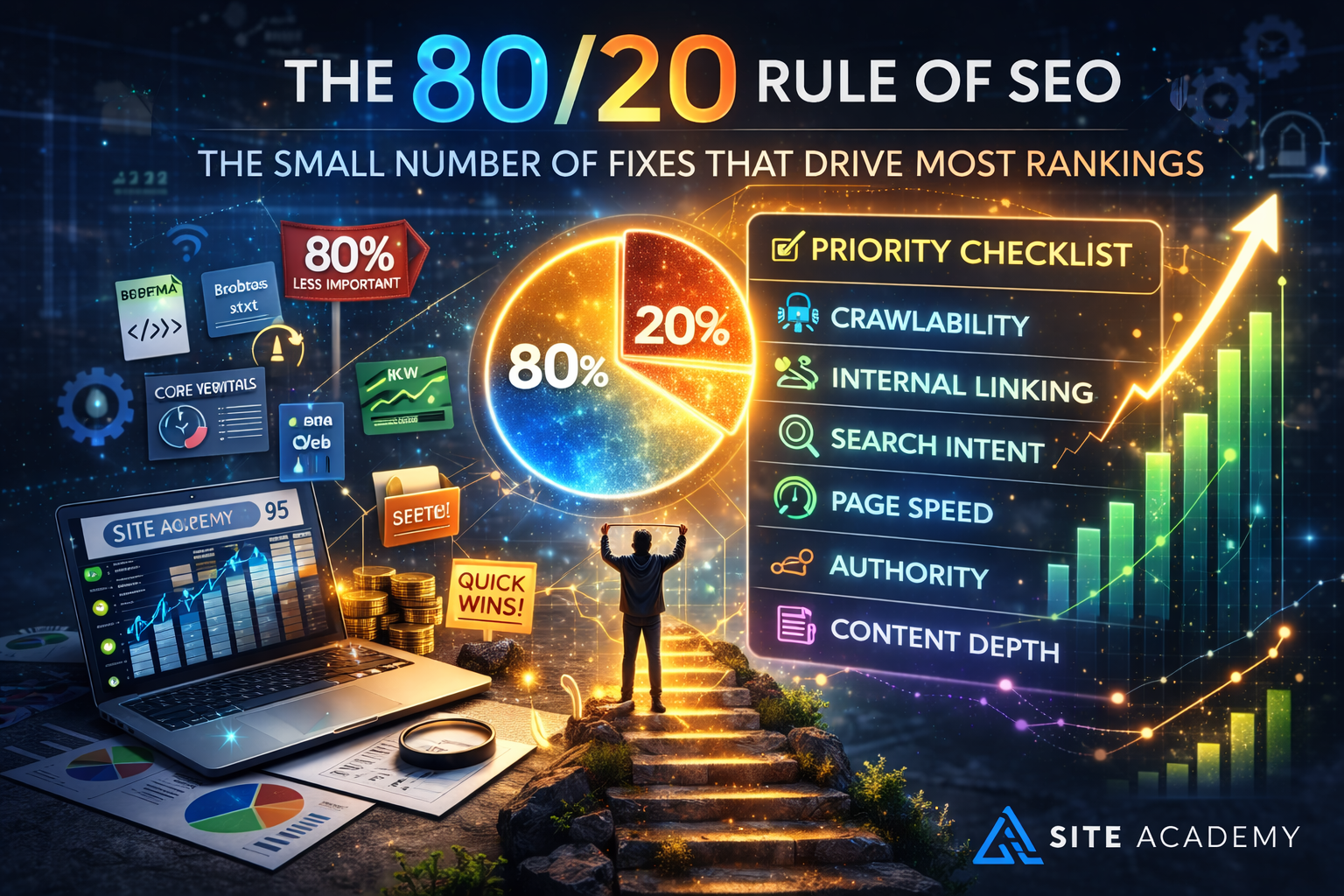
The 80/20 Rule of SEO: The Small Number of Fixes That Drive Most Rankings
SEO often feels overwhelming.
You read checklists containing hundreds of ranking factors:
- schema markup
- meta tags
- Core Web Vitals
- backlinks
- content optimisation
- technical audits
- page experience metrics
Very quickly, website owners reach the same conclusion:
“There’s too much to fix.”
This is where many sites stall — not because SEO is difficult, but because effort is spread across too many low-impact tasks.
The reality is far simpler.
In SEO, just like business and productivity, the 80/20 rule applies.
A small number of improvements drive the majority of ranking results.
Understanding which fixes actually matter allows you to grow faster while avoiding months of unnecessary optimisation work.
What the 80/20 Rule Means in SEO
The 80/20 principle suggests:
Around 80% of results come from roughly 20% of actions.
In SEO terms, this means:
- Most ranking gains come from a handful of core improvements.
- Many commonly discussed SEO tasks have minimal early impact.
- Prioritisation matters more than perfection.
Successful websites rarely optimise everything immediately.
They focus first on the factors that unlock visibility.
Why Beginners Struggle With SEO Progress
New site owners often make one of two mistakes:
Trying to Fix Everything
They chase every recommendation simultaneously, leading to slow progress and confusion.
Fixing the Wrong Things
They spend hours adjusting minor settings while ignoring structural issues preventing rankings entirely.
SEO success comes from solving blocking problems first.
Below are the highest-impact areas responsible for most ranking improvements.
1. Crawlability: If Google Can’t Access It, Nothing Else Matters
Before rankings happen, search engines must properly access and understand your site.
Common crawlability issues include:
- broken internal links
- blocked pages in robots.txt
- missing sitemaps
- redirect chains
- orphaned pages
Even excellent content cannot rank if Google struggles to crawl it efficiently.
This is often the single biggest hidden issue on newer websites.
Running your site through the Site Academy SEO Checker quickly highlights crawlability problems that silently limit visibility.
Fixing these early frequently produces faster indexing and ranking improvements.
2. Internal Linking: The Most Underrated SEO Advantage
Internal linking is one of the highest-impact yet most ignored ranking factors.
Every internal link helps Google understand:
- page relationships
- topic hierarchy
- content importance
- authority distribution
Many websites publish articles that remain isolated.
Instead, strong sites create connected ecosystems.
For example:
- beginner guides linking to advanced tutorials
- strategy articles linking to technical explanations
- related topics reinforcing one another
This allows authority gained by one page to strengthen others automatically.
Internal linking improvements alone can significantly increase rankings without creating new content.
3. Search Intent Alignment: Ranking the Right Content
One of the biggest SEO mistakes is optimising content for keywords rather than intent.
Google ranks pages that best match what users actually want.
Consider the difference:
- informational searches want explanations
- comparison searches want evaluations
- transactional searches want solutions
If your content format doesn’t match intent, rankings struggle regardless of optimisation quality.
High-performing pages typically:
- answer questions clearly
- structure information logically
- solve problems directly
- minimise unnecessary friction
Intent alignment often delivers faster ranking gains than technical tweaks.
4. Page Speed Basics: Remove Friction, Not Chase Perfection
Page speed matters — but not in the way many believe.
You don’t need a perfect performance score.
You need a fast-enough experience.
High-impact improvements include:
- optimised images
- reliable hosting
- reduced unnecessary scripts
- browser caching
- compression enabled
Many site owners waste time chasing minor milliseconds instead of addressing larger SEO gaps.
Focus on removing obvious slowdowns rather than achieving theoretical perfection.
The Site Academy SEO Checker helps identify performance issues that genuinely affect usability and crawl efficiency.
5. Authority Signals: Trust Unlocks Rankings
Technical optimisation prepares your site.
Authority allows it to compete.
Google evaluates trust through signals such as:
- backlinks from relevant websites
- brand mentions
- citations
- consistent publishing history
Many websites plateau because authority signals lag behind optimisation work.
Once technical and content foundations are strong, authority becomes a major ranking driver.
Importantly, authority compounds over time.
Even small improvements can create long-term momentum.
6. Content Depth: Coverage Beats Quantity
Publishing more pages does not automatically improve SEO.
Google increasingly rewards complete topic coverage.
Instead of producing dozens of unrelated articles, successful websites build depth around core themes.
Strong topical content typically includes:
- foundational guides
- supporting articles
- practical tutorials
- problem-solving resources
Depth signals expertise.
Expertise builds trust.
Trust improves rankings.
A smaller number of well-connected, comprehensive pages often outperforms large volumes of thin content.
Why Fixing Everything Early Is a Mistake
Many SEO checklists contain 100+ recommendations.
Attempting to complete them all immediately leads to diminishing returns.
Early-stage SEO success usually follows this order:
- Ensure crawlability
- Improve internal linking
- Align content with intent
- Remove performance friction
- Build authority signals
- Expand topical depth
Once these foundations exist, smaller optimisations become meaningful.
Before that point, they rarely move rankings.
How to Identify High-Impact Fixes Quickly
The biggest challenge isn’t knowing what SEO factors exist.
It’s knowing which ones matter right now.
Using the Site Academy SEO Checker, website owners can:
- prioritise critical issues first
- identify ranking blockers
- avoid low-impact optimisation work
- track SEO health improvements over time
Instead of guessing where effort should go, you gain clarity on the fixes most likely to improve visibility.
The Fastest Path to SEO Progress
Improving rankings fast rarely means doing more work.
It means doing the right work.
Websites that grow consistently focus on:
- accessibility
- clarity
- relevance
- authority
- structured growth
SEO rewards prioritisation far more than perfection.
Most successful websites didn’t win because they optimised everything.
They won because they fixed the few things that mattered most — early, consistently, and intelligently.
Apply the 80/20 rule to your SEO strategy, focus on high-impact improvements, and rankings often begin improving faster than expected.
Share this content:



Post Comment