Strategy
Technical SEO
crawl budget for small websites, Google crawl demand, Google crawl frequency, Googlebot not crawling site regularly, how often does Google crawl a website, how to get Google to crawl your site more often, how to increase Google crawl frequency, improve crawl frequency SEO, low crawl activity in Google Search Console, recurring crawl patterns SEO, why Google barely crawls my site, why Google crawls my site but not often, why Google crawls my site once and not again, why Google is not crawling my site regularly, why Google is not crawling updated pages, why Google is not revisiting my site, why Google stopped crawling my website, why my site feels stale to Google, why my website is not being crawled often, why new pages are not getting crawled quickly
SEO Checker
0 Comments
Why Google Crawls Your Website… But Barely Crawls It Again
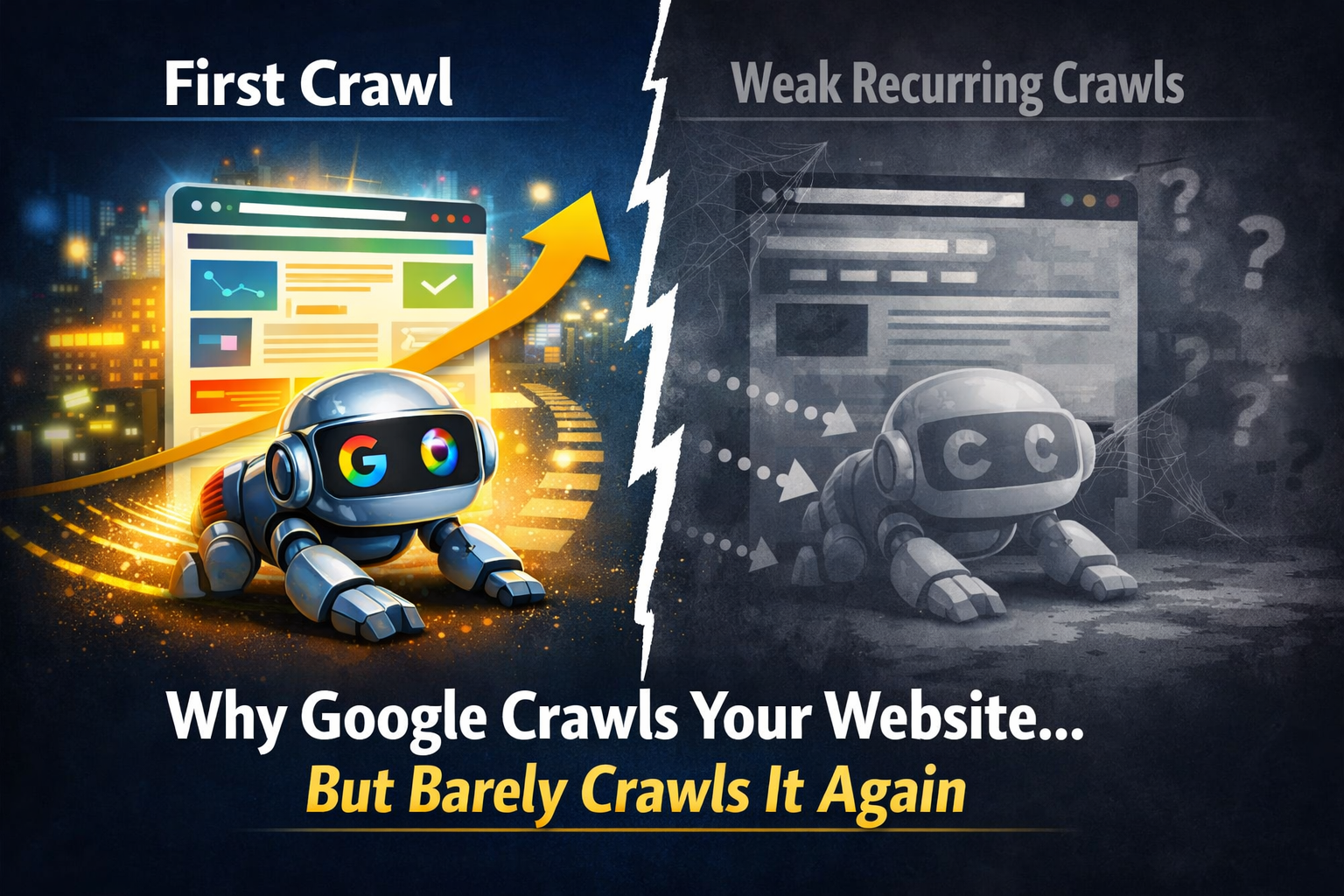
A lot of website owners see this happen without realising what it means.
They launch a new website.
Or publish a new page.
Then they notice Google seems to find it fairly quickly.
Maybe it gets crawled.
Maybe it gets indexed.
Maybe it even gets a few early impressions.
And at that point, they assume:
- “Google’s found the site, so we’re fine.”
- “The page is indexed, so it should build from here.”
- “If it got crawled once, Google must be interested.”
But then something quietly happens in the background.
Google barely comes back.
Or at least, not very often.
Crawl activity becomes weak.
Updates get picked up slowly.
New pages take longer than expected to get noticed.
Older pages don’t seem to gain momentum.
And the whole website starts to feel like it’s stuck in a kind of slow SEO limbo.
This is one of the most overlooked technical SEO issues on small business websites and newer sites:
Google crawls the website… but doesn’t keep coming back with much interest.
That matters more than most people realise.
Because while the first crawl helps Google discover your site…
ongoing crawl activity helps Google keep paying attention to it.
And if Google’s crawl interest in your site is weak, SEO momentum often becomes weak too.
In this post, we’ll break down why this happens, what it usually means, and how to make your website more likely to earn stronger recurring crawl activity over time.
The First Crawl Is Not the Same as Ongoing Crawl Interest
This is the first thing to understand.
A lot of site owners confuse:
- being crawlable
with - being worth crawling regularly
Those are not the same thing.
Being crawlable means:
- Google can access the site
- pages aren’t blocked
- URLs can be discovered
- there are no obvious technical barriers
Being worth crawling regularly means:
- Google believes there’s ongoing value in revisiting the site
- pages may have changed
- new content may appear
- existing pages may matter
- the site may deserve closer monitoring
- the site may have signals worth refreshing in Google’s index
That’s a very different thing.
A site can be:
- technically crawlable
- fully indexable
- even initially crawled
…and still not build much recurring crawl demand.
That’s where many sites get stuck.
Why This Matters More Than People Think
If Google doesn’t return to your site often enough, several things can happen:
- new pages get discovered more slowly
- updates take longer to be reflected
- refreshed content gets picked up later
- internal link changes take longer to influence crawling
- ranking improvements feel delayed
- the site feels like it has no momentum
- pages can stagnate for longer
This doesn’t always mean the site is “broken”.
But it often means Google has not yet decided your site is one it needs to keep checking closely.
And for smaller websites, newer websites, or weaker sites, that’s very common.
Why Google Crawls a New Website at First
When a website is new, Google will often make an initial effort to understand what it is.
This can happen because:
- the homepage is discovered
- a sitemap is submitted
- internal links expose pages
- a backlink points to the site
- a page is manually requested in Search Console
- Google sees a new domain/entity appearing
That first phase is often exploratory.
Google is effectively asking:
- What is this website?
- How many pages does it have?
- What kind of content is here?
- Is it worth indexing?
- Is it structured properly?
- Does it look legitimate?
That’s why a lot of sites get:
- an early crawl
- some indexing
- a bit of early visibility
But that does not automatically mean Google is highly interested long-term.
It just means the site got initial attention.
Why Google Then Slows Down Crawl Frequency
This is the part most people never think about.
If Google decides a site doesn’t need frequent revisits, crawl activity can become weak.
That usually happens because the site is not sending enough signals that say:
“This website is active, useful, changing, and worth checking again.”
Common reasons Google slows down crawl frequency include:
- thin or low-value pages
- weak internal linking
- pages that feel disconnected
- little site growth
- few meaningful updates
- low content quality
- duplicate or near-duplicate pages
- weak overall authority
- little external discovery (few backlinks / mentions)
- stale structure
- weak user usefulness signals (indirectly reflected through quality)
In simple terms:
Google doesn’t want to waste resources revisiting pages that don’t seem important.
And if enough of your site feels like that, the whole site can become a low-priority crawl target.
Thin or Low-Value Pages Quietly Reduce Crawl Interest
This is one of the biggest causes.
A lot of websites technically have “lots of pages”…
…but not many pages that feel genuinely useful.
Examples include:
- short service pages with little depth
- near-duplicate location pages
- weak category pages
- thin tag/archive pages
- generic blog posts with no real substance
- placeholder pages
- product pages with almost no unique value
- low-effort supporting pages
If a site is full of pages that feel low-value, Google may still crawl them…
…but it often becomes less motivated to keep returning often.
That doesn’t just affect those pages individually.
It can influence how much overall crawl attention the site receives.
Weak Internal Linking Can Make a Site Feel Less Important
Internal linking is not just about helping pages rank.
It also helps Google understand:
- what matters
- what connects to what
- which pages are worth prioritising
- where value flows through the site
If your site has:
- isolated pages
- buried pages
- no real hub structure
- weak contextual links
- blog posts that never support core pages
- orphaned content
- important pages only accessible through archives or old posts
…then Google has less reason to treat those pages as important.
And when enough of a site feels structurally weak, crawl behaviour often weakens too.
This is especially common on sites that have:
- random blog publishing without content clustering
- service pages with no supporting content
- poor navigation hierarchy
- no “related content” sections
- weak category or hub pages
- pages buried too deep in the click path
A site with strong internal structure often earns better crawl behaviour over time because Google can see where the important value lives.
No Update Signals = No Reason to Revisit Often
If nothing meaningful changes, Google may stop checking as frequently.
That’s just practical.
A lot of business owners assume “update” means:
- publish a new blog post every week
But that’s not the only kind of useful update.
Google can pick up signals from things like:
- refreshed service page content
- updated FAQs
- new testimonials
- changes to internal links
- updated pricing or service information
- expanded sections
- improved resource pages
- new case studies
- added location/service blocks
- fresh schema or business details
If a site goes long periods with no meaningful change at all, it can start to feel stale.
And stale sites often attract weaker crawl attention.
Weak Site Growth Can Make a Website Feel Static
This is slightly different from updates.
Even if your existing pages are fine, Google often pays more attention to sites that show signs of healthy growth.
That doesn’t mean publishing endlessly.
It means the site appears to be developing.
Examples of healthy growth:
- adding useful new service pages
- expanding supporting content around core topics
- publishing genuinely helpful resources
- improving site structure
- strengthening content clusters
- adding new sections that support the business/site
A site that launched 20 pages and hasn’t meaningfully evolved since can start to feel static.
A site that keeps improving its content ecosystem tends to look more worth revisiting.
Crawl Budget Isn’t Just for Massive Websites
This is a big misconception.
People hear “crawl budget” and think it only matters if they have:
- 100,000 pages
- huge ecommerce catalogues
- giant media sites
That’s not really the right way to think about it.
For smaller websites, it’s less about a formal “crawl budget problem” and more about:
- crawl priority
- crawl demand
- crawl interest
- how much Google thinks your site deserves attention
Even a 30-page site can feel slow if:
- Google barely revisits it
- new pages are discovered late
- changes are reflected slowly
- important pages don’t get reinforced
So no, most small sites don’t have classic enterprise crawl budget issues.
But they absolutely can have weak crawl interest issues.
And that’s often what people are really experiencing.
Why Some Websites Feel “Stale” to Google
This is one of the best ways to think about it.
Some sites feel alive.
Some sites feel stale.
A stale site often looks like this:
- little or no content growth
- pages rarely updated
- thin pages
- weak internal linking
- disconnected structure
- no new mentions or links
- no evolving trust signals
- little reason for Google to expect change
- the same low-value content sitting unchanged for long periods
That doesn’t mean the site is “bad”.
It just means it may not be giving Google enough reason to stay engaged.
And SEO often rewards sites that look like they are:
- maintained
- useful
- evolving
- being actively improved
Crawl Activity Can Be an Early Sign of SEO Momentum
This is one of the most underrated SEO indicators.
A lot of people obsess over:
- rankings
- clicks
- impressions
And yes, those matter.
But crawl behaviour can be an early clue that Google is becoming more interested in your site.
If Google starts:
- revisiting key pages more often
- picking up changes faster
- discovering new content more quickly
- crawling deeper sections of the site
- checking supporting pages more regularly
…that can be a sign the site is building crawl trust and SEO momentum.
It doesn’t guarantee rankings.
But it often means Google is paying more attention.
And attention is part of progress.
How to Encourage Stronger Recurring Crawl Patterns
This is the part people actually want.
How do you make Google more likely to keep coming back?
There’s no “force crawl interest” button.
But there are ways to make your site more worth revisiting.
1) Improve Thin Pages Instead of Just Adding More Pages
Don’t just keep publishing more weak pages.
If your site already has:
- thin service pages
- weak location pages
- low-value blog posts
- empty-ish category pages
…improve those first.
Make them:
- deeper
- clearer
- more useful
- better structured
- more supportive of real intent
A smaller site with stronger pages often outperforms a bigger site with weak pages.
2) Strengthen Internal Linking and Page Hierarchy
Make it obvious what matters.
Use:
- service hubs
- category pages
- related content modules
- contextual links inside content
- footer links to important areas
- clear navigation pathways
This helps Google understand:
- page importance
- topic relationships
- crawl pathways
- where the real value is
A better-structured site is often easier to revisit intelligently.
3) Refresh Important Pages, Not Just the Blog
If you want stronger crawl signals, don’t think only in terms of “new post published”.
Update:
- top service pages
- key commercial pages
- FAQs
- trust sections
- comparison blocks
- resource pages
- About page
- Contact details
- testimonials
- service area coverage
Those are meaningful site changes too.
4) Build Better Topic Clusters
If your site has one page per topic and nothing supporting it, that can feel weak.
Instead, create content ecosystems:
- main service page
- supporting FAQs
- related blog posts
- comparison pieces
- local support pages (if relevant)
- internal links back to the main page
This makes the site feel richer and more connected.
That often helps both crawling and rankings.
5) Earn New Links and Mentions Over Time
External discovery still matters.
If other websites:
- link to you
- mention you
- cite your content
- reference your tools/resources
…Google has more reasons to revisit.
This is another reason why stagnant sites with no new external signals can feel “quiet” in search.
6) Make New Content Worth Discovering
Don’t publish for the sake of it.
Publish things that are:
- useful
- specific
- clearly targeted
- internally supported
- relevant to your site’s core topics
If every new page feels weak or disconnected, it won’t help much.
If new content strengthens the site’s main topics, it’s far more likely to build momentum.
7) Keep Technical Hygiene Clean
Even if crawl interest is the bigger issue, don’t ignore the basics.
Make sure:
- pages are indexable
- canonicals are correct
- internal links work
- redirects are clean
- sitemap is updated
- no accidental noindex issues
- page speed is reasonable
- mobile experience is strong
A site that is both valuable and easy to crawl is always in a better position.
What to Check If Your Site Feels Like Google Has Lost Interest
If your site feels like it got some early attention but then went quiet, ask yourself:
- Are our pages actually strong enough?
- Are our key pages well linked internally?
- Are important pages buried too deep?
- Have we updated anything meaningful recently?
- Are we building out real topic depth?
- Are we publishing disconnected content or structured content?
- Are there too many low-value pages?
- Are we earning any new mentions or backlinks?
- Does the site feel active and maintained?
- Would I think this site is worth revisiting often?
That last question is surprisingly useful.
This Is Why Some Websites Feel Like They Have No SEO Momentum
A lot of sites are not failing because they’re blocked from Google.
They’re failing because Google is only mildly interested.
That’s a very different problem.
And it’s often why a site can be:
- indexed
- technically crawlable
- even somewhat visible
…but still feel painfully slow.
Because what it lacks is not access.
It lacks ongoing crawl demand.
And when crawl demand is weak, momentum is usually weak too.
The Better SEO Question to Ask
Instead of asking:
“Is Google crawling my site?”
A better question is:
“Is Google interested enough in my site to keep coming back regularly?”
That’s a much smarter SEO question.
Because the first crawl only proves you exist.
Recurring crawl attention is a much better sign that Google sees your site as:
- active
- useful
- evolving
- worth monitoring
And that’s where stronger SEO growth often begins.
If You Want More SEO Momentum, Give Google a Reason to Care
That’s really the core lesson here.
If your site feels stuck after the early stages, the issue may not be that Google “can’t crawl” it.
It may simply be that your site isn’t giving Google enough reasons to keep returning often.
If you want stronger crawl patterns over time, focus on building a site that looks:
- useful
- maintained
- well-structured
- internally connected
- genuinely evolving
- supported by stronger pages
- worthy of repeat attention
That’s what helps turn a site from:
“Google found it once”
into:
“Google keeps checking because this site matters.”
And in SEO, that difference is bigger than most people realise.
Share this content:



Post Comment