Why Your Service Pages Don’t Rank (Even When Your Homepage Does)
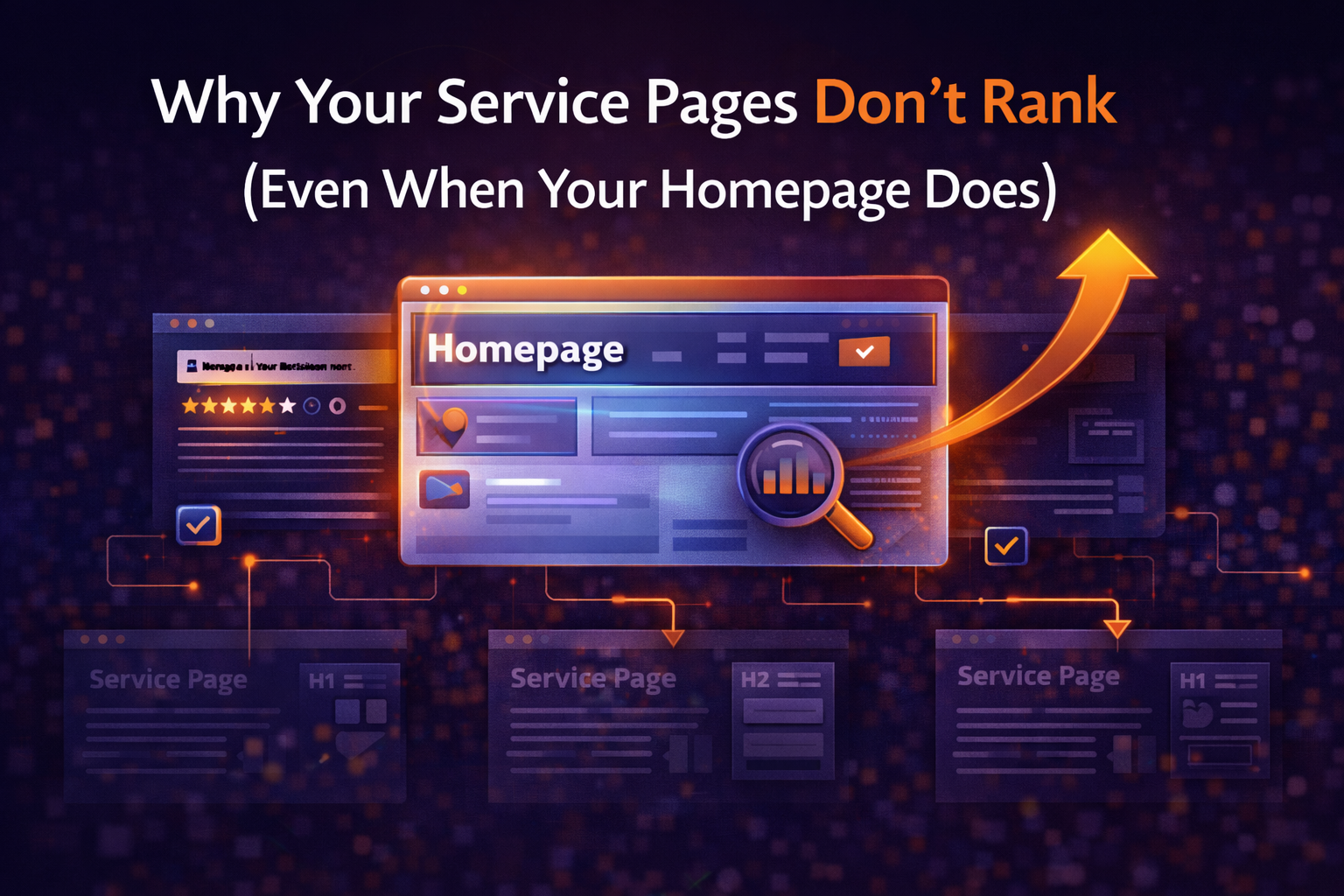
A lot of business owners run into the same frustrating SEO problem:
Their homepage ranks for their brand name, sometimes even a few broad terms…
…but their service pages barely move.
You might have pages for:
- SEO services
- web design
- plumbing
- bookkeeping
- electrical work
- consulting
- removals
- photography
…and despite having dedicated pages for those services, Google still seems to prefer your homepage — or worse, ignores the service pages almost completely.
This is incredibly common.
And in most cases, it happens for a simple reason:
Your homepage has more authority, more links, and more context — while your service pages are often too weak, too generic, or too disconnected to compete.
If you’ve been wondering why your service pages don’t rank, this guide breaks down the real reasons and shows you what to fix.
Why This Happens So Often
Your homepage is usually the strongest page on your website.
It often gets:
- the most internal links
- the most external links
- the most direct visits
- the most brand relevance
- the most crawl attention
That means Google already understands your homepage better than most of the other pages on your site.
Service pages, on the other hand, are often:
- short
- generic
- lightly linked
- missing supporting context
- not clearly aligned to a specific search intent
So even though you created them to rank for important services, they often don’t send strong enough signals.
This is where service page SEO becomes important.
The Homepage vs Service Page Problem
One of the biggest mistakes businesses make is expecting the homepage to do everything and expecting service pages to rank without enough support.
Your homepage is usually best for:
- your brand name
- very broad commercial positioning
- introducing your company
- linking people deeper into the site
Your service pages should usually be the pages targeting intent-specific searches.
For example:
- homepage: “ABC Plumbing”
- service page: “Emergency Plumber in Croydon”
- service page: “Boiler Repair Services”
- service page: “Leak Detection for Businesses”
If your homepage ranks but service pages don’t, it often means Google trusts your site overall — but doesn’t see enough value, relevance, or specificity in the service pages yet.
This ties directly into a point we covered in our post on why Google isn’t ranking your homepage for everything — Google often prefers internal pages for intent-specific queries, not broad front-page catch-all pages. If you’ve not read that yet, it’s worth reviewing alongside this one.
1. Your Service Pages Are Too Thin
This is probably the most common issue.
A lot of service pages are basically just:
- a heading
- a short paragraph
- a bullet list
- a contact button
That might be enough for a brochure website.
It is usually not enough for search visibility.
If your page says:
“We offer professional web design services for businesses. Contact us today.”
…that does very little to prove relevance or usefulness.
Google needs more context.
A strong service page should usually explain:
- what the service is
- who it is for
- the problems it solves
- what makes your approach different
- the process or deliverables
- common questions
- relevant examples or proof
- where you provide it (if location matters)
Thin pages rarely rank because they don’t demonstrate enough depth.
This also connects with what we covered in The Hidden Cost of Ignoring Search Intent — if the page doesn’t fully satisfy what the user is looking for, traffic won’t convert and rankings often remain weak.
2. “We Offer X” Is Not Enough
Many service pages are written like this:
- “We offer SEO services”
- “We provide accountancy services”
- “We deliver web design solutions”
The problem is that this kind of copy is vague and interchangeable.
If ten businesses can swap their brand names and the page still reads the same, the content is probably too generic.
Google wants pages that feel:
- specific
- useful
- relevant
- differentiated
A better service page explains:
- what type of client the service is best for
- what outcomes it creates
- how it works
- what makes it more trustworthy
- what someone should expect next
Your page should not read like a placeholder.
It should read like a page that genuinely helps someone understand whether your service is right for them.
3. Weak Intent Matching
This is one of the biggest reasons service pages fail.
A business creates a page called:
“Our Services”
…and expects it to rank for:
- SEO consultant London
- emergency electrician near me
- boiler repair services
- family solicitor for child arrangements
That almost never works.
Google is trying to match the search query to the most relevant page.
If someone searches for a specific service, they usually want:
- a page dedicated to that service
- clear evidence it matches their need
- proof the provider understands the problem
- trust signals
- a clear next step
A broad services page rarely satisfies that.
This is exactly why search intent matters so much.
4. Your Service Pages Lack Location and Context Signals
For local businesses and service providers, location relevance matters a lot.
A page that just says:
“We offer plumbing services”
…is much weaker than:
“Emergency Plumbing Services in Sutton and South London”
If local intent is part of the search, your service pages often need:
- location-specific headings
- service area references
- local context in the copy
- examples of local work where possible
- clear signals of where you operate
This is especially important for:
- trades
- local consultants
- agencies targeting regions
- legal services
- accountants
- clinics
- photographers
- removals
- cleaning businesses
Without context, the page may be too broad to compete.
5. Poor Heading Structure and Weak On-Page SEO
Some service pages fail because they’re simply not structured well.
Common issues include:
- vague H1s like “Welcome” or “Our Services”
- no subheadings
- repeated phrases stuffed awkwardly
- no hierarchy in the content
- no real explanation under headings
A strong service page usually has:
- one clear H1 focused on the service
- helpful H2 sections that explain the offer
- content that answers real user questions
- natural keyword usage
- scannable structure
For example:
- H1: Boiler Repair Services in Surrey
- H2: What Our Boiler Repair Service Includes
- H2: Common Boiler Problems We Fix
- H2: Why Homeowners Choose Us
- H2: Frequently Asked Questions
That structure helps both users and search engines.
6. Weak Internal Linking From the Homepage and Blog
This is massively underused.
A lot of businesses create service pages… and then barely link to them.
If the only way to reach a service page is:
- a dropdown menu
- a footer link
- a single buried navigation item
…you are not sending a strong signal that the page matters.
Internal links help Google understand:
- which pages are important
- how topics connect
- which pages support each other
- where authority should flow
To strengthen service pages, link to them from:
- the homepage body content
- relevant blog posts
- case studies
- FAQs
- comparison pages
- related service pages
For example, if you run Site Academy and write about:
- homepage SEO
- search intent
- trust signals
- internal linking
- technical readiness
…those articles can naturally link to service pages about:
- SEO audits
- backlink services
- technical SEO help
- on-page SEO reviews
This is exactly the kind of internal structure that helps pages gain relevance over time.
It also connects directly with The 80/20 Rule of SEO: The Small Number of Fixes That Drive Most Rankings, because internal linking is one of those high-impact fixes that often moves the needle faster than people expect.
7. Your Service Pages Don’t Build Trust
This is a big one — especially for commercial pages.
A service page can be technically decent and still fail because it doesn’t make people feel confident.
That matters more than many people realise.
Google increasingly rewards pages that appear genuinely useful and credible, and users absolutely respond to trust signals.
Weak service pages often have:
- no testimonials
- no proof
- no client results
- no case studies
- no credentials
- no examples
- no clear company identity
A stronger page includes:
- testimonials related to that service
- before/after examples or outcomes
- industries served
- certifications or credentials
- real photos where appropriate
- clear author/business credibility
8. Your Homepage Is Accidentally Competing With Your Service Pages
This is a sneaky one.
Sometimes the homepage ranks because you’ve accidentally made it the strongest candidate for the service keyword.
That can happen when:
- the homepage repeats the service term too heavily
- service links are weak
- service pages are too generic
- the homepage has stronger anchors and mentions
- all authority flows to the homepage only
In those cases, Google may think:
“This site’s homepage is the best match I can find, even if it’s not ideal.”
That’s not necessarily good news.
It often means your service page hasn’t been built strongly enough to win the query it was supposed to target.
The solution is not usually to weaken the homepage.
It’s to make the service page:
- more specific
- more useful
- more internally supported
- more trustworthy
- more aligned to the query
9. Your Service Page Isn’t Supported by Related Content
This is one of the biggest missed opportunities for smaller websites.
A service page should not sit alone.
It should be supported by related content around the topic.
For example, if you offer technical SEO audits, supporting content might include blog posts on:
- why your homepage isn’t ranking
- why search intent matters
- how internal linking affects rankings
- the 80/20 rule of SEO
- why new websites don’t rank in the first 6 months
- the hidden SEO benefit of blogging consistently
This creates a topic cluster.
That helps search engines understand:
- the service page is important
- the site has depth in this subject
- the business knows what it’s talking about
10. Your Service Pages Might Need Better Titles and Meta Descriptions
This doesn’t directly cause rankings on its own, but it absolutely influences clarity and click-through.
A weak title like:
Services | Company Name
…does very little.
A stronger one might be:
Technical SEO Audit Services for Small Businesses | Site Academy
Or for a local business:
Emergency Electrician in Croydon | 24/7 Local Electrical Repairs
A better title helps:
- search engines understand the page
- users understand the offer
- click-through rates improve
- page relevance becomes clearer
Meta descriptions also matter because they frame the offer in search results.
What a Strong Service Page Should Usually Include
If you want to rank service pages more effectively, this is a good practical structure to follow.
A strong service page often includes:
- a clear H1 focused on the exact service
- a strong page title aligned to the target query
- a clear explanation of what the service is
- who the service is for
- what problems it solves
- why someone should choose you
- trust signals (testimonials, proof, credentials)
- FAQs related to the service
- location relevance where appropriate
- clear internal links to supporting content
- a clear call to action
If you look at your service page and it mostly says:
“We provide professional services. Contact us today.”
…that page almost certainly needs work.
A Simple Service Page SEO Checklist
If your homepage ranks but your service pages don’t, review each service page against this checklist.
Ask yourself:
- Is the page specific enough?
- Is it targeting one clear service intent?
- Is the title strong and relevant?
- Does the H1 clearly match the service?
- Is the content genuinely useful or just generic?
- Does it include trust signals?
- Does it include local context if needed?
- Is it linked from the homepage and relevant blog posts?
- Is it supported by related articles?
- Does it feel like the best page on the site for that service?
If the answer is “no” to several of these, that’s usually the reason the page isn’t ranking.
How Site Academy Can Help You Spot Weak Service Pages
One reason service pages underperform is that many businesses don’t realise how many small issues are stacking up at once.
It’s rarely just one thing.
It’s usually a combination of:
- weak titles
- thin content
- poor structure
- weak trust signals
- missing metadata
- weak internal linking
- unclear page intent
That’s exactly why it helps to run your website through the Site Academy SEO Checker before trying to push harder on rankings.
Our free checker can help you spot foundational issues that often hold service pages back, including technical and on-page gaps that make it harder for Google to trust and prioritise the right pages.
If you’re serious about improving service page SEO, the first step is making sure the basics are solid.
The Real Reason Your Homepage Ranks and Your Service Pages Don’t
In most cases, this problem comes down to one simple truth:
Google already trusts your homepage more than your service pages.
That does not mean your website can’t rank for services.
It usually means the service pages need to become:
- more specific
- more useful
- more trusted
- more internally supported
- more aligned with real search intent
The good news is that this is fixable.
And when service pages improve, they often become some of the most valuable pages on the entire website — because they attract the kind of traffic that is actually ready to enquire, buy, or book.
If your homepage is getting visibility but your service pages are not, don’t assume the answer is “more backlinks” or “more traffic”.
Start by asking a better question:
Does this service page genuinely deserve to rank for the query I want it to target?
That question usually leads to the right fixes.
Share this content:


Post Comment