SEO Fundamentals
beginner seo mistakes, common seo mistakes, fix seo errors, free seo audit, improve website seo, on page seo mistakes, seo audit tool, seo checker tool, seo mistakes 2026, seo tips for beginners, technical seo problems, website seo checker, website seo issues, why my website isn’t ranking
SEO Checker
0 Comments
Top 10 SEO mistakes beginners still make in 2026 (and how to fix them)
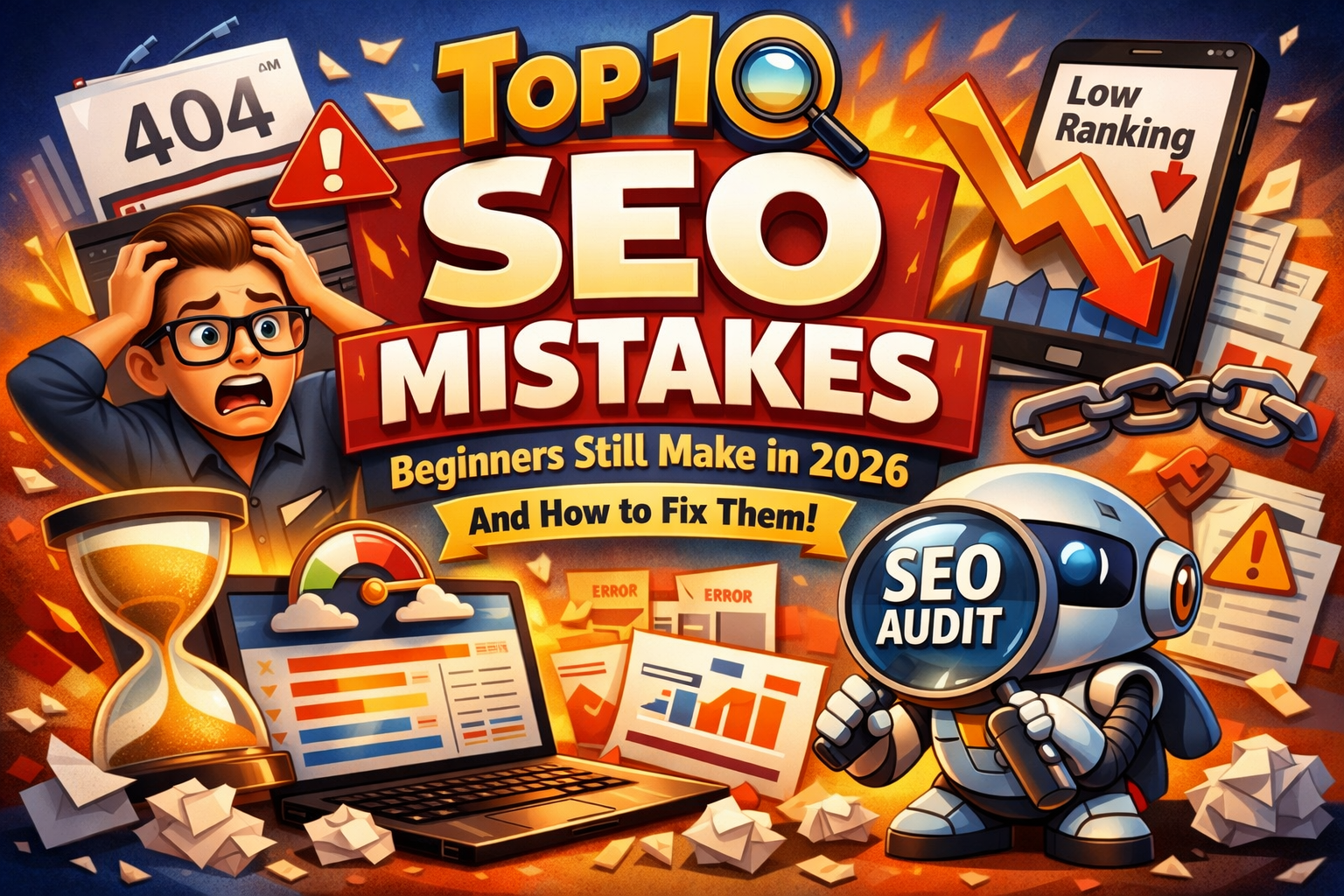
SEO has changed a lot over the years, but one thing hasn’t: beginners still fall into the same traps. In 2026, search engines are smarter, competition is tougher, and small mistakes can quietly hold your entire site back.
If you’ve ever wondered why your site isn’t ranking, chances are one (or more) of these issues is the culprit. The good news? Every mistake below is fixable — especially if you’re using a free SEO audit or a reliable website SEO checker to spot problems early.
1. Ignoring technical SEO entirely
Many beginners focus only on content and keywords, assuming Google will “figure the rest out”. It won’t.
Common technical issues include:
- Slow page speed
- Broken internal links
- Missing HTTPS
- Crawl errors
- Pages blocked by robots.txt
If search engines struggle to crawl or render your site, rankings suffer regardless of how good your content is. A website SEO checker can quickly flag these technical problems before they snowball.
2. Targeting keywords that are far too competitive
Trying to rank for broad terms like “SEO” or “fitness” as a new site is a losing battle.
Beginners often:
- Choose keywords with huge search volume but extreme competition
- Ignore search intent
- Skip long-tail opportunities
In 2026, relevance beats volume. Long-tail keywords with clear intent convert better and are far easier to rank for. A free SEO audit will usually highlight keyword gaps and missed opportunities.
3. Poor or missing title tags
Title tags remain one of the strongest on-page ranking signals — yet they’re still regularly neglected.
Common mistakes:
- Titles that are too short or too long
- Duplicate titles across pages
- Titles with no keywords
- Auto-generated titles that make no sense
Your title should clearly describe the page, include a primary keyword, and encourage clicks. A proper SEO checker will instantly flag weak or duplicate titles.
4. Thin or unhelpful content
Search engines now evaluate content depth, usefulness, and clarity — not just word count.
Beginner content often:
- Repeats what everyone else has already said
- Lacks structure and headings
- Fails to answer real user questions
- Is written purely for keywords
If your content doesn’t genuinely help someone, it won’t rank for long. A free SEO audit can help identify pages with thin or underperforming content.
5. Forgetting internal linking
Internal links guide both users and search engines around your site. Without them, your pages exist in isolation.
Common internal linking issues:
- Important pages with no links pointing to them
- Overusing the same anchor text
- Deep pages buried too many clicks away
Strong internal linking improves crawlability and spreads ranking power across your site — something many beginners overlook.
6. Not optimising for mobile users
Mobile-first indexing is no longer “new”, yet many sites are still poorly optimised for phones.
Typical problems include:
- Text that’s hard to read on small screens
- Buttons too close together
- Layouts that break on mobile
- Slow mobile load times
If your site performs badly on mobile, rankings and conversions will suffer. A website SEO checker can highlight mobile usability issues in minutes.
7. Missing or broken meta descriptions
Meta descriptions don’t directly affect rankings, but they do affect click-through rates — which indirectly impacts performance.
Beginner mistakes:
- Leaving meta descriptions blank
- Using the same description site-wide
- Stuffing keywords instead of writing naturally
A compelling meta description improves visibility and encourages clicks. Most free SEO audit tools flag missing or duplicated descriptions automatically.
8. Forgetting image optimisation
Images are often uploaded straight from a camera or designer without any optimisation.
Common issues:
- Large file sizes slowing pages down
- Missing alt text
- Generic filenames like IMG_1234.jpg
Image optimisation improves accessibility, page speed, and image search visibility — all easy wins in 2026.
9. No clear site structure
If users can’t easily find what they’re looking for, search engines probably can’t either.
Poor structure looks like:
- Confusing navigation
- Pages not grouped by topic
- Orphaned content
- No logical URL hierarchy
A clear structure improves rankings, usability, and conversions. A website SEO checker can quickly identify structural weaknesses.
10. Never running an SEO audit
The biggest mistake of all? Flying blind.
Many beginners:
- Never audit their site
- Rely on guesswork
- Miss critical issues for months or years
Regular checks using a free SEO audit help you catch problems early, track improvements, and prioritise what actually matters.
Your site doesn’t need to be perfect — but it does need to avoid these common mistakes. Running a website SEO checker regularly is one of the easiest ways to understand why your site isn’t ranking and what to fix next.
If you’re serious about improving visibility in 2026, start with a free SEO audit, fix the fundamentals, and build from there.
Share this content:

Post Comment