Strategy
algorithm re-evaluation Google, bounce rate SEO impact, content alignment SEO, improve SEO conversions, informational vs transactional intent, intent based content strategy, keyword intent analysis, ranking wrong keywords, search intent examples, search intent for beginners, search intent mismatch, search intent SEO strategy, SEO intent optimisation, SEO traffic quality, traffic but no sales, user intent marketing strategy, website conversion alignment, what is search intent, why traffic not converting, wrong keyword traffic
SEO Checker
0 Comments
The Hidden Cost of Ignoring Search Intent (Why Traffic Alone Means Nothing)
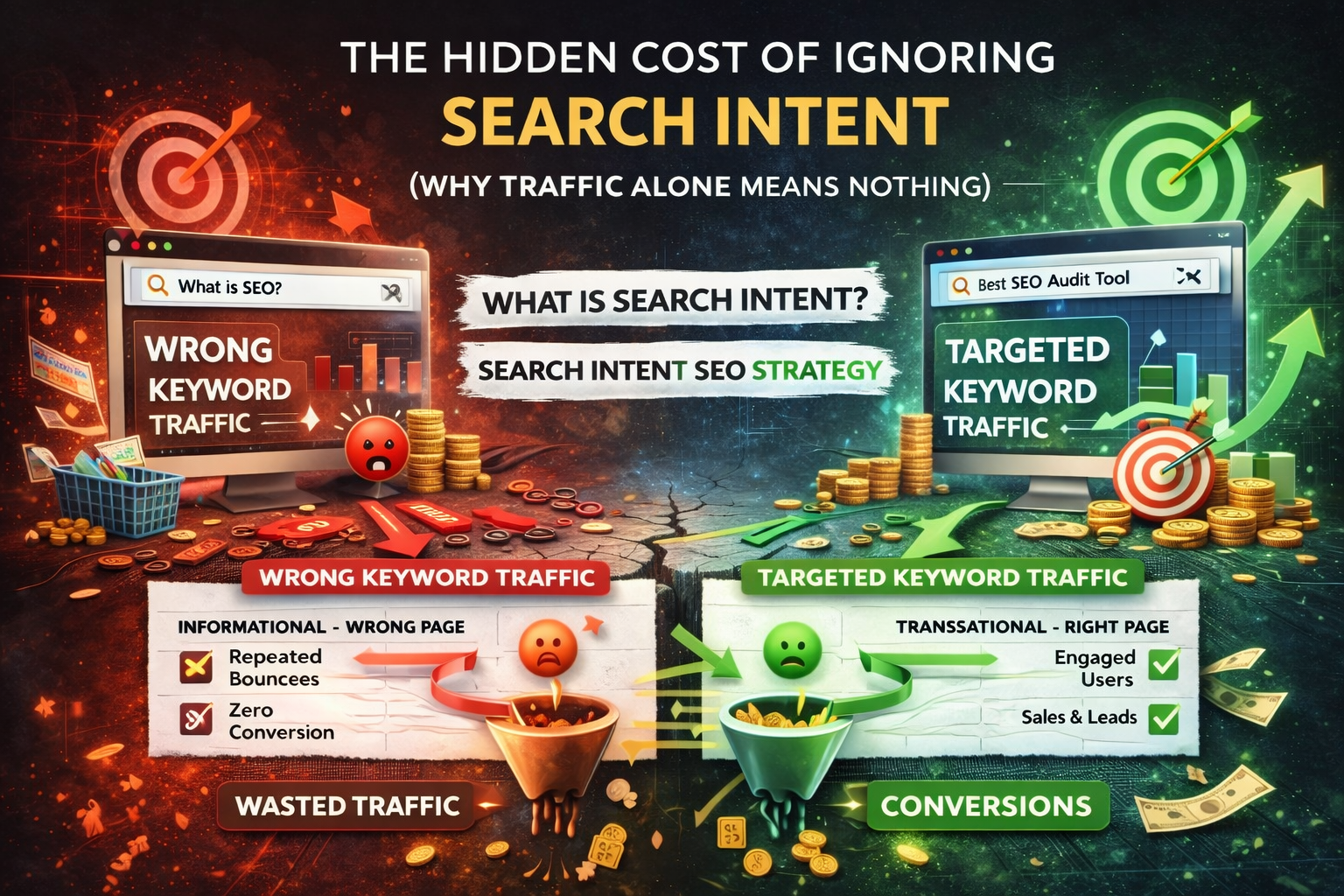
Traffic feels good.
Seeing impressions rise.
Watching visitors increase.
Celebrating higher rankings.
But here’s the uncomfortable truth:
Traffic alone means nothing.
If the traffic is wrong, it doesn’t convert.
If it doesn’t convert, it doesn’t sustain growth.
And if it consistently underperforms, Google notices.
This is the hidden cost of ignoring search intent.
This article explores:
- What search intent actually is
- Why ranking for the wrong keyword creates wasted traffic
- How informational vs transactional mismatch destroys conversions
- How bounce signals affect algorithm re-evaluation
- And how to realign content for profitable growth
Optimised for:
- what is search intent
- search intent SEO strategy
Because understanding intent is no longer optional — it’s foundational.
What Is Search Intent?
Search intent is the reason behind a search query.
When someone types something into Google, they’re not just entering keywords — they’re expressing a goal.
That goal usually falls into one of four broad categories:
1. Informational
They want to learn something.
Example: what is search intent
2. Navigational
They want to reach a specific brand or website.
Example: Site Academy SEO Checker
3. Commercial Investigation
They’re comparing options.
Example: best SEO audit tools
4. Transactional
They’re ready to act.
Example: buy SEO software
If your content does not align with the intent behind the query, rankings become fragile and conversions suffer.
Ranking for the Wrong Keyword
One of the biggest hidden growth killers is ranking for keywords that look impressive but don’t match your offer.
For example:
A SaaS tool ranks for:
- what is SEO
That might generate traffic.
But what percentage of those visitors want to buy software?
Very few.
Now compare that to ranking for:
- best SEO audit tool
- SEO checker for small business
Lower search volume — but dramatically higher intent.
This is the difference between vanity traffic and strategic traffic.
The Informational vs Transactional Mismatch
Here’s where most businesses lose money.
They create a page targeting an informational keyword…
But try to sell immediately.
Example:
User searches:
what is search intent
They land on:
- A sales-heavy landing page
- Overwhelming CTAs
- Product pitches
They leave.
Why?
Because the user wanted education, not a sales funnel.
This is known as intent mismatch.
And it quietly destroys both conversion rates and ranking stability.
Why Traffic But No Sales Happens
If you’re thinking:
We have traffic but no sales
Search intent is often the culprit.
When informational visitors land on transactional pages, they bounce.
When transactional visitors land on blog posts with no clear next step, they drift away.
In both cases:
- Conversion rates drop
- Engagement weakens
- Revenue stagnates
Traffic without alignment becomes expensive noise.
Bounce Signals and Algorithm Re-Evaluation
Google doesn’t just rank content and forget it.
It evaluates performance over time.
If a page ranks but consistently:
- Has short dwell time
- High bounce rates
- Low engagement
- No onward clicks
Google may re-evaluate whether it truly satisfies intent.
This can lead to:
- Ranking drops
- Fluctuations
- Gradual decline
Not because your SEO was bad — but because intent alignment was weak.
Google’s goal is simple:
Show results that satisfy users.
If yours doesn’t, it won’t hold position forever.
The Economics of Wrong Keyword Traffic
Let’s break this down practically.
Imagine:
10,000 visitors per month
1% conversion rate
100 conversions
Now imagine you align intent correctly:
3,000 visitors per month
5% conversion rate
150 conversions
Lower traffic. Higher revenue.
That’s intent economics.
High-volume traffic with low relevance is often less profitable than lower-volume traffic with high alignment.
The Hidden Cost: Opportunity Waste
When you target the wrong keywords:
- You invest time creating content
- You build links
- You optimise technically
- You push promotion
But the underlying audience doesn’t match your offer.
That’s not just low ROI — it’s opportunity cost.
You could have targeted high-intent keywords instead.
How to Build a Proper Search Intent SEO Strategy
Fixing intent alignment requires structure.
Here’s the framework.
Step 1: Analyse Current Rankings
Look at:
- Which keywords are driving traffic
- What type of intent they represent
- Whether the page format matches
If traffic is informational but your page is transactional, you have a mismatch.
Step 2: Separate Content by Intent
Your site should clearly distinguish between:
Educational Pages
Answer questions fully.
Minimise hard selling.
Build trust and authority.
Commercial Pages
Focus on solution, benefits, proof, clarity.
Blending the two usually weakens both.
Step 3: Create Intent-Specific Pathways
Informational content should:
- Educate
- Build credibility
- Naturally guide users to next steps
Transactional pages should:
- Remove friction
- Reinforce value
- Provide clear CTAs
Internal linking bridges these stages.
Step 4: Strengthen Structural Clarity
Search engines understand structure.
Your site architecture should:
- Group similar topics together
- Separate blog content from service pages
- Use internal links to reinforce hierarchy
A clear structure improves both rankings and conversion flow.
Running a full technical scan ensures crawl efficiency and structural clarity before scaling intent-driven content.
Content Re-Alignment Strategy
If you’ve already created content targeting the wrong intent, don’t panic.
You have options.
Option 1: Adjust the Page to Match Intent
Rewrite the content to better satisfy what users are looking for.
Option 2: Split the Content
Create:
- One informational guide
- One commercial landing page
Then link them strategically.
Option 3: Target a Better Keyword
Sometimes it’s smarter to pivot to a keyword that aligns with your business model.
The Real Goal
The goal isn’t more traffic.
The goal is relevant traffic.
When people search:
- what is search intent
- search intent SEO strategy
They want clarity on how to align content with user expectations.
And businesses that master this outperform those chasing volume.
Final Thought
Ignoring search intent doesn’t just reduce conversions.
It creates:
- Wasted traffic
- Unstable rankings
- Poor ROI
- Misleading analytics
Traffic amplifies alignment — or misalignment.
If your site isn’t converting despite traffic growth, the issue may not be technical.
It may be intent.
And once you align your structure, content, and strategy around search intent, growth becomes far more predictable — and far more profitable.
Share this content:

Post Comment