Strategy
Technical SEO
accessibility and seo, accessibility audit tools, accessible website best practices, alt text seo benefits, aria roles seo, free website seo checker, heading structure seo, improve website seo, improve website usability seo, navigation structure seo, screen reader seo impact, search engine clarity signals, semantic html seo, seo audit, technical seo accessibility, website seo checker
SEO Checker
0 Comments
The Hidden Ranking Benefits of Accessibility Best Practices
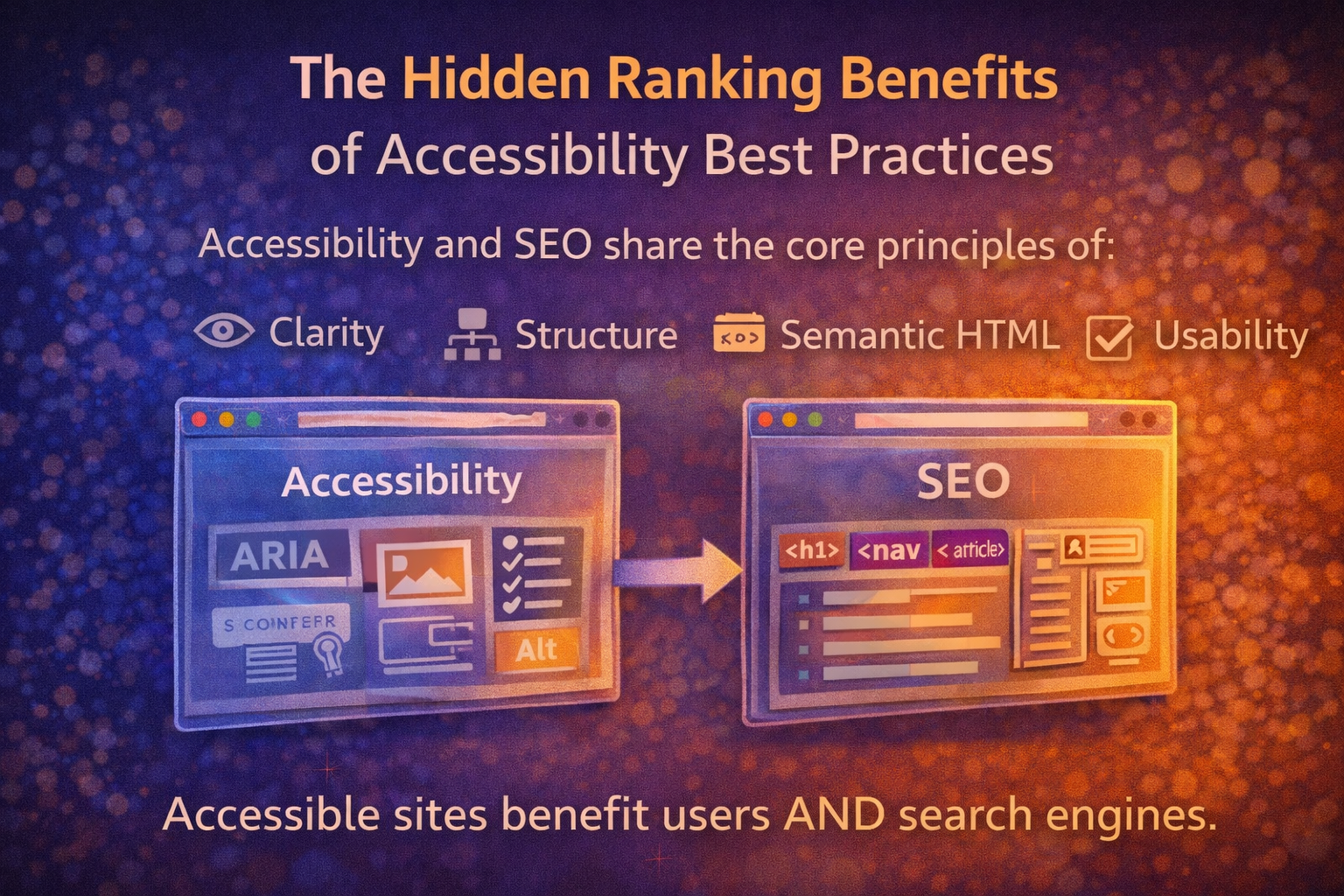
Accessibility and SEO are often treated as separate disciplines.
One is about compliance and inclusivity.
The other is about rankings and traffic.
In reality, they overlap more than most people realise.
Both are built on the same foundations:
- Clarity
- Structure
- Semantic HTML
- Logical navigation
- Usability
When you improve accessibility properly, you often improve search performance as a side effect.
Not because Google is “rewarding accessibility” directly — but because accessible sites tend to be structurally clearer, easier to interpret, and more usable.
And those are exactly the signals search engines respond to.
Accessibility and SEO Share the Same Core Goal
At its core, search engines try to understand:
- What a page is about
- How it is structured
- Which content is important
- How usable it is
Accessibility aims to ensure:
- Screen readers can interpret content
- Navigation works without a mouse
- Meaning is conveyed clearly
- Content is perceivable by all users
Both require structured, meaningful markup.
When structure improves, interpretation improves.
When interpretation improves, confidence improves.
Confidence is a ranking factor.
Accessibility Improvements That Also Benefit SEO
Let’s look at the specific overlaps.
1️⃣ Semantic HTML Improves Structural Clarity
Accessible sites rely on semantic elements:
<header><nav><main><article><section><footer>
Instead of generic <div> containers everywhere.
Why this matters for SEO:
- Clearer content hierarchy
- Improved content segmentation
- Stronger structural signals
- Reduced ambiguity for crawlers
Search engines interpret semantic structure more efficiently than deeply nested generic markup.
Semantic clarity reduces friction in crawling and rendering.
2️⃣ Proper Heading Structure Reinforces Topic Signals
Accessibility guidelines recommend:
- One clear
<h1> - Logical progression of
<h2>,<h3> - No skipped heading levels
This helps screen reader users navigate content.
It also helps search engines understand:
- Primary topic
- Supporting sections
- Content depth
Poor heading structure leads to:
- Fragmented interpretation
- Reduced topical clarity
- Weakened internal hierarchy
An accessibility fix here often strengthens SEO structure automatically.
3️⃣ Alt Text Supports Both Screen Readers and Image Search
Alt text exists for visually impaired users.
But it also:
- Describes images to search engines
- Supports image indexing
- Reinforces contextual relevance
Well-written alt text:
- Describes meaning, not just objects
- Aligns with page topic
- Avoids keyword stuffing
Example:
Weak alt text:
“image1.jpg”
Over-optimised alt text:
“best seo audit free website seo checker tool online”
Balanced alt text:
“Dashboard view showing website SEO performance metrics”
Accessibility requires descriptive clarity.
SEO benefits from contextual reinforcement.
4️⃣ Clear Navigation Reduces Cognitive and Crawl Friction
Accessible navigation ensures:
- Logical link ordering
- Keyboard navigability
- Descriptive anchor text
- Avoidance of vague links like “click here”
For SEO, this improves:
- Internal linking strength
- Crawl path clarity
- Authority flow
- User engagement
If users can’t navigate easily, they bounce.
If crawlers encounter weak or ambiguous links, interpretation weakens.
Navigation clarity is both an accessibility and ranking factor.
5️⃣ ARIA Roles — Use Carefully, But Correctly
ARIA (Accessible Rich Internet Applications) roles help assistive technologies understand dynamic elements.
Examples include:
role="navigation"role="main"aria-labelaria-expanded
When used properly, ARIA enhances clarity.
When misused, it can create confusion — both for assistive tools and search engines.
The key principle:
ARIA should enhance semantic HTML — not replace it.
Accessible code is typically cleaner code.
Cleaner code is easier to crawl and interpret.
Accessibility Improves User Behaviour Signals
Beyond technical structure, accessibility improves:
- Readability
- Layout stability
- Interaction clarity
- Mobile usability
These influence:
- Time on page
- Bounce rates
- Engagement depth
Search engines measure behavioural patterns indirectly.
If users interact comfortably, rankings tend to stabilise or improve.
Accessibility reduces friction for everyone — not just users with disabilities.
Tools for Accessibility Audits
Accessibility should be audited alongside SEO — not separately.
Useful tools include:
- Lighthouse (Accessibility + Performance overlap)
- WAVE accessibility evaluation tool
- axe DevTools
- Screen reader simulation tools
Pair this with a structured seo audit to examine:
- Heading hierarchy
- Alt text completeness
- Navigation structure
- Semantic markup
- Rendering clarity
A strong website seo checker identifies technical issues.
Accessibility tools reveal structural clarity gaps.
Combined, they provide a fuller picture.
Real Examples of Accessibility Fixes That Improved Rankings
Here are common real-world improvements:
Example 1: Heading Restructure
Problem:
- Multiple
<h1>tags - Skipped heading levels
- No clear topic hierarchy
Fix:
- Single, focused
<h1> - Logical section breakdown
Result:
- Improved content clarity
- Increased ranking stability
- Better snippet generation
Example 2: Navigation Simplification
Problem:
- Overly complex dropdowns
- Ambiguous anchor text
- Deep click paths
Fix:
- Clear primary navigation
- Descriptive anchors
- Reduced depth
Result:
- Improved crawl efficiency
- Better internal link distribution
- Higher engagement metrics
Example 3: Improved Alt Text Across Key Pages
Problem:
- Missing or generic alt attributes
Fix:
- Descriptive, contextual alt text
- Image relevance alignment
Result:
- Increased image search impressions
- Reinforced topical signals
- Slight organic uplift
These changes didn’t “game the algorithm”.
They improved clarity.
Clarity builds confidence.
Confidence supports rankings.
Accessibility Is Ethical — and Strategic
There’s a deeper point here.
Improving accessibility:
- Makes your site usable for more people
- Demonstrates care and professionalism
- Reduces legal risk
- Builds trust with users
At the same time, it strengthens:
- Structural signals
- Interpretative clarity
- User satisfaction
This is not optimisation theatre.
It’s structural improvement.
Why This Matters for Long-Term SEO
Search engines evolve toward:
- Understanding intent
- Evaluating usefulness
- Measuring satisfaction
Accessible websites tend to:
- Be easier to understand
- Be easier to navigate
- Be easier to interpret
- Be easier to engage with
Which aligns perfectly with modern ranking mechanics.
If you treat accessibility as separate from SEO, you miss one of the most sustainable ranking advantages available.
Improving accessibility isn’t just good practice.
It’s strategic clarity.
And when your site becomes clearer for users, it usually becomes clearer for search engines too.
Share this content:

Post Comment