Strategy
crawl reindexing after redesign, does redesigning a website affect seo, improve website seo safely, internal linking seo issues, long term seo strategy, preserve seo during redesign, ranking drop after redesign, seo audit before redesign, seo risks of website redesign, technical seo website changes, url changes seo, website migration seo impact, website redesign and seo, website redesign seo impact, website structure seo
SEO Checker
0 Comments
The Hidden SEO Cost of Constant Website Redesigns
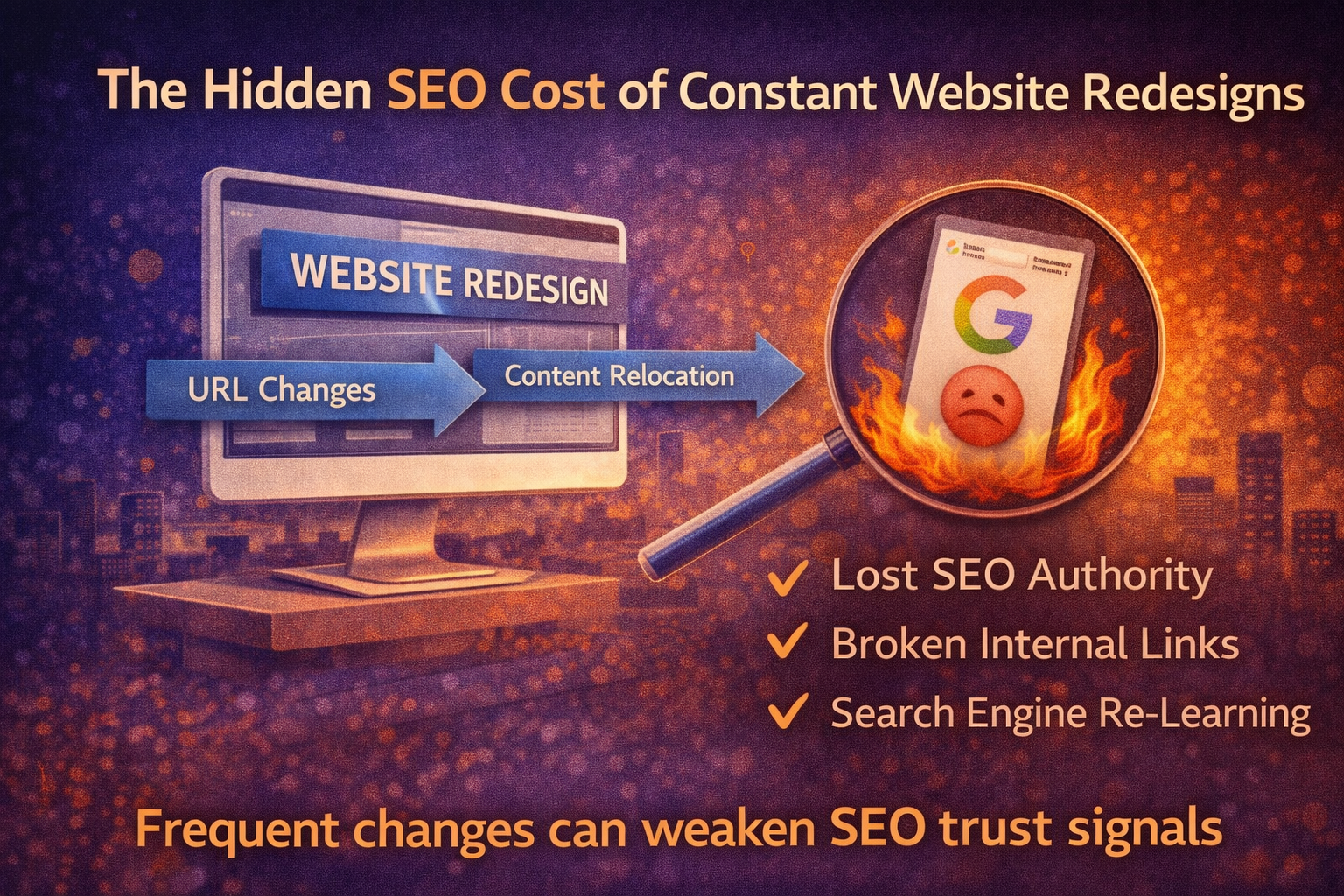
Redesigning a website feels productive.
New layout.
Modern styling.
Updated branding.
Improved visuals.
For many businesses, a redesign feels like progress — and it’s often assumed that a new website will automatically improve SEO.
But there’s a hidden reality few people talk about:
Frequent website redesigns can quietly damage search performance.
Not because redesigns are bad…
but because search engines value stability and trust more than visual change.
Search Engines Learn Websites Over Time
Google doesn’t instantly understand your website.
It learns gradually.
Over months and years, search engines build confidence in:
- Your URLs
- Site structure
- Internal linking patterns
- Content locations
- Topic relationships
- User engagement behaviour
Every stable signal strengthens trust.
A major redesign can unintentionally reset many of those signals.
1️⃣ URL Instability Breaks Accumulated Trust
One of the most common redesign mistakes is changing URLs.
Examples include:
/services/seo→/seo-services/blog/post-name→/articles/post-name- Removing folders entirely
- Changing permalink structures
Even when redirects are added, disruption occurs.
Why?
Because URLs carry historical signals such as:
- Backlinks
- Engagement history
- Indexing confidence
- Ranking data
Changing URLs forces search engines to reassess pages almost from scratch.
Redirects help — but they rarely transfer 100% of accumulated trust.
Stable URLs are powerful long-term assets.
2️⃣ Internal Link Disruption Weakens Authority Flow
Internal linking acts like a roadmap for search engines.
It tells Google:
- Which pages matter most
- How topics connect
- Where authority should flow
During redesigns, navigation and linking structures often change dramatically.
Common issues include:
- Important pages removed from navigation
- Reduced internal links to key content
- New menus replacing established pathways
- Previously reinforced pages becoming isolated
Even without deleting content, internal authority distribution changes.
Rankings can decline simply because reinforcement disappears.
3️⃣ Content Relocation Confuses Context
Design updates frequently move content around.
Examples:
- Combining pages
- Splitting long articles
- Moving service descriptions
- Changing page hierarchy
To users, this may feel cleaner.
To search engines, it introduces uncertainty.
Google must relearn:
- Which page answers which query
- Topic relationships
- Content depth signals
- Canonical relevance
Temporary ranking drops often follow because interpretation confidence decreases.
4️⃣ Crawl Re-Learning Periods Slow Visibility
After structural change, search engines must:
- Re-crawl URLs
- Re-render pages
- Re-evaluate internal links
- Reprocess canonical signals
- Recalculate relevance
This process takes time.
Large redesigns can trigger weeks — sometimes months — of recalibration.
Businesses often misinterpret this as an algorithm penalty when it’s simply re-learning.
Consistency shortens crawl cycles.
Frequent redesigns extend them.
5️⃣ Loss of Historical Performance Signals
Search engines analyse historical behaviour, including:
- Click-through rates
- Engagement patterns
- Content stability
- User satisfaction trends
When pages change significantly, historical comparisons weaken.
A redesigned page may technically contain the same information, but structural differences can reduce continuity.
In effect, the page becomes “new” again from an evaluation perspective.
Long-term signals reset.
6️⃣ The Design vs Structure Trade-Off
Design improvements are valuable.
Better usability, faster performance, and clearer layouts can absolutely help SEO.
The problem occurs when visual redesign overrides structural stability.
Good redesigns preserve:
✅ URLs
✅ Content intent
✅ Internal linking logic
✅ Topic hierarchy
✅ Navigation clarity
Poor redesigns prioritise aesthetics over architecture.
Search engines care far more about structure than appearance.
Why Businesses Fall Into the Redesign Trap
Many companies redesign because:
- Rankings slow temporarily
- Traffic plateaus
- Competitors look more modern
- Marketing teams want change
But redesigning rarely fixes underlying SEO issues.
Often the real problems are:
- Weak intent alignment
- Thin content
- Poor internal linking
- Limited authority
- Technical friction
A new design cannot solve structural weaknesses.
When a Redesign Does Make Sense
Redesigns are beneficial when they improve:
- Page speed
- Mobile usability
- Accessibility
- Navigation clarity
- Technical performance
The key principle:
Evolve structure carefully — don’t replace it unnecessarily.
Incremental improvement usually outperforms dramatic overhaul.
A Better Approach: Evolution Instead of Reinvention
Strong SEO growth typically comes from:
- Gradual UX improvements
- Content expansion
- Internal linking refinement
- Technical optimisation
- Stable architecture
Search engines reward consistency.
Sites that change intelligently build cumulative trust.
Sites that reinvent themselves repeatedly restart evaluation cycles.
Before Redesigning, Ask These Questions
- Are rankings actually limited by design?
- Will URLs remain unchanged?
- Will internal links be preserved?
- Is content intent staying consistent?
- Are redirects planned carefully?
If the answer is unclear, a structured SEO audit should happen before redesign decisions.
Understanding what already works prevents accidental loss.
The Long-Term SEO Perspective
SEO success rarely comes from dramatic change.
It comes from predictable, stable improvement.
Search engines trust websites that demonstrate:
- Consistency
- Reliability
- Structural clarity
- Long-term presence
Constant redesign sends the opposite signal.
Final Thought
A modern design can improve user experience.
But trust — both human and algorithmic — is built through stability.
The most successful websites don’t repeatedly reinvent themselves.
They evolve carefully, protect accumulated signals, and improve structure without destroying history.
In SEO, progress often comes not from starting over…
…but from strengthening what already works.
Share this content:


Post Comment