Technical SEO
free website seo checker, heading structure seo, how to audit a single page for seo, improve website seo, internal linking seo audit, on page seo audit checklist, page level seo audit, rendering issues seo, schema validation seo, seo audit, seo page analysis, serp comparison seo, single page seo audit, technical seo audit guide, website seo checker
admin
0 Comments
How to Audit a Single Page Like a Search Engine
Most SEO advice tells you to “audit your site”.
That sounds productive.
It also sounds overwhelming.
In reality, search engines don’t rank websites.
They rank pages.
If you learn how to audit a single page properly — deeply, systematically, objectively — you gain a framework you can apply anywhere.
This approach builds clarity.
Clarity builds confidence.
Confidence builds rankings.
Let’s walk through how to dissect one page the way a search engine does.
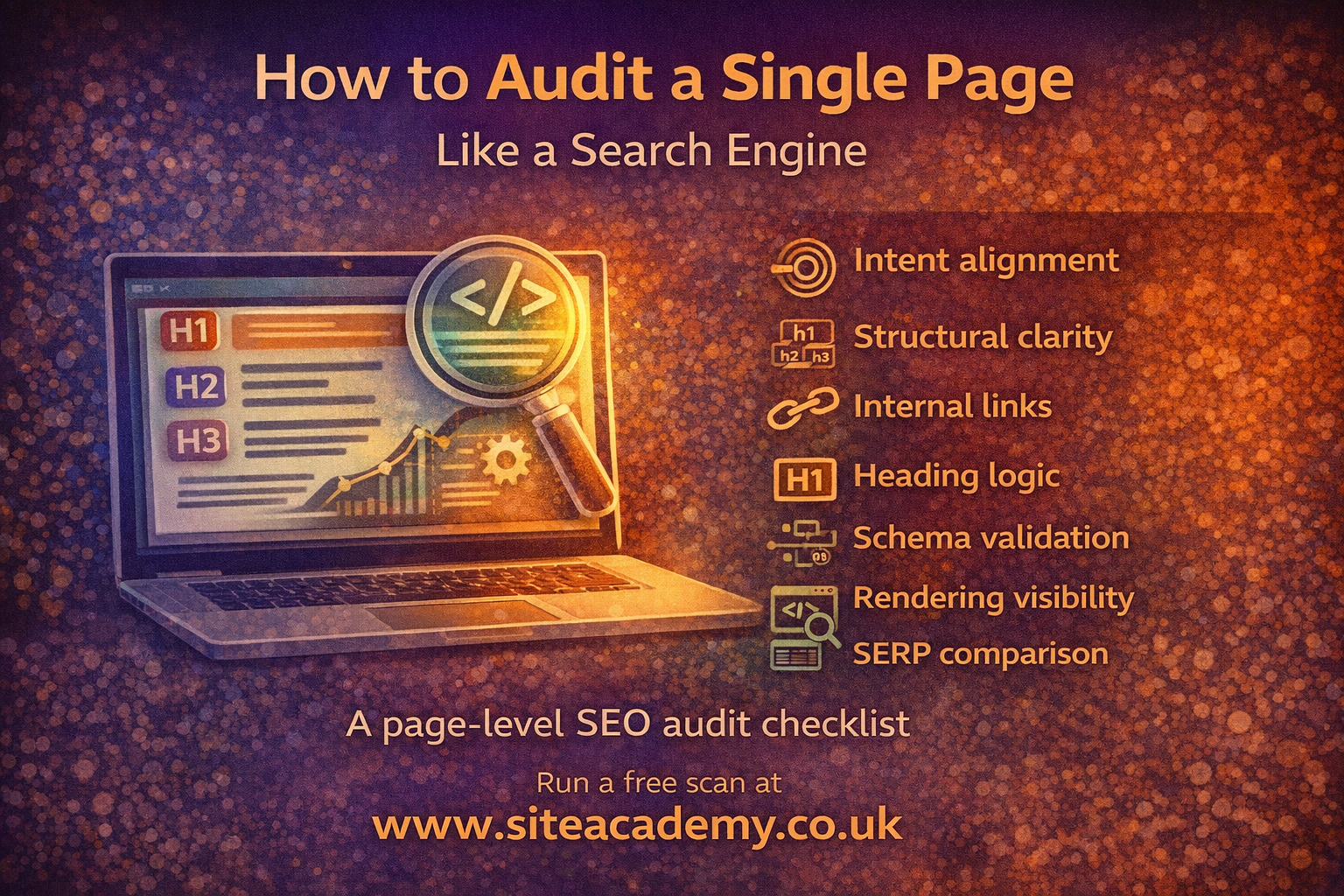
Step 1: Intent Alignment — What Is This Page Actually Trying to Do?
Before touching technical elements, ask:
- What query is this page targeting?
- Is the intent informational, commercial, transactional, or navigational?
- Does the content format match the dominant SERP format?
Search engines prioritise intent satisfaction above all else.
If the top 10 results are:
- Step-by-step guides
- Deep educational breakdowns
- Comparison-based articles
…and your page is a short sales pitch, alignment is weak.
Quick Intent Check
Search your target keyword and compare:
- Content depth
- Structure
- Angle
- Media usage
- Freshness
If your page format doesn’t match user expectation, no amount of technical optimisation will compensate.
Step 2: Structural Clarity — Can the Page Be Understood Instantly?
Search engines interpret structure before nuance.
Review:
- Is there a clear
<h1>? - Are sections logically grouped?
- Is content broken into scannable segments?
- Is the main topic obvious without guessing?
Clarity reduces ambiguity.
Ambiguity weakens ranking confidence.
Look at your page without reading every word.
Can you understand its structure in 10 seconds?
If not, it likely needs refinement.
Step 3: Heading Logic — Is There a Clear Hierarchy?
Headings are structural signals.
Check:
- One clear
<h1> - Logical
<h2>sections - Supporting
<h3>under relevant sections - No random heading jumps
Poor heading logic can:
- Fragment topical signals
- Reduce contextual clarity
- Create interpretation gaps
Strong heading hierarchy strengthens topic reinforcement.
This is one of the most common improvements discovered during a focused seo audit.
Step 4: Internal Link Reinforcement — Does the Site Support This Page?
Search engines evaluate pages in context.
Ask:
- Are relevant supporting pages linking to this URL?
- Are anchor texts descriptive?
- Is this page part of a broader topic cluster?
- Is authority flowing toward it internally?
If a page sits isolated, it lacks reinforcement.
Strong pages are:
- Linked from related content
- Referenced within topic clusters
- Supported by contextual anchor text
Internal linking is not decoration.
It is signal amplification.
Step 5: Schema Validation — Is Structured Data Clear and Accurate?
Schema doesn’t replace content.
It confirms it.
Review:
- Is schema present?
- Does it match visible content?
- Is it the correct schema type?
- Are required fields complete?
- Is there any conflicting markup?
Common issues include:
- FAQ schema without visible FAQs
- Article schema on product pages
- Incorrect canonical URLs inside schema
- Mixed schema types on one page
Structured data inconsistency creates hesitation.
Clean schema strengthens confidence.
Step 6: Rendering Visibility — Can Google Actually See Everything?
Modern sites often rely heavily on JavaScript.
Test:
- Does key content load without JS?
- Is the main copy visible in raw HTML?
- Are headings rendered server-side?
- Do important elements appear late or conditionally?
A page can look perfect in a browser but partially render for search engines.
Rendering gaps weaken topical signals.
Use:
- URL inspection in Search Console
- Rendered HTML comparison
- Structured testing tools
Visibility is foundational.
If Google can’t see it clearly, it can’t evaluate it confidently.
Step 7: SERP Comparison — How Does Your Page Stack Up?
Now compare directly with ranking competitors.
Evaluate:
- Content depth
- Topical breadth
- Media integration
- Internal linking strength
- Freshness
- Authority signals
Ask:
- Do competitors answer more related questions?
- Do they include clearer structure?
- Do they solve the problem more thoroughly?
- Is their page easier to navigate?
Ranking is relative.
You are not being evaluated in isolation.
Step 8: Diagnose Weakness by Category
After auditing the page, classify weaknesses:
Intent Issue
- Wrong format
- Misaligned purpose
- Surface-level answers
Structural Issue
- Weak headings
- Poor hierarchy
- Cluttered layout
Reinforcement Issue
- Limited internal links
- No topical cluster
- Thin contextual support
Technical Issue
- Canonical conflicts
- Rendering gaps
- Schema errors
Clarity at this stage removes guesswork.
How to Combine Manual Review With Automated Scanning
Manual evaluation reveals strategic gaps.
Technical scanning reveals structural friction.
After your manual review, you can:
- Run a free scan at siteacademy.co.uk
- Use a website seo checker to confirm:
- Indexability
- Canonical consistency
- Meta data clarity
- Rendering visibility
- Schema validation
Automation highlights technical weaknesses.
Your analysis determines strategic direction.
Together, they form a complete diagnostic process.
Why This Method Builds Authority
Auditing one page deeply:
- Teaches systems thinking
- Removes emotional reactions
- Builds repeatable skill
- Reduces blind editing
- Strengthens strategic confidence
Instead of reacting to rankings, you begin diagnosing structure.
High utility builds trust.
And trust compounds.
Final Perspective
Search engines don’t judge websites vaguely.
They interpret pages systematically.
If you learn to audit one page like a search engine:
- You stop guessing
- You stop overreacting
- You stop chasing surface metrics
You start improving clarity.
And clarity is one of the most powerful ranking advantages available.
Share this content:

Post Comment