Technical SEO
early SEO growth strategy, Google indexing new sites, Google ranking delay, google trust signals, how long SEO takes, improve website rankings, new site SEO timeline, new website SEO, SEO audit tools, seo checker, SEO for new websites, SEO optimisation for beginners, SEO sandbox period, seo trust factors, Site Academy, technical seo audit, website authority building, website not ranking on Google, website ranking factors 2026, why new websites don’t rank
SEO Checker
0 Comments
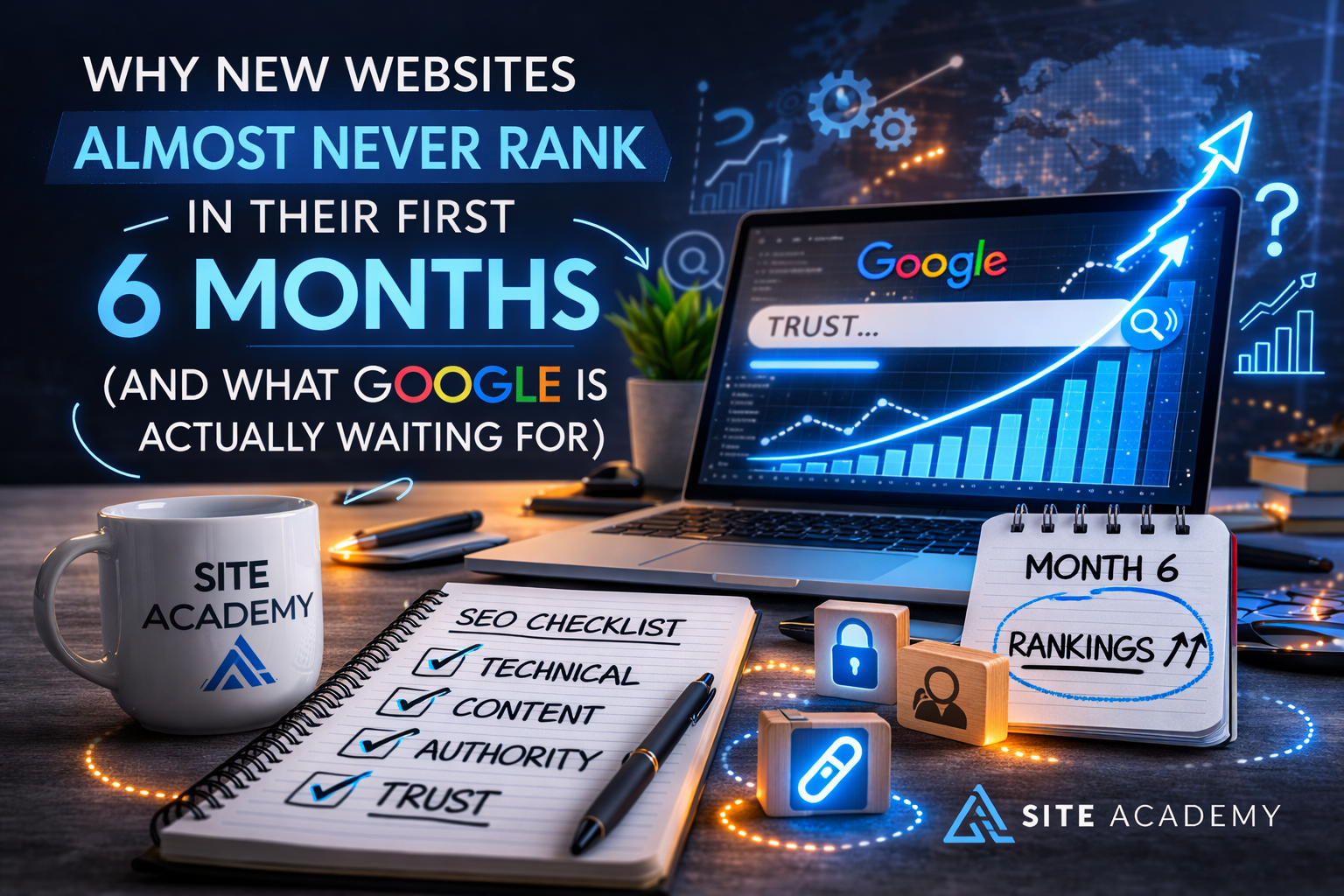
Why New Websites Almost Never Rank in Their First 6 Months (And What Google Is Actually Waiting For)
Launching a new website is exciting.
You publish pages.
You optimise titles.
You write content carefully.
You submit your sitemap.
Then you wait…
…and nothing happens.
No rankings.
No traffic.
No visibility.
Many website owners assume something is broken — but in most cases, Google is behaving exactly as expected.
If your new website isn’t ranking yet, it usually isn’t because your SEO is bad. It’s because your site hasn’t earned enough trust signals for Google to confidently show it to users.
Understanding what happens during the first six months can completely change how you approach growth — and prevent months of wasted effort.
The Biggest SEO Myth: “Good Content Ranks Immediately”
One of the most common misunderstandings in SEO is this:
If content is good and optimised, it should rank quickly.
In reality, Google rarely treats new websites the same as established ones.
Older domains benefit from:
- historical performance data
- backlink trust
- crawl familiarity
- consistent publishing signals
- proven user engagement
A brand-new site has none of these.
From Google’s perspective, your website is still unknown.
Before rankings increase, Google needs evidence that your site is reliable, useful, and likely to satisfy searchers consistently.
What Google Is Actually Doing During the First 6 Months
When your website launches, Google begins a quiet evaluation process.
This period is sometimes called the Google Sandbox, although it’s not an official feature. It’s better understood as a trust-building phase.
Google is watching for patterns.
1. Crawl Behaviour and Stability
Initially, Google crawls cautiously.
It wants to see:
- pages loading reliably
- no frequent downtime
- stable URLs
- proper internal linking
- consistent structure
Websites that constantly change layout, delete pages, or restructure navigation slow this process dramatically.
Running regular checks using an SEO Checker helps confirm that technical foundations remain stable while Google learns your site.
2. Content Consistency (Not Volume)
Publishing 50 articles in one week rarely helps.
Google looks for consistency over time:
- Are new pages appearing regularly?
- Is content focused on a clear topic?
- Does the website demonstrate expertise?
A steady publishing rhythm signals legitimacy far more than sudden bursts of activity.
New sites that publish consistently often begin seeing traction between months three and six.
3. Topic Understanding
Google doesn’t rank websites — it ranks topical authority.
During early months, Google tries to answer:
- What is this website about?
- Who should see its content?
- Is it specialised or generic?
If your articles jump between unrelated subjects, Google struggles to categorise your site.
Successful new websites usually focus tightly on one area before expanding.
This is why platforms like Site Academy emphasise structured content strategy rather than random keyword targeting.
4. User Interaction Signals
Even small amounts of traffic provide important feedback.
Google observes:
- whether users stay on pages
- whether they return to results quickly
- whether visitors explore additional content
These behavioural signals help Google determine whether your site deserves broader exposure.
Early visitors matter more than most people realise.
5. Authority and External Validation
This is often the biggest delay factor.
Google trusts websites partly based on how the wider internet responds to them.
Signals include:
- mentions from other websites
- backlinks
- citations
- social discovery
- brand searches
Without external references, Google has little reason to prioritise a new domain over established competitors.
Even technically perfect websites can stall here.
Why Many New Websites Feel “Stuck”
Around months two to four, many site owners experience frustration.
They see:
- pages indexed but not ranking
- impressions without clicks
- rankings appearing briefly then disappearing
This phase is normal.
Google is testing your pages on small audiences before expanding visibility.
Think of it as controlled exposure rather than rejection.
Sites that continue improving during this stage almost always outperform those that constantly restart strategies.
The Hidden Problem: Technical Friction
New websites frequently contain small technical issues that compound over time.
Examples include:
- missing meta descriptions
- slow loading pages
- weak internal linking
- duplicate titles
- missing schema
- poor mobile optimisation
Individually minor, collectively significant.
Using an SEO Checker early allows you to remove these friction points before they limit growth.
Many websites fail not because content is poor, but because technical trust never fully develops.
What You Should Focus On Instead of Rankings
Obsessing over rankings in the first six months is usually counterproductive.
Instead, focus on building signals Google values long-term.
Build Technical Confidence
Ensure pages load quickly, securely, and consistently.
Regular audits through Site Academy help confirm that your site remains technically healthy as it grows.
Strengthen Internal Linking
Help Google understand relationships between pages.
Every new article should connect logically to existing content.
This improves crawl efficiency and authority flow.
Publish With Purpose
Create content clusters around core topics rather than isolated posts.
Topical depth accelerates trust.
Earn Early Authority Signals
Even a small number of relevant backlinks can dramatically improve discovery speed.
Google interprets links as independent validation.
Stay Consistent
The most underrated ranking factor for new websites is persistence.
Sites abandoned after three months rarely succeed.
Sites maintained steadily often experience sudden growth after trust thresholds are crossed.
When Rankings Usually Begin to Improve
While every website differs, a common timeline looks like this:
Months 0–2
- Indexing begins
- Minimal visibility
Months 3–4
- Initial impressions
- Keyword testing
- Ranking fluctuations
Months 5–6
- Trust signals accumulate
- Stable rankings appear
- Traffic begins compounding
Growth after this stage is often much faster than expected.
Many successful websites appear to “suddenly” take off — but the groundwork was laid months earlier.
The Reality Most SEO Guides Don’t Explain
Google isn’t delaying your success.
It’s reducing risk.
Search engines must protect users from spam, low-quality sites, and temporary projects.
Before promoting a new website widely, Google waits for proof that your site will continue delivering value.
Your job during the first six months isn’t chasing rankings.
It’s demonstrating reliability.
How Site Academy Helps Accelerate the Process
Understanding what Google is waiting for allows you to focus effort where it matters most.
Using the Site Academy SEO Checker, you can:
- identify technical weaknesses early
- prioritise fixes correctly
- monitor SEO health over time
- remove hidden ranking barriers
- build long-term search trust
Rather than guessing why rankings are slow, you gain clear insight into what needs improving next.
New websites rarely fail because they lack potential.
They fail because owners expect immediate results from a system designed to reward consistency, trust, and proven value over time.
If you continue improving your site, refining technical foundations, and building authority signals, rankings almost always follow.
And when they do, growth tends to compound far faster than the slow beginnings suggest.
The first six months aren’t wasted time — they’re the phase where future visibility is quietly being earned.
Share this content:


Post Comment