Technical SEO
compound seo problems, duplicate content seo, free website seo checker, improve website seo, internal linking strategy, javascript seo problems, page speed seo, ranking slowdown causes, rendering issues seo, schema markup issues, seo audit, seo friction, seo performance optimisation, small seo problems, technical seo issues, website seo checker, why my website isn’t ranking
SEO Checker
0 Comments
Why Small Technical Issues Compound Into Big Ranking Problems
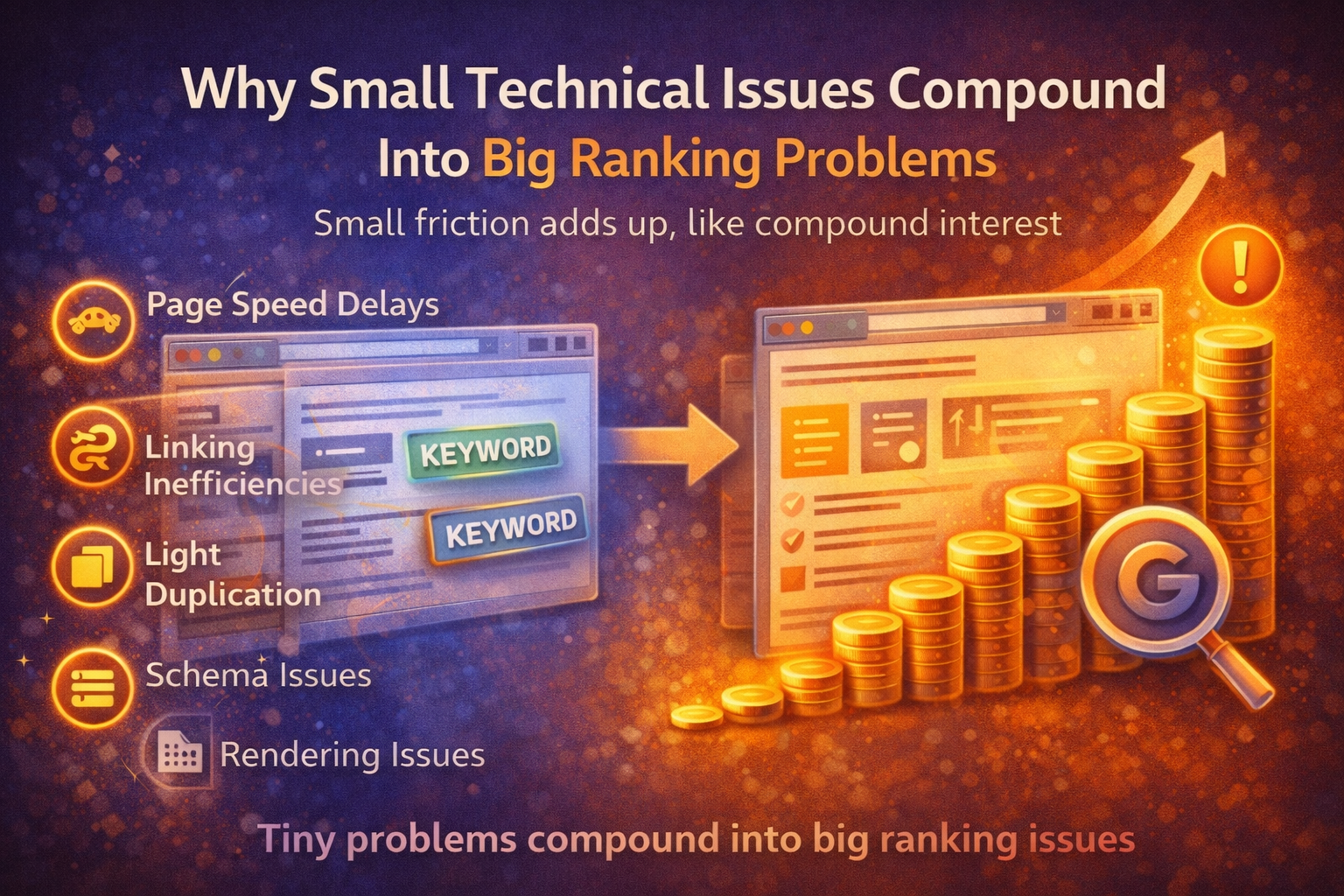
Most websites don’t fail because of catastrophic SEO mistakes.
They fail because of friction.
Not dramatic 404 storms.
Not total deindexing.
Not manual penalties.
Just small, seemingly harmless inefficiencies — stacking quietly over time.
Think of it like compound interest.
Except instead of building wealth, you’re compounding resistance.
The Compound Interest of SEO Friction
In finance, compound interest works in your favour. Small, consistent gains grow exponentially.
In SEO, small inefficiencies compound in the opposite direction.
Each one alone is minor:
- A 0.3 second page speed delay
- A few slightly awkward internal links
- A bit of light duplication
- Schema inconsistencies
- Content loading slightly late
Individually, none of these “break” a site.
Together, they erode trust, clarity, and performance.
Over time, that erosion becomes measurable.
1️⃣ Minor Page Speed Delays
Let’s start with performance.
Not slow enough to feel broken.
Just slower than optimal.
Examples:
- Uncompressed images adding 200–300ms
- Render-blocking scripts
- Slight layout shifts
- Multiple small JavaScript files
Your site still loads. Users don’t complain.
But search engines measure relative performance.
If competitors load faster, even marginally, they accumulate an edge.
Performance affects:
- Crawl efficiency
- User engagement
- Bounce rates
- Core Web Vitals
A seo audit may flag “moderate” performance concerns — nothing urgent.
But moderate delays across every page become structural disadvantage.
That disadvantage compounds.
2️⃣ Slight Internal Linking Inefficiencies
Internal linking is one of the most powerful SEO levers.
But small inefficiencies stack:
- Important pages three or four clicks deep
- Inconsistent anchor text
- Overuse of generic phrases like “click here”
- Core pages rarely linked contextually
Each link slightly influences:
- Crawl paths
- Signal reinforcement
- Topical clarity
- Authority flow
No single weak link ruins a site.
But dozens of slightly weak links dilute structural strength.
Over months or years, this leads to:
- Slower ranking movement
- Reduced authority consolidation
- Poorer topic association
Search engines respond to reinforcement patterns.
Weak reinforcement equals weak compounding.
3️⃣ Light Duplication
Light duplication doesn’t trigger penalties.
But it does introduce ambiguity.
Examples:
- Similar service pages with overlapping copy
- Tag archives repeating blog content
- Parameter URLs indexing accidentally
- Slightly rewritten articles targeting similar keywords
Search engines now face micro-decisions:
- Which page is primary?
- Which URL should rank?
- Are these competing with each other?
That uncertainty fragments signals.
Instead of one strong page accumulating trust, multiple weaker pages compete internally.
This is called cannibalisation — but in small doses, it often goes unnoticed.
A website seo checker may highlight duplication warnings that seem trivial.
They rarely are.
Ambiguity compounds.
4️⃣ Mixed Schema Types
Structured data is meant to clarify meaning.
But minor schema inconsistencies create noise:
- Article schema on category pages
- Multiple schema types overlapping
- Product schema without complete properties
- FAQ schema not matching visible content
Each inconsistency alone seems harmless.
But search engines rely on structured data to validate intent.
If signals conflict, confidence drops.
Schema inconsistency rarely causes dramatic ranking loss.
It creates subtle hesitation.
And hesitation slows compounding authority.
5️⃣ Partial Rendering Issues
JavaScript-heavy sites often experience partial rendering problems.
Not total failures — just friction:
- Headings injected late
- Content assembled after API calls
- Critical text hidden behind interactions
- Lazy-loaded elements missing from initial render
To users, everything looks fine.
To search engines operating under time constraints, some meaning may be incomplete.
A free website seo checker may flag rendering concerns without catastrophic errors.
But partial visibility reduces interpretative confidence.
And reduced confidence reduces ranking momentum.
Why Compounding Matters
Here’s the key insight:
Search rankings are relative.
If your competitor has:
- Slightly faster load times
- Slightly clearer internal linking
- Slightly stronger canonical control
- Slightly cleaner schema
- Slightly more stable structure
They don’t just win once.
They accumulate advantage.
Over time:
- Their pages get crawled more efficiently
- Their authority consolidates more clearly
- Their signals remain consistent
- Their growth compounds positively
Meanwhile, your friction compounds negatively.
The gap widens quietly.
Why This Is So Hard to Spot
No dashboard screams “You are compounding friction.”
There’s no dramatic drop.
Just:
- Slower ranking improvements
- Pages stalling on page two
- Content that “should rank” but doesn’t
- Inconsistent growth
Because each issue individually feels minor, they’re often deprioritised.
But SEO is cumulative.
Small inefficiencies don’t stay small.
The Diagnostic Shift
Instead of asking:
“What’s broken?”
Start asking:
“Where is friction stacking?”
Review:
- Page speed across templates
- Internal link depth patterns
- Duplicate clusters
- Schema consistency
- Rendering stability
A proper seo audit isn’t about hunting dramatic errors.
It’s about identifying micro-inefficiencies before they compound.
Reducing Friction Compounds Too
The good news?
Compound mechanics work both ways.
Improve:
- Speed by small margins
- Link reinforcement slightly
- Deduplicate overlapping content
- Clarify schema intent
- Strengthen initial HTML visibility
Those small gains accumulate.
Over months, they become noticeable.
Clarity compounds.
Trust compounds.
Momentum compounds.
Big ranking problems rarely begin big.
They begin small — and consistent.
If your site passes technical checks but growth feels slower than it should, look for friction.
Because in SEO, just like finance, what compounds quietly often matters most.
Share this content:




Post Comment